Latest News and Comment from Education

Showing posts with label NAEP NATIONAL ASSESSMENT OF EDUCATIONAL PROGRESS. Show all posts

Friday, May 14, 2021

CURMUDGUCATION: Does The Nation's Report Card Have A New Reading Problem

CURMUDGUCATION: Does The Nation's Report Card Have A New Reading Problem
Does The Nation's Report Card Have A New Reading Problem


Chester "Checker" Finn has concerns about the National Assessment Governing Board (NAGB), the folks who bring us the National Assessment of Education Progress (NAEP), aka The Nation's Report Card, aka that Big Standardized Test that periodically fuels massive freak outs about the Youths and their Learnings.

Finn recently expressed concern over a "gag order" placed on the group by the chair, Haley Barbour, former Mississippi governor and RNC chair, which is a legit concern for any such body. This week he's worrying about a shift in the framework for reading assessments, both because it will interrupt the stream of consistent data and because there's some concern handling the issue of background knowledge and the socio-cultural context of reading, and this leads to a host of the usual debates surrounding reading tests.

None of this is new. What is reading exactly? What you believe shapes how and what you test. If you think, as the Common Core years encouraged us to, that reading is some set of discrete skills that somehow exist in your brain separate from knowledge etc, then you want to design tests in which knowledge doesn't matter, so, for example, giving third graders reading passages about ancient Turkish trading history or some other topic on which you can expect all students to be equally ignorant. If you think reading is basically decoding, you design extreme tests like the DIBELS test where students are required to decode nonsense syllables. If we drift to the end of the pool that's all about CONTINUE READING: CURMUDGUCATION: Does The Nation's Report Card Have A New Reading Problem

Tuesday, April 27, 2021

Education Research Report: Reading Skills of Fourth-Graders Performing Below NAEP Basic

Education Research Report: Reading Skills of Fourth-Graders Performing Below NAEP Basic
Reading Skills of Fourth-Graders Performing Below NAEP Basic


Results from the 2018 NAEP Oral Reading Fluency (ORF) study show, for the first time, that fluent reading of text can be a major challenge for many fourth-grade public school students who perform below NAEP Basic on the NAEP reading assessment. This study was administered to a nationally representative sample of over 1,800 fourth-graders from 180 public schools. Students read two types of text out loud: (1) short passages to assess their oral reading fluency (the ability to read text aloud with appropriate speed, accuracy, and expression); and (2) word lists to assess their foundational skills, word recognition, and phonological decoding. Students performing below NAEP Basic were divided into three equal subgroups.

A new NCES report, Highlights of the 2018 NAEP Oral Reading Fluency Study, highlights the key concepts and major findings of the 2018 NAEP ORF study. For additional details, see its companion publication, the 2018 NAEP Oral Reading Fluency Study, which is being released with the Highlights report.

Key Findings

  • Across all of the data described in these reports, there is a consistent and positive relationship between NAEP reading assessment performance and oral reading fluency and foundational skills.
  • Oral reading fluency and foundational skills declined significantly at each step down the NAEP reading achievement levels, from NAEP Advanced to NAEP Proficient to NAEP Basic.
  • To better understand performance below NAEP Basic, we created three new levels confined to the NAEP Basic category-below NAEP Basic High, Medium, and Low. The observed decline in oral reading fluency is also seen amongst these categories- from High to Medium to Low.
  • There are noticeable variations in performance among the three below NAEP Basic subgroups for every dimension of oral reading fluency (reading aloud with proper speed, accuracy, and expression) and for each of the two foundational skills (recognizing familiar written words and decoding unfamiliar ones).
  • For an estimated 1.27 million public school fourth-graders (36 percent) performing below NAEP Basic in reading in 2018, and in particular for an estimated 420,000 fourth-grade students in the below NAEP Basic Low subgroup, fluent reading of connected text, such as paragraphs, is a major challenge.
  • A closer look at the underlying sources of poor fluency reveals that foundational skills (such as the ability to read and understand common words) are inadequate in the below NAEP Basic subgroups. Research has established these skills as being the main drivers of oral reading fluency and critical prerequisite skills for the subsequent development of reading comprehension

Wednesday, April 14, 2021

CURMUDGUCATION: Don't Forget--No Nation's Report Card NAEP Test This Year

CURMUDGUCATION: Don't Forget--No Nation's Report Card NAEP Test This Year
Don't Forget--No Nation's Report Card NAEP Test This Year


You may have forgotten, or just not noticed at the time, but I want to remind you that last November, the National Center for Education Statistics pulled the plug on the 2021 NAEP, the Big Standardized Test that is supposed to measure the nation's progress in math and reading. Betsy DeVos asked for cancellation. The National Assessment Governing Board, chaired by Haley Barbour agreed with it. The CCSSO exec director said she believed it was the right decision.

The NAGB felt that it was best to put off the test until 2022 "when it should be feasible to collect and report valid and reliable data." (In other words, that's not possible this year.)

James Woodworth, head of NCES, said in part

Due to the impact of the COVID pandemic on school operations, it will not be possible for NCES to conduct the National Assessment of Educational Progress (NAEP) assessments in accordance with the statutory requirements defined by the Education Sciences Reform Act (ESRA) which requires NAEP to be conducted in a valid and reliable manner every 2 years (20 U.S.C. 9622(b)(2)(B)).

Also

The change in operations and lack of access to students to be assessed means that NAEP will not be CONTINUE READING: 
CURMUDGUCATION: Don't Forget--No Nation's Report Card NAEP Test This Year

Tuesday, December 1, 2020

NAEP 2021 Has Been Canceled. State Tests Should Also Be Canceled. | Diane Ravitch's blog

NAEP 2021 Has Been Canceled. State Tests Should Also Be Canceled. | Diane Ravitch's blog
NAEP 2021 Has Been Canceled. State Tests Should Also Be Canceled.


The accountability hawks have decided that NAEP testing must be canceled this spring because of the pandemic, but the burdensome, useless, meaningless annual testing of every single student from grades 3-8 should not be disrupted. Betsy DeVos proposed canceling NAEP, and the director of the National Center for Education Statistics complied. There will be no NAEP 2021.

This is backwards.

If we want to understand the impact of the coronavirus on American students, NAEP testing should go forward. NAEP—the National Assessment of Educational Progress—has been administered to scientific samples of American students since the late 1960s. Since 1992, it has provided state-by-state comparisons. It disaggregates scores by race, gender, income, English language status, disability status, and other criteria. It measures achievement gaps among whites, blacks, Hispanics, and Asians. It supplies the same valuable information for a score of urban district that volunteer to be tested. No stakes are attached to NAEP results.

In short, NAEP is the ideal gauge for measuring the CONTINUE READING: NAEP 2021 Has Been Canceled. State Tests Should Also Be Canceled. | Diane Ravitch's blog

Monday, November 30, 2020

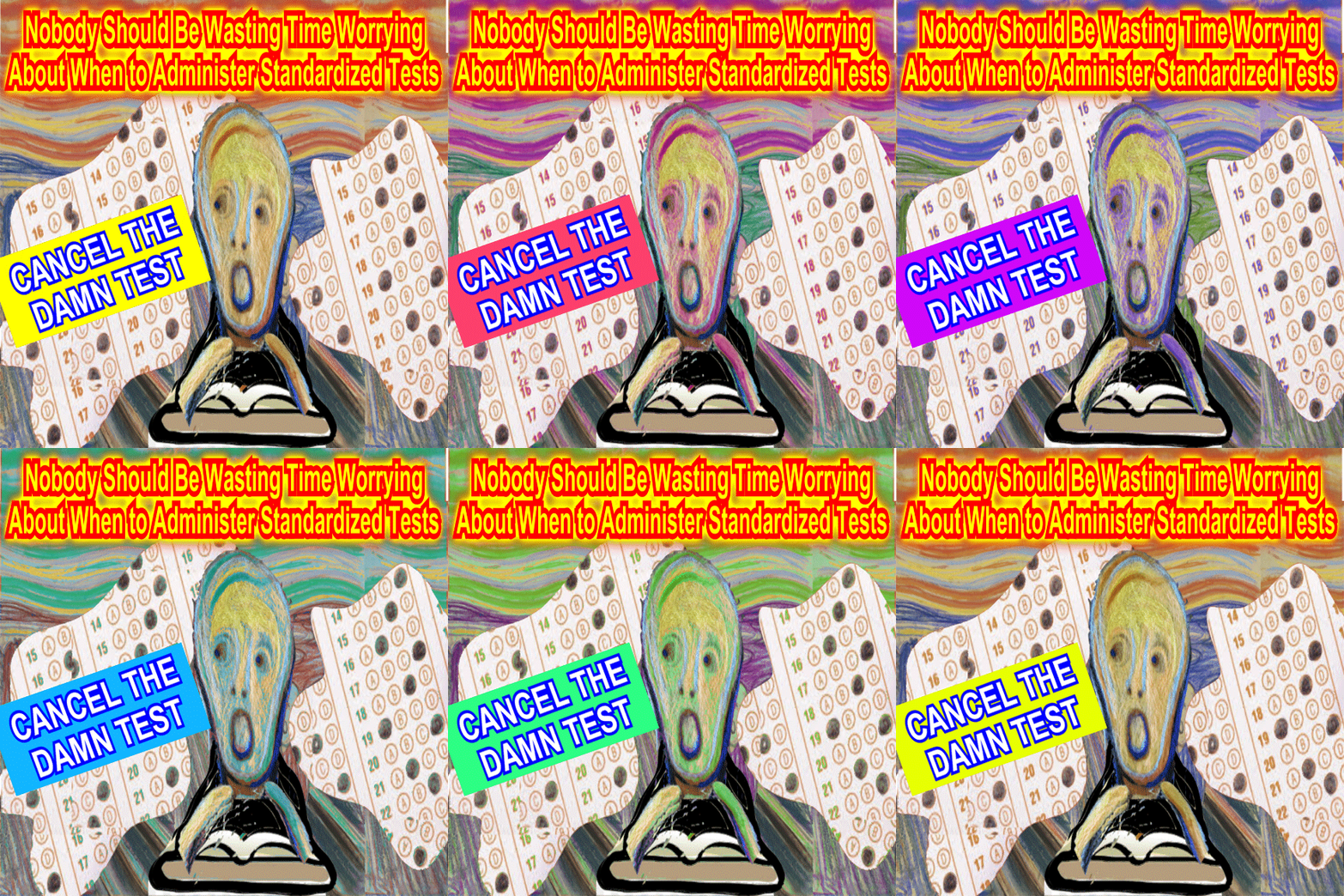
Nobody Should Be Wasting Time Worrying About When to Administer Standardized Tests | janresseger

Nobody Should Be Wasting Time Worrying About When to Administer Standardized Tests | janresseger
Nobody Should Be Wasting Time Worrying About When to Administer Standardized Tests


Parents, children, teachers, principals, and school superintendents are living through a time of unknowns. COVID-19 is raging across the states with many public schools operating only online. Some public schools, which have been able to open in person or on hybrid schedules, have subsequently been forced to close already reopened buildings or specific classrooms as COVID-19 cases arise and everybody quarantines.

In the midst of a chaotic situation with no good and stable solutions for many public schools, suddenly last week everybody started worrying about what to do about this year’s standardized tests. The Washington Post‘s Perry Stein reports that outgoing Secretary of Education, Betsy DeVos postponed the winter administration of the National Assessment of Educational Progress, the one test administered across all the states, the test that tracks school achievement over the decades and is not distorted by high stakes consequences.

Representatives Bobby Scott (D-VA) and Patty Murray (D-WA), the Democratic leaders of the House Education Committee, agreed to delay the NAEP, but said the nation needs some kind of measure of learning loss during the pandemic.  They released a statement declaring that annual state tests mandated under the Every Student Succeeds Act must surely be administered: “Existing achievement gaps are widening for our most vulnerable students, including students from families with low incomes, students with disabilities, English learners, and students of color. In order for our nation to recover and rebuild from the pandemic, we must first understand the magnitude of learning loss that has impacted students across the country. That cannot happen without assessment data.”

While I frequently agree with Representatives Scott and Murray, I think worrying about CONTINUE READING: Nobody Should Be Wasting Time Worrying About When to Administer Standardized Tests | janresseger


Thursday, October 29, 2020

CURMUDGUCATION: DeVos New NAEP Baloney Sandwich

CURMUDGUCATION: DeVos New NAEP Baloney Sandwich
DeVos New NAEP Baloney Sandwich


Betsy DeVos would like you to know--again, some more--that public schools are failing. 

Her exhibit this time is the newly-released NAEP results for 12th graders in 2019. And as usual at NAEP time, her brief exhortation is riddled with baloney. 

America is the greatest country on the face of the earth, and we should deliver our rising generation the greatest educational opportunities possible. Sadly, today’s results confirm America’s schools continue to fall far short, and continue to fail too many kids, especially the most disadvantaged.

Wave that flag. But recognize that the NAEP 12th grade scores did not break out students by low-income levels, so DeVos has no idea which students, exactly, are holding the fuzzy end of the test score lollipop. Also, let's not lose sight of the fact that the NAEP is administered to public and private schools, so the same schools that she wants a voucher-paved path to for students--those beloved private schools are in this mix, too.

It’s particularly troubling to see the results for our lowest performing and most disadvantaged students getting worse. Education funding flows most heavily to these students’ schools, but these data make clear money to schools alone will not fix the problem. It’s a problem of approach CONTINUE READING: 
CURMUDGUCATION: DeVos New NAEP Baloney Sandwich


NAEP 12th Grade Scores: Unchanged Since 2005 | Diane Ravitch's blog

NAEP 12th Grade Scores: Unchanged Since 2005 | Diane Ravitch's blog
NAEP 12th Grade Scores: Unchanged Since 2005


Those of you who have followed this blog for many years know that I don’t put much stock in twelfth grade NAEP (National Assessment of Educational Progress) scores. Having served for seven years on the NAEP governing board (the National Assessment Governing Board), I know that twelfth graders are a perennial problem. Unlike students in fourth and eighth grades, the seniors know the test doesn’t count. They are not motivated.

Bearing that in mind, it is nonetheless surprising that the recently released NAEP 12th grade reading and math scores have barely budged since 2005.

Even if kids aren’t trying hard, their scores should have gone up if they were actually better educated.

I argued in Slaying Goliath that NAEP scores for fourth and eighth grade have been flat for the past decade. And these kids are doing their best.

NAEP scores show the abject failure of “education reform” inflicted on students and educators since passage of No Child Left Behind. NCLB, Race to the Top, VAM, charter schools, vouchers, merit pay, Common Core: a massive failure.

It’s time to throw out the status quo. It’s time for a new CONTINUE READING: NAEP 12th Grade Scores: Unchanged Since 2005 | Diane Ravitch's blog