Latest News and Comment from Education

Wednesday, March 24, 2021

Get rid of the damn test! | Teacher in a strange land

Get rid of the damn test! | Teacher in a strange land
Get rid of the damn test!


Guest blog from Jodi Mackley. Jodi is an advocate for public education, BLM curriculum, and creative writing for all students.  She taught secondary English in the same public school district for 30 years, and now enjoys “retirement” in a much smaller (though public) school setting. 

Next month, I may have to give the MStep test to my high school students, most of whom are English Language Learners. This is my first year teaching them. I don’t need to spend a week or more discouraging them with badly written test questions (which I did not create, do not see ahead of time and won’t get to see afterward). %#*!? is what I have to say about that.

Do ELLs really have to take this test? 

Can ELLs get support? 

Are ELLs scored the same as non-ELLs? 

Heck, who is the bottom-line-authority forcing all kids to take this test? And why can’t caring adults cry out for transparency, change, revolution? For some answers, I went to the Migration Policy Institute for some facts. Only one statement stuck with me: 

“Michigan administers the MStep for accountability purposes.” 

Accountability? Sounds like someone has been naughty. Is it me? I know it’s not my students. They are the last ones to complain about tasks thrust upon them. It’s true. They are happily embracing their American freedoms. 

We expect language learners to be English proficient within six years. Really? Are the test makers fluent in other languages? Can they read culturally biased questions, CONTINUE READING: Get rid of the damn test! | Teacher in a strange land

Education Secretary Cardona stands firm on standardized testing mandate amid criticism - The Washington Post

Education Secretary Cardona stands firm on standardized testing mandate amid criticism - The Washington Post
Education Secretary Cardona stands firm on standardized testing mandate amid criticism


A day after more than 500 education researchers asked Education Secretary Miguel Cardona not to force school districts to administer federally mandated student standardized tests this year during the coronavirus pandemic, Cardona said Tuesday that policymakers needed the data obtained from the exams.

Appearing at the 2021 legislative conference of the Council of Chief State School Officers (CCSSO), Cardona said giving school districts flexibility in how and when they administer the exams — as the department has already given — was the right thing to do. “One size does not fit all,” he said.

But he said, student data obtained from the tests was important to help education officials create policy and target resources where they are most needed. When federal funding is distributed to states, he said, “we have to make sure we are laser-focused on addressing inequities that have existed for years. ... Every bit of data helps.”

The Education Department announced this week how much money each state, the District of Columbia and Puerto Rico would receive from the $122 billion in funding for K-12 schools that was included in the $1.9 trillion American Rescue Plan Act.

Cardona made the comment during a question-and-answer period at the CCSSO conference when he was asked what he hoped to learn from the exams. His CCSSO appearance came a day after 548 members of the academic research community sent Cardona a letter, urging him to award states waivers from the exams because they will “exacerbate inequality” and “produce flawed data.”

They also urged Cardona to invest in “more holistically evaluating school quality” by “developing new measures of educational opportunities.”

Cardona said Tuesday that he would be willing to “reexamine what role assessments” play in education — but not immediately. CONTINUE READING: Education Secretary Cardona stands firm on standardized testing mandate amid criticism - The Washington Post

Parent Advocacy Group Seeks Equity For Sacramento Students — The Sacramento Observer

Parent Advocacy Group Seeks Equity For Sacramento Students — The Sacramento Observer
Parent Advocacy Group Seeks Equity For Sacramento Students


(WORDINBLACK.COM) – The Center at Sierra Health Foundation announced this week the launch of the Parents Advocating for Student Success (PASS) Program to engage parents and families for educational equity for all students in Sacramento City Unified School District (SCUSD).

The PASS Program is funded for two years and will train, empower, and support parents on school campuses to increase and facilitate parent engagement, prioritize parent concerns related to their child’s education, collectively advocate for solutions to improve student achievement, and ensure the healthy social and emotional development of all children. 

The center this week releases a request for qualifications for local community organizations to manage and create the program’s final design with parents, with input and participation from existing community organizations and parent coalitions.

“Parents — or any positive, caring adult in the lives of students inclusive of parents, caregivers, extended family members, and guardians — have always been among the most committed advocates for the needs of children,” said Chet P. Hewitt, president and CEO of Sierra Health Foundation and of the center. “The PASS Program will be an additional resource for families to articulate their visions for student success and for all allies who care about kids to move forward positive change throughout the district.”

The project was announced at a press conference at Hiram Johnson High School in collaboration with a PASS Coalition of organized families of SCUSD students, community-based organizations, labor unions, business organizations, and civic leaders. SCUSD the past several years has faced numerous major financial and administrative challenges, resulting in educational inequity for CONTINUE READING: Parent Advocacy Group Seeks Equity For Sacramento Students — The Sacramento Observer

Statement from Sec of Education Miguel Cardona regarding NAEP 2021 School Survey + Biden-Harris Administration to Announce Actions to Help Schools Reopen Safely U.S. Department of Education @ed.gov

Statement from U.S Secretary of Education Miguel Cardona regarding NAEP 2021 School Survey | U.S. Department of Education
Statement from U.S Secretary of Education Miguel Cardona regarding NAEP 2021 School Survey


“Today’s findings from the National Center for Education Statistics show encouraging early progress in states and communities’ efforts to reopen schools safely and quickly. As of February, 76% of schools were open for full-time or hybrid learning. While schools continue to show us what’s possible as they work to open their doors and meet students’ needs, we know that we still have a lot of ground to go. Data from January show there were critical gaps in access to in-person instruction, particularly for communities of color and students disproportionately impacted by the COVID-19 pandemic.

“At the Department of Education, we are committed to working with schools all across the country to get them reopened quickly and safely and to build confidence among families and educators. We owe it to our students - especially students in underserved communities and students with disabilities  - to get all our schools opened safely and to meet the social, emotional, mental health, and academic needs of all students. Between the critical funds allocated from the American Rescue Plan and the bold initiatives this Department is putting forward, I am confident that we can bridge the gaps that the COVID-19 pandemic has exacerbated and build a better educational system for all of our students.”

Statement from U.S Secretary of Education Miguel Cardona regarding NAEP 2021 School Survey | U.S. Department of Education


Biden-Harris Administration to Announce New Actions to Help Schools Reopen Safely and Meet Students’ Needs | U.S. Department of Education - https://www.ed.gov/news/press-releases/biden-harris-administration-announce-new-actions-help-schools-reopen-safely-and-meet-students%E2%80%99-needs

How the U.S. Department of Education is Helping Schools Reopen Safely and Meet the Needs of Students | U.S. Department of Education - https://www.ed.gov/news/press-releases/how-us-department-education-helping-schools-reopen-safely-and-meet-needs-students

Maurice Cunningham: The Marketing of the “National Parents Union” | Diane Ravitch's blog

Maurice Cunningham: The Marketing of the “National Parents Union” | Diane Ravitch's blog
Maurice Cunningham: The Marketing of the “National Parents Union” 


Maurice Cunningham watches the flow of “Dark Money” into the privatization of public funding for schools. A professor of political science, he has recently followed the money trail of the “National Parents Union,” which he points out is neither “national,” nor “parents,” nor a “union.”

NPU markets itself as if it were a “grassroots” group, but it is funded by the Walton Family Foundation and Charles Koch and enjoys the high-priced assistance of Mercury Communications LLP to get its anti-public school, anti-union message into the national media. Mercury currently represents Teach for America and at one time represented Eva Moskowitz (who fired them).

With this expensive marketing, NPU presents itself as an authentic voice of parents.

Cunningham writes:

Here’s an example of the coverage from the New York Times: “National Parents Union, a collection of 200 advocacy organizations across 50 states representing parents from communities of color.” But there is no CONTINUE READING: Maurice Cunningham: The Marketing of the “National Parents Union” | Diane Ravitch's blog

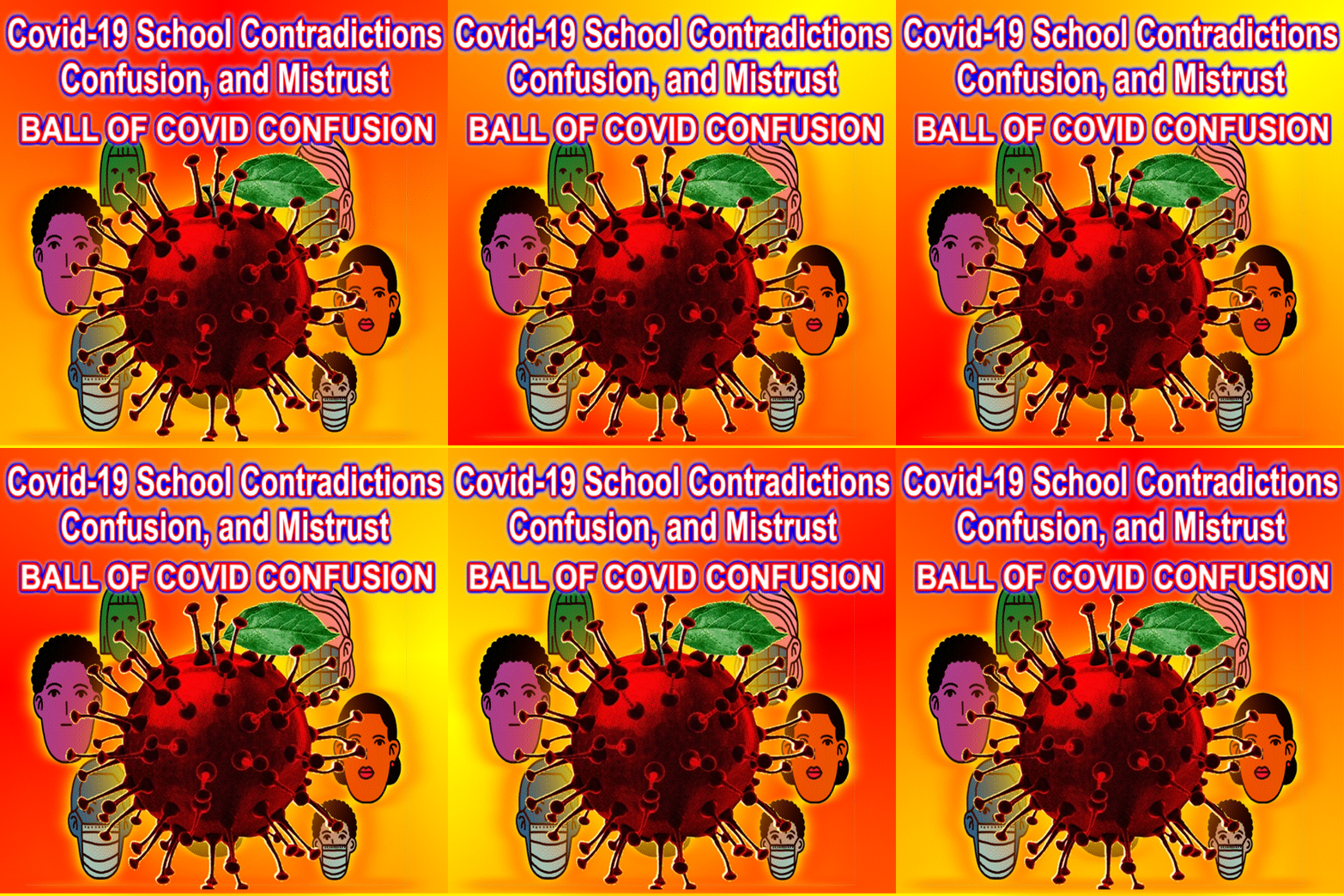
NANCY BAILEY: Covid-19 School Contradictions, Confusion, and Mistrust

Covid-19 School Contradictions, Confusion, and Mistrust


Covid-19 is a strange phenomenon without any proven how-to guides. Recommendations and contradictions surrounding Covid-19 and schools have raised uncertainty. When there’s a lack of clarity, people become suspicious of what they’re told, and they wonder what and who to believe.

Parents and Teachers Can’t Agree

Many parents believe schools are safe, few children get sick, Covid-19 is not real or not as bad as it’s made to sound, and teachers’ unions are remiss for their caution about in-person learning.

On the other hand, persons of color are hesitant to send their children back to school.

According to Mother Jones:

The pandemic has dealt a disproportionately heavy blow to Black Americans. According to CDC data published in September, Black youth accounted for 29 percent of COVID-19 deaths among people under 21, twice the percentage for white youth. The federal agency also found Black children under 18 at a significantly higher risk of hospitalization—almost four times higher than white children and teens.

Mixed Messages From the CDC, Pediatricians and Dr. Fauci

Parents who blame teachers for schools not fully opening, do so partly due to a sloppy push to make schools sound safe from the CDC, pediatricians, and Dr. Fauci.

Many claims ignore problems with school infrastructure and how schools work, while CONTINUE READING: Covid-19 School Contradictions, Confusion, and Mistrust

Being an American, Christian, or Both: A Fundamental Problem of “Can” v. “Should” – radical eyes for equity

Being an American, Christian, or Both: A Fundamental Problem of “Can” v. “Should” – radical eyes for equity
Being an American, Christian, or Both: A Fundamental Problem of “Can” v. “Should”


March is a harbinger of spring.

March 2021 has also been an harbinger for some sort of return to normal after a year of living through a pandemic in the U.S. and across the world.

Mid-March now may force us to reconsider what we have wished for since the return to normal in U.S. includes two mass shootings in a week—8 murdered around Atlanta, GA followed by a mass shooting at a grocery store in Boulder, CO leaving 10 dead.

Mass shootings are so normal in the U.S. that they very much define what it means to be “American,” what it means to be a “Christian Nation,” routinely and darkly emphasized after every bloody event: ‘No Way To Prevent This,’ Says Only Nation Where This Regularly Happens.

After the Atlanta shooting and the predictable debates about racism, hate crimes, and gun control, one meme proclaimed “You can’t be a Christian if” by detailing the contradictions between racism and Christian values.

The problem with this claim is that many people in the U.S. do in fact identify as Christian while also actively expressing racism or passively ignoring and CONTINUE READING: Being an American, Christian, or Both: A Fundamental Problem of “Can” v. “Should” – radical eyes for equity

Peter Greene: How a Non-Profit Charter School Can be Run for Profit | Diane Ravitch's blog

Peter Greene: How a Non-Profit Charter School Can be Run for Profit | Diane Ravitch's blog
Peter Greene: How a Non-Profit Charter School Can be Run for Profit


Peter Greene reviewed the Network for Public Education’s report on for-profit charter schools in Forbes, where he is a regular columnist.

He writes:

It has become cliche for politicians and policy makers to oppose “for profit” charter schools. It’s also a safe stance, because most people agree they’re a bad idea; for-profit charter schools are not legal in almost all states. 

But charter school profiteers have found many loopholes, so that while they may not be able to set up for-profit charters, they can absolutely run charter schools for a profit. That may seem like a distinction without a difference, but the difference is that one is illegal in almost all states, and the other, as outlined in a new report, can be found from coast to coast. The new report, “Chartered for Profit,” from the Network for Public Education examines the size and reach of “the hidden world of charter schools operated for financial gain.” (Full disclosure: I am a member of NPE.)

The most common workaround for operating a charter school for profit is a management corporation. In this CONTINUE READING: Peter Greene: How a Non-Profit Charter School Can be Run for Profit | Diane Ravitch's blog

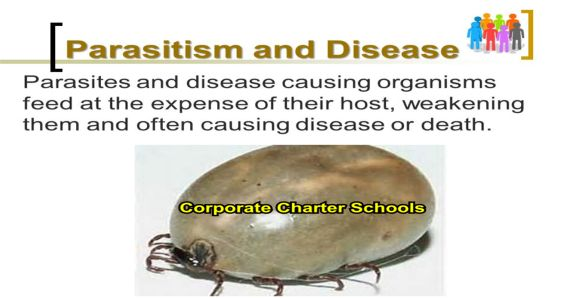
Big Education Ape: THE CALIFORNIA CHARTER SCHOOL ASSOCIATION FOR PROFIT PARASITES - https://bigeducationape.blogspot.com/2019/10/the-california-charter-school_7.html


Big Education Ape: Major New Report Shows that Charters Are Too Often Parasites Weakening Host School Districts | janresseger - https://bigeducationape.blogspot.com/2016/12/major-new-report-shows-that-charters.html

Teacher Tom: How Free and Equal Humans Are Meant to Live Together

Teacher Tom: How Free and Equal Humans Are Meant to Live Together
How Free and Equal Humans Are Meant to Live Together


Two freshly-minted three-year-olds were playing on the floor, not together, but near one another. I was lying amidst them, fiddling with whatever came to hand. The boy picked up a toy that was meant to impersonate a tiny version of the cast iron hand pump we have on our playground. After a moment, the boy said, perhaps to me, "Hey, it's a pump!"

The girl responded, "I want it."

That's what we had been encouraging kids to do for months, ask for things they want rather than just snatching them. The boy continued playing with the toy pump without saying a word. I briefly considered saying, "When you're finished with that, she wants it," but let the urge pass. The boy silently played with the toy for 30 seconds longer, then unceremoniously handed it to her. I was going to say something about that as well, some words of acknowledgement or even praise, but again thought better of it.

A five-year-old once told me, unprompted, as if it was something he'd given a lot of thought, "I don't like doing CONTINUE READING: Teacher Tom: How Free and Equal Humans Are Meant to Live Together

Widespread Attacks on Voting Rights and Attempts to Privatize Public Schools Together Threaten Democracy | janresseger

Widespread Attacks on Voting Rights and Attempts to Privatize Public Schools Together Threaten Democracy | janresseger
Widespread Attacks on Voting Rights and Attempts to Privatize Public Schools Together Threaten Democracy


In Friday’s NY Times, columnist Jamelle Bouie reflected on Georgia Senator Raphael Warnock’s first speech on the Senate floor:

“Warnock is the first African-American to represent Georgia in the Senate and only the second elected from the South since Reconstruction. His presence on the Senate floor is historic just on its own.  It represents progress—and yet it is also evocative of the past. A Black lawmaker from the South, urging his mostly white colleagues to defend the voting rights of millions of Americans is, to my mind, an occasion to revisit one particular episode in the history of American democracy: the fight in Congress over the Civil Rights Act of 1875.”

Bouie summarizes what was in this bill, proposed by Massachusetts Senator Charles Sumner in a Reconstruction Congress right after the Civil War: “As originally written, Sumner’s bill would, ‘Secure equal rights in railroads, steamboats, public conveyances, hotels, licensed theaters, houses of public entertainment, common schools, and institutions of learning authorized by law, church institutions, and cemetery associations incorporated by national or State authority; also on juries in courts, national and State.'” In 1871, the bill was repeatedly blocked in committee, but Senator Sumner reintroduced it in modified form in 1873: “This revised bill added a clause that stated that ‘no citizen of the United States shall, by reason of race, color, or previous condition of servitude, be excepted or excluded from full and equal enjoyment’ of ‘common schools and public institutions of learning, the same being supported by moneys derived from general taxation or authorized by law.'”

School integration held up the bill’s passage, however, and when it finally passed in 1875, “It did so without the schools clause.” “It was the schools clause that proved especially CONTINUE READING: Widespread Attacks on Voting Rights and Attempts to Privatize Public Schools Together Threaten Democracy | janresseger

New Data Highlight Disparities In Students Learning In Person | 89.3 KPCC

New Data Highlight Disparities In Students Learning In Person | 89.3 KPCC
New Data Highlight Disparities In Students Learning In Person


The U.S. Education Department has released the first in a series of school surveys intended to provide a national view of learning during the pandemic. It reveals that the percentage of students who are still attending school virtually may be higher than previously understood.

As of January and early February of this year, 44% of elementary students and 48% of middle school students in the survey remained fully remote. And the survey found large differences by race: 69% of Asian, 58% of Black and 57% of Hispanic fourth graders were learning entirely remotely, while just 27% of White students were.

Conversely, nearly half of white fourth-graders were learning full-time in person, compared with just 15% of Asian, 28% of Black and 33% of Hispanic fourth-graders. The remainder had hybrid schedules.

This disparity may be partly driven by where students live. City schools, the survey found, are less likely than rural schools to offer full-time, in-person classes. Full-time, in-person schooling dominated in the South and the Midwest, and was much less common in the West and Northeast.

The racial and ethnic gaps may also be driven in part by which families are choosing to stay remote, even where some in-person learning is offered. Three out of 4 districts around the country were offering some in-person learning as of January, the CONTINUE READING: New Data Highlight Disparities In Students Learning In Person | 89.3 KPCC

2018–19 State Meal Reimbursement Rates Restored + CACFP Integrity Plan - Nutrition (CA Dept of Education)

2018–19 State Meal Reimbursement Rates Restored - Nutrition (CA Dept of Education)
2018–19 State Meal Reimbursement Rates Restored


The purpose of this message is to inform School Nutrition Program Operators that the California Department of Education (CDE) has recently restored the state meal reimbursement rate for the School Nutrition Programs for May and June 2019.

Background

California’s annual budget requires the CDE to prorate the amount of state reimbursement provided to eligible recipients in the event that funds appropriated in the Budget Act are insufficient. In fiscal year 2018-19, state funds were not sufficient to reimburse all eligible meals at the prescribed rate(s). Therefore, the CDE reduced the statutory reimbursement rate of $0.2368 to $0.2194 for May and June 2019 and to $0.1800 for remaining June 2019 claims, for every free and reduced-price (F/RP) breakfast and lunch served.

In fiscal year 2020-21, the CDE was appropriated additional funding to retroactively provide full reimbursement for all eligible meals served in fiscal year 2018-19. An additional payment will therefore be processed for all eligible meals that received a reimbursement of less than $0.2368.

Payment Timeframe

Operators can expect to receive payment checks for the restored reimbursement rate by Spring 2021.

Payment Identification

The information below will assist in identifying these payments within the Child Nutrition Information and Payment System (CNIPS)External link opens in new window or tab..

Once logged into CNIPSExternal link opens in new window or tab., select school year 2018-2019, then on the Claims Tab in the blue menu bar select “Payment Summary” under Item. In the Payment Summary screen, there are four fields that will help provide important details regarding the $0.2368 restored rate payments, including the Schedule Number, State Year, Fund Authority, and Account Description.

  • Schedule Number: This is found on the far left of the Payment Summary screen.

  • State Year: This is to the right of the Schedule Number and should indicate 2018-2019.

  • Fund Authority: This is found on the far right of the Payment Summary screen. CNIPSExternal link opens in new window or tab. will reflect that these payments are made from State Prop 98 funds.

  • Account Description: This is found on the second line of the Payment Summary screen, directly below the Schedule Number.

Contact Information

If you have any questions or need assistance, please contact your Child Nutrition Fiscal Services Analyst using the analyst directory information provided on the Nutrition Services web page.

Questions:   Nutrition Services Division | 800-952-5609

Coronavirus (COVID-19) Main Web Page

The California Department of Education (CDE) Nutrition Services Division (NSD) recognizes the challenge of providing nutritious meals to children and adults everyday while trying to keep up with the numerous changes, flexibilities, and nationwide waivers that have gone into effect over the past several months. As part of receiving the national waivers, the U.S. Department of Agriculture (USDA) requires program operators to have a written plan in place to ensure program integrity while operating under numerous COVID-19 waivers. The NSD has developed a Child and Adult Care Food Program (CACFP) Integrity Plan guide to support program operators.

When operating under the various waivers, program operators are required to maintain written procedures that outline plans to ensure the integrity of the CACFP while serving and distributing meals to a child or adult during the COVID-19 pandemic. The CACFP Integrity Plan guide assists program operators in the development of standard operating procedures (integrity plan) and helps identify some of the required documents program operators must collect and maintain to meet CACFP requirements while implementing the nationwide waivers. This guide also provides prompting questions that program operators should consider and answer when developing an integrity plan to ensure their procedures and documents address and meet all CACFP requirements related to preparing, serving, distributing and claiming meals served to children in their CACFP.

Additionally, the USDA Policy Memorandum SP 05-2021, CACFP 04-2021, SFSP 04-2021: Questions and Answers relating to the Nationwide Waiver to Allow Summer Food Service Program and Seamless Summer Option Operations during School Year 2020–21 was issued on January 5, 2021. Question Number 2 addresses flexibilities during the pandemic to the federal requirements for maintaining attendance records for At-risk Centers in accordance with Title 7, Code of Federal Regulations, Section 226.17a(o)(1). This policy memo is available on the USDA Food and Nutrition Service web pageExternal link opens in new window or tab..

The CACFP Integrity Plan Guide is attached to this email and is available on the Resources tab of the CDE COVID-19 Guidance in the Child Nutrition Programs web page. It is also available in the Download Forms section of the Child Nutrition Information and Payment System (CNIPS)External link opens in new window or tab., Form ID CACFP 91.

Contact Information

If you have any questions regarding this subject, please contact your Field Services Unit (FSU) Child Nutrition Consultant (CNC). The FSU CNC list is available in the Download Forms section of the CNIPSExternal link opens in new window or tab., Form ID Caseload.

Questions:   Nutrition Services Division | 800-952-5609

CURMUDGUCATION: Jebucation Has New Five Year Plan

CURMUDGUCATION: Jebucation Has New Five Year Plan
Jebucation Has New Five Year Plan


Long long ago, when Jeb! Bush still had White House dreams, he cooked up a Floridian reform group, which then scaled up to national status as the Foundation for Excellence in Education, which has now become ExcelInEd. Headed up by Patty Levesque, the organization  remains a clearinghouse for education disruption ideas pushed by well-heeled, well-connected education amateurs. It is hard to pretend any more that these are serious people who have goals other than breaking up public education so that the private market can profit from the pieces. 

Their website is still chock full of carefully twisted stats (Florida is first in AP test participation!) and same old baloney talking points (US students rank 38th internationally in math on the PISA scores--which is of course right where they've always ranked). The message remains as always that public schools are failing and we must open education to the privateers who want access to all those sweet, sweet tax dollars. (It also includes some celebrity bad quotes).

The group is busy-- they push policy ideas out into the states and have been busy filing briefs in support of ESAs (the newest flavor of education voucher) and just generally supporting the privatization agenda whenever they can. And they put on an annual gathering of privatizers and profiteers called, seriously, EdPalooza.

Recently Levesque was interviewed by Rick Hess. As with his recent exit interview with Betsy DeVos, this is Hess being uncharacteristically soft and fuzzy, allowing his subject to spin her tale without ever questioning or challenging her story. The end result is illuminating only because it gives us an unvarnished picture of the alternate reality that Levesque wants to promote.

Levesque's account of what EIE has done is standard reformy fare-- they're "developed policy CONTINUE READING: CURMUDGUCATION: Jebucation Has New Five Year Plan

A long-awaited federal survey highlights challenges ahead for schools - Chalkbeat

A long-awaited federal survey highlights challenges ahead for schools - Chalkbeat
The federal government finally has data on schooling during COVID. Here are 3 key takeaways.


The federal government has released its first, long-awaited snapshot of schooling during the pandemic.

A newly released federal survey shows that a huge swath of American school children — particularly students of color — were still learning remotely in January. Of those students, a small but substantial share were getting little or no live instruction from a teacher.

The information was collected as part of President Biden’s push to get more schools reopened for in-person learning. The Trump administration had rejected the idea of such national recordkeeping.

The survey questions were given to a representative set of schools in 44 states serving either fourth or eighth grade. The data will be updated monthly through July.

In the months since schools answered these questions, more school buildings have opened as COVID case rates have fallen. A more recent estimate suggests that 80% of students now have access to in-person instruction.

But the federal survey highlights two major, continuing challenges facing school officials: the fact that tens of millions of students have received virtual instruction for months, and have missed out on learning and crucial support, and the continued reluctance of some families to return for in-person instruction, even when it’s available.

“We have a huge and long road of recovery and restoring instructional support to CONTINUE READING: A long-awaited federal survey highlights challenges ahead for schools - Chalkbeat