It is also well- known that privately-operated charter schools have higher teacher, principal, and student turnover rates than public schools, ensuring instability in the school milieu.
These and other facts stem directly from the privatized and marketized character of segregated charter schools, whether they are non-profit or for-profit. Privatization is usually associated with greater corruption, higher costs, less efficiency, lower quality services, less transparency, and restricted public access. The so-called “free market” ensures a law of the jungle fend-for-yourself atmosphere.
It should also be noted that privately-operated charter schools, which are governed by unelected individuals and are ostensibly “open to all,” have long offered fewer services, programs, and resources than public schools while also engaging in selective enrollment practices. This is not due to a shortage of CONTINUE READING: Charter Schools Have Fewer Nurses and More Inexperienced Teachers than Public Schools | Dissident Voice
Capitalism Is Your Daddy: “what sort of person to die as”
From “you are what you eat” to “when you have sex with someone, you are having sex with all of their sexual partners,” we seem obsessed with fear-mongering in order to shape how people behave, and thus, who people become.
About fifty pages into Keiichiro Hirano’s A Man, the reader experiences the first hints of what becomes one motif of the novel:
In the end, although Kido would only drift to law school in the grips of the fuzzy thinking that plagues many students of the humanities, his father’s words would contribute to his firm decision, while enrolled there, to try to see things through and become a lawyer.
A work written by a Japanese author about a Korean naturalized as Japanese (Akira Kido) resonates in several ways with growing up and making career choices in the U.S.
In less than fifty more pages, Kido is gripped in a panic attack identified as “existential anxiety”: “Kido’s fear of the same thing [death] happening to him made him painfully sensitive to the minutiae of life” (p. 99).
A few days ago, I posted Nancy Bailey’s critique of McKinsey & Company’s report claiming that it’s time for schools to get tough on students. As Bailey points out, when I worked in the Department of Education, the White House was crawling with McKinsey consultants, smart young things who knew everything about education but were seldom old enough to have been in the classroom for long.
Our faithful reader and meticulous researcher Laura Chapman (a retired arts educator) responded to Nancy’s post as follows, describing the mastermind of the McKinsey report:
Nancy Bailey probably knows that the author of the McKinsey report, Jimmy Sarakatsannis jumped straight to McKinsey as an expert in everything about K-12 and teacher education from his job as a science teacher for CONTINUE READING: Laura Chapman: McKinsey’s Education “Expert” | Diane Ravitch's blog
Congratulations on your nomination to be U.S. education secretary, Miguel Cardona. You are poised to take this position at a critical point in American history. As you know well, for generations we have lived through a system of separate and unequal education. COVID-19 has greatly exacerbated the learning loss disparities experienced by children of color. Now, with Congress failing to deliver to schools, educators, students and parents the much needed learning and PPE resources, and states cutting their 2021 budgets, things are primed to get a lot worse.
When one couples the historic impact of structural racism on education with the challenges brought on by COVID-19, it is clear we are in a maze without a clear exit. But in times of uncertainty, the past can be a guiding light. One important lesson from the past: the positive impact of targeted economic stimulus packages.
Importance of stimulus packages
We know stimulus packages can make a difference. For example, according to the Department of Education, President Barack Obama’s American Recovery and Reinvestment Act “helped save or create an estimated 325,000 education jobs.” The stimulus needed now must go well beyond protecting teachers’ jobs, which are undoubtedly important, and extend to transforming learning and investing in families and community-based institutions. The bottom line is we cannot facilitate change and remedy years of divestment without an infusion of stimulus resources.
A stimulus moves us away from the scarce resources frame that too often dominates when confronting the need to invest in children. The bipartisan Emergency Economic Stabilization Act of 2008, which created the Troubled Assets Relief Program, a $700 billion fund to purchase toxic assets from banks, didn’t force banks or their CEOs to compete for needed resources to stabilize their operations. Instead, it provided them with well-calculated, targeted resources needed to do the job. Likewise, we are at a moment when the public education system, its students and educators are in dire need of resources to stabilize operations and eliminate the toxicity of racial disparities.
A targeted, multi-year $1-2 trillion Education Stabilization Program is a vital part of a larger Racial Equity Stimulus Package proposed by one of us, John Jackson, and other civil rights leaders. This education-focused stimulus would allow for the critical racial equity investments needed from birth and throughout the public preK-12 education system.It would serve as a stabilization fund for states whose education budgets are challenged by COVID-19-caused revenue shortfalls, while also requiring a maintenance of effort by states. It would also include investments to enable the expansion of community schools, address student mental health and socio-emotional needs, support states moving toward tuition-free community college, and make significant investments in Historically Black Colleges and Universities and other institutions that serve minorities and lead the nation in graduating students of color.
Stimulus resources are especially needed to address the significant learning loss caused by the pandemic, felt most deeply in communities of color. These targeted funds can contribute to making gains on eliminating racial disparities in education by liberating learning, upending the constraining structures and paradigms in the educational system which have led to learning disparities identifiable by race and ethnicity.
Inequality in education
Black students and other students of color have long faced a host of challenges where education is concerned — disproportionately under-resourced schools, school closures, criminalization in schools, a lack of teachers who look like them and curricula too often not culturally relevant to them. These biased policies and practices undeniably continue to limit education outcomes for Black and brown students and those from tribal communities. While most students have access to free public education, they remain shackled in achieving their learning potential. As such, it is impossible to address the systemic learning gaps without addressing the racially disparate learning constraints within the education system or, said another way, without liberating their learning.
In this moment of far-reaching change, we must pause to examine whether we are committed to investing in the future. That is the question we must pose to elected officials and those on whom the hopes of children and families rest.
If the twin pandemics of COVID-19 and structural racism experienced in 2020 have shown us anything, it is that there must be a radical shift in how we interact with those around us, and that should force us to rethink how we invest in and educate all students. It has exposed not only past education inequities but the danger of prolonged future disinvestment. While leadership by Congress and the president are needed to move the Racial Equity Stimulus package, your leadership is needed, Secretary Cardona, to target education investments to ensure that we liberate learning for all students and flatten the curve of structural racism so damaging to student learning in America.
John H. Jackson (@DrJohnHJackson)is president and CEO of the Schott Foundation for Public Education. Derrick Johnson (@DerrickNAACP) is the president of the NAACP.
The Debate About School Safety Is No Longer Relevant
Even in places where schools want to reopen, too many teachers are sick or quarantining for classrooms to operate, and substitutes cannot fill the void.
For months, the debate about whether to open schools has centered on one question: Are schools safe? The only trouble is, this hardly matters anymore. Except in the few remaining regions with modest rates of viral spread, the transmission risk from and within schools is now beside the point. So many teachers and staff members are sick, quarantining, or have stepped down that many schools trying to remain open or to reopen just do not have the personnel available to do so well.
The examples are countless. Littleton Public Schools in Colorado, in announcingtheir shift to remote learning, stated that one of their primary reasons for doing so was that “keeping enough staff in schools for supervision is becoming a real concern. It is especially difficult, and impossible on some days, to have enough licensed teachers in classrooms delivering quality instruction.” Jeannine Nota-Masse, the superintendent of Rhode Island’s second-largest school district, was quoted in a local news story as saying, “Now you have students in the building and not enough adults to cover for the adults that are home for various reasons.” One elementary school near Milwaukee lacked 10 teachers on a recent day; Metro Nashville Public Schools has, according to The Tennessean, “had more than 200 teachers or staff members in quarantine or self-isolation each week since the end of October.” In a Reuters survey of 217 districts across 30 states, about half reported significant staffing issues—and this was before Thanksgiving, Christmas, and the arrival of deep winter.
The reason for the shortages isn’t intransigent teachers’ unions or unreasonable fear; it’s simply that the virus is too widely spread. Upwards of 200,000 new COVID-19 cases are reported most days, and Anthony Fauci recently warned that January numbers will likely look even bleaker. The new viral variant, if it takes CONTINUE READING: The Debate About School Safety Is No Longer Relevant - The Atlantic
Guarded Hope and 7 Concerns for Public Education this New Year
We have a new President and a new education secretary and hope for the future of public education.
Hope doesn’t come easy because schools face what appear to be insurmountable difficulties due to Covid-19. Also, wealthy individuals and groups who want school privatization are established in the system, mostly in dozens of anti-public school nonprofits, foundations, and think tanks.
We’ll be watching to see who Education Secretary Miguel Cardona chooses to work in the U.S. Department of Education and watch what happens to public schools at the State and local levels.
Here are some concerns.
1. Covid-19
Covid-19 dominates the education discussion. Governors and school officials must take the virus and school openings seriously without caving to political pressure to open schools when it’s dangerous. The virus doesn’t care what school students attend. Some CONTINUE READING: Guarded Hope and 7 Concerns for Public Education this New Year
She had chosen a Disney princess book for me to read to her, but we were mostly just talking our way through the pages. I was pretty certain she hadn't seen the movie, but she nevertheless seemed to know a lot about the characters and the story. I turned a page and she remarked, "That's a little Snow White."
"Yes, but she's bigger than the dwarfs."
"They're little too. On the other page they were big."
We flipped back to find the same characters, but framed to appear closer to the reader. I said, "Oh, that Snow White isn't little, she's just farther away."
She furrowed her brows at the picture for a moment, then said, "She is little."
"Yes, she looks smaller because she's farther away. This one looks bigger because she's so close."
Jake Jacobs: End the Tax Breaks for Charter Schools and the Uber-Rich
Jake Jacobs is a middle school art teacher in New York. He is the national co-administrator of the BadAss Teachers Association, an organization of militant activist teachers.
He writes:
Joe Biden’s recent nomination of Miguel Cardona as a relatively lesser-known, less controversial selection for Secretary of Education was telling. It shows the incoming administration’s reticence to take a side in the ongoing battle over school choice and standardized testing, just like most members of Congress and the major U.S. media.
On the campaign trail, Biden drew cheers from teachers for his promise to end standardized testing, but he noticeably never added any such policy to his website. As was well known by teachers in those audiences, federally mandated tests provide no educational benefit but are the fuel in the engine driving charter school expansion.
Tester tells Martin: “Democrats can really do some positive things in rural America just by talking about infrastructure and what they’re doing for infrastructure, particularly in the area of broadband. And then I would say one other policy issue is how some Republicans want to basically privatize public education. That is very dangerous, and I think it’s a point that people don’t want to see their public schools close down in Montana.”
Although I now live in an inner-ring suburb of Cleveland, Ohio, I grew up in in Havre, Montana, 35 miles up the road from Tester’s farm just outside of Big Sandy. As I read that NY Times interview, I was particularly interested in Tester’s statement about the threat school privatization poses in rural communities, which is why I was surprised and delighted to find a copy of Tester’s book wrapped up for me under the Christmas tree.
Many hope President Joe Biden’s administration will significantly reshape federal education policy. During last year’s campaign for President, Biden, the candidate, declared a public education agenda that contrasts sharply with what happened to federal policy in public education beginning in the 1990s and culminating in the 2002 No Child Left Behind and later in 2009 in Arne Duncan’s Race to the Top. Jack Schneider and Jennifer Berkshire describe the past couple of decades: “Together, led by federal policy elites, Republicans and Democrats espoused the logic of markets in the public sphere, expanding school choice through publicly CONTINUE READING: Montana’s Senator Jon Tester Says Democrats Can Win in Red States By Prioritizing Public Education | janresseger
What Shall We Do About the Children After the Pandemic
Teresa Thayer Snyder December 12, 2020
Diane Ravitch's BLOG
I sincerely plead with my colleagues, to surrender the artificial constructs that measure achievement and greet the children where they are, not where we think they “should be.”
Students line up to have their temperature checked before entering PS 179 elementary school in the Kensington neighborhood, Sept. 29, 2020 in Brooklyn, AP Photo/Mark Lennihan // Politico
Dear Friends and Colleagues:
I am writing today about the children of this pandemic. After a lifetime of working among the young, I feel compelled to address the concerns that are being expressed by so many of my peers about the deficits the children will demonstrate when they finally return to school. My goodness, what a disconcerting thing to be concerned about in the face of a pandemic which is affecting millions of people around the country and the world. It speaks to one of my biggest fears for the children when they return. In our determination to “catch them up,” I fear that we will lose who they are and what they have learned during this unprecedented era. What on CONTINUE READING: Choosing Democracy: Are Children Falling Behind?
Curriculum Associates, "Learning Loss," and Corporate Gain
Curriculum Associates (CA) started in a garage in 1969 with four employees, and for twenty years the company marketed supplementary basic curriculum materials to K-12 school systems. In 1989, the original head of the company, Frank Ferguson, saw the testing accountability writing on the wall, and he expanded the focus of the company into the assessment market with the creation ofTEST READY®Mathematics.
In 2008, Ferguson stepped down as CEO and hired Rob Waldron, who had previously run Kaplan's after-school tutoring division, which was funded in the early 2000s by billions of NCLB federal education dollars that ended up in corporate coffers. This is a clip from a 2008 Harper's article by a former Kaplan employee:
In New York City, Kaplan provides NCLB- mandated tutoring for the high school Regents exams and the subject exams administered to students in the third through eighth grades.) Many educators argue that the gains from prep courses are negligible and the programs themselves ultimately harmful, since they drain precious funds and class time. A recent Chicago Public Schools study examining student performance on the Iowa Test of Basic Skills found “little difference between tutored students and those who were eligible but did not receive tutoring.” The price tag for supplemental tutoring in Chicago, which 60,000 students received in the 2004–2005 school year: $50 million.
In Waldron's first year as CEO at Curriculum Associates, CA did $26 million in business. By 2020, CA was doing $260 million a year and was in the top 10 education publishers in the world.
You see, CA was one of the first companies to see the gargantuan profit potential in Common Core. In 2008, the company aggressively created and marketed print materials aligned with Common Core.
COVID AND SCHOOLS: THE DATA AND SCIENCE THEN AND NOW
Early on in the pandemic the thinking was that masks were not necessary. In fact, there is a video circulating online that shows Dr Anthony Fauci, director of the National Institute of Allergy and Infectious Diseases (NIAID) at the National Institutes of Health (NIH), saying “there’s no reason to be walking around with a mask.” Fauci’s remarks were made on March 8, 2020 and do not represent his current stance or the national conversation about the importance of face coverings nor the updated guidance issued by the Centers for Disease Control and Prevention (CDC). That was then, this is now.
The virus spreads in schools — but schools are rarely superspreaders
School outbreaks typically come from the community — not vice versa
Children transmit the virus — but not how adults do
For months, the common conversation in the media and research was that schools were not heavily documented sites for Covid or superspreading events. But I kept hearing anecdotally from the field that the situation was different. A friend that works in a Texas school district was infected in a public school by another teacher. The friend relayed that the teachers were rapidly getting sick in her school, but the students were not showing symptoms. This is not the only Texas superspreader event that flew under the radar. The Texas State Board of Education hosted their own superspreader event when they were forced to meet in person by Board leadership to make a political point. The argument made was if the State Board of Education couldn’t meet in person, why would school districts across the state of Texas agree to do so? While I am not an epidemiologist, anecdotally, this information seems quite problematic compared to the public discourse about school reopening. The AAMC article did include an important caveat and/or hedging.
The early data suggest that schools can reopen safely under certain conditions, but the analyses come with follow-up questions and multiple caveats — the most basic of which is some form of, “That’s what we know so far.” “We’re nine to 10 months into a brand-new disease,” cautions Helen Bristow, MPH, program manager of Duke’s ABC Science Collaborative, which guides schools on COVID-19 safety. “We’re regularly learning something we didn’t know before.”
That was then and this is now.
So what is the latest? The Guardian reported on January 2, 2021 that Symptomless cases in schools could be key driver in spread of Covid-19. Please read that again. They report that “Up to 70% of schoolchildren infected with coronavirus may not know they have it until after a positive test result.” Please read that again. In my own experience, I have heard many stories of people testing negative and then not soon after testing positive and/or having symptoms. Has this “negative” test situation happened to your friends and family too? This is now being borne out in the broader data.
A key factor in the spread of Covid-19 in schools is symptomless cases. Most scientists believe that between 30% and 40% of adults do not display any Covid symptoms on the day of testing, even if they have been infected. For children, however, this figure is higher. “It is probably more like 50% for those in secondary school while for boys and girls in primary school, around 70% may not be displaying symptoms even though they have picked up the virus,” says Professor Martin Hibberd of the London School of Hygiene and Tropical Medicine.
The Guardian
We don’t know what we don’t know. Proponents of immediate school reopening often point to contact tracing and testing. However, in the United States the number of cases has rapidly overwhelmed contact tracing and testing. It’s hard to argue that testing and contact tracing is currently adequate for K-12 schools.
The US Department of Education has absolutely failed in its responsibility to track the spread of Covid in higher education and K-12. LITERALLY FAILED. Besty DeVos said it was not her job. In the absence of leadership from Betsy DeVos and the US Department of Education, the free press of our nation have stepped into that glaring gap. The COVID Monitor is a US News database that tracks coronavirus cases in K-12 schools. They’ve shown there had been nearly 250,000 student and staff cases across the United States since Aug. 1— and that data doesn’t include the massive December surge. Read that again. 250,000. While those have been tied to schools, we also know that more than 1 million children have been diagnosed with COVID-19 in the United States.
The most distressing part of this pandemic is the death. Every time I have been forwarded an article by a reader of Cloaking Inequity about the death of an educator, I have posted it on my Twitter to make point. Educators are being infected with Covid and they are dying.
Inaccurate, unprovenclaims have filled the data gap, aiming to assuage anxieties about reopening schools for in-person classes, with seemingly little regard for the potential impacts the virus may have on the students, staff and communities affected by such choices. With uncertainties about the long-term effects of infection on an individual’s health, the evidence of children being asymptomatic spreaders and the increase in pediatric cases recently, public pleas for closing schools have grown.
In guidance from the Centers for Disease Control and Prevention, schools are called a “potential source of COVID-19 outbreaks, due to the number of individuals intermingling in close proximity for extended periods of time.”
It makes sense when you think about it. Stuff a bunch of people into a confined space for eight hours a day and the likelihood of catching the virus increases.
And internationally, data indicates how quickly schools may become superspreaders.
In Israel, for example, many schools closed due to COVID-19 outbreaks only two weeks after the country fully reopened classrooms. Districts in Georgia and Mississippi experienced similar scenarios when they started school in August.
A recent study from the United Kingdom in November also showed a decline in cases in every age group except, apparently, among school-aged children and teens.
US News
Yes, internationally, they have already figured out in the public consciousness that schools are platforms for superspreading. It is very clear that Covid has taken advantage of some of American’s most challenging traits— denial and hubris— in the debate about reopening schools.
So what does the national data reported in early December by US News tell us about the situation with communities, schools, and Covid?
Their analysis of their national data shows that the high school student case rate (13 per 1,000 students enrolled for in-person classes) is nearly three times that of elementary school students (4.4 per 1,000).
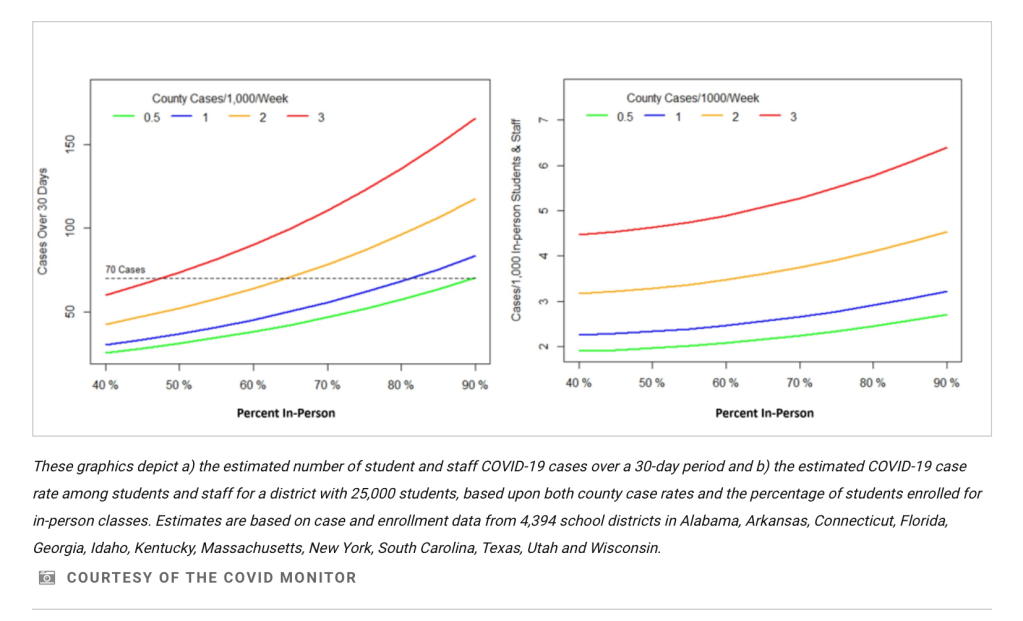
They observed that the higher the community case rate, the higher the school district case rate, as depicted in the graphic below.
They found that case rates for school districts are often much higher than case rates in the community. Meanwhile, within their data, a recent review of school district case rates based on total enrollment showed that less than 3% of all districts reporting two or more cases met a lowest-risk, case-rate threshold advised by the CDC for communities.
They also show that the percentage of students enrolled for in-person classes directly impacts the case rate in school districts. A recent study based on their data found school districts can reduce COVID-19 case rates by about 40% by reducing the in-person class size by 50%.
Based on data from Florida, their data show that school districts without mask mandates have an average case rate (12.1 per 1,000) nearly twice as high as those with mask mandates (6.9 per 1,000).
Do you come away from this independent national data thinking that schools are safe to reopen under current circumstances and do not contribute to the spread of the virus?
Also, there is worrisome new data. @DrEricDing say “new B117 Covid variant is not only more infectious, it’s potentially more infectious in children 0-9 (+24%) and 10-19 (+14%), and less among 60-79, compared to common strains. More sobering—the R estimate is much higher.” See more at this thread h/t to LH.
Arguments about social and mental well-being of students due to online learning have been made by experts in various fields. However, now that we have data, research and experience strongly indicates we need to prioritize the health of communities in the midst of a worldwide pandemic. We must do this until ALL states prioritize the vaccination of educators and provide the financial and strategic resources to reopen safely. States should immediately prioritize this goal so that we can both address the social and mental well-being of students as well as protect the health of the nation.
We’ve seen how problematic and absent leadership has led to less than a quarter of Covid vaccines (as of right now) being used for vaccinations in Florida, Texas and other states. Yet many states are insisting and placing enormous political and financial pressure on school to reopen. It’s a severe and gross failure of leadership to allow vaccines to sit on shelves and at the same time demand educators reopen schools. I have been impressed by the leadership in Kentucky prioritizing educators for inoculation as a high priority group so that schools can reopen more safely. Furthermore, absent inoculating all educators and providing the financial and strategic resources for districts to reopen schools safely (i.e. PPE, smaller class sizes etc.) for students and families, President-elect Joe Biden’s promise to open all schools in the first 100 days is a problem and a national disaster waiting to happen. I am sure President-Elect Joe Biden is aware that Secretary of Education-Designate Cardona pressured schools to reopen in Connecticut throughout 2019. So, considering the current knowledge in the data and science, it is my hope that Biden and Cardona get it right on school reopening in the upcoming months, otherwise history and voters won’t be kind.
Please Facebook Like, Tweet, etc below and/or reblog to share this discussion with others.