Latest News and Comment from Education

Showing posts with label SALON. Show all posts

Tuesday, April 27, 2021

Push to bar trans students from school sports hits legal roadblock | Salon.com

Push to bar trans students from school sports hits legal roadblock | Salon.com
Push to bar trans students from school sports hits legal roadblock
Judge tosses suit trying to block trans athletes


On Sunday, a federal judge threw out a Connecticut lawsuit that sought to bar transgender athletes from participating in high school girls' sports teams.

The suit, brought by four cisgender runners — Selina Soule, Chelsea Mitchell, Alanna Smith, and Ashley Nicoletti – was filed against the Connecticut Interscholastic Athletic Conference (CIAC), a governing state body which sets the requirements for student athletic participation. The suit alleges that "CIAC policy puts non-transgender girls at a competitive disadvantage in girls' track and, as a result, denies them rights guaranteed by Title IX." The plaintiffs specifically claim to have been deprived of titles and opportunities as a result of their competitive disadvantage, according to AP News

The presiding judge over the case, U.S. District Judge Robert Chatigny, dismissed the suit because the two transgender athletes – who the plaintiffs allege held a competitive advantage – have since graduated from high school.

"I conclude that the request to enjoin enforcement of the CIAC policy has become moot due to the graduation of Yearwood and Miller, whose participation in girls' track provided the impetus for this action," Chatigny wrote. "There is no indication that Smith and Nicoletti will encounter competition by a transgender student in a CIAC-sponsored event next season."

Chatigny argued that the plaintiffs were no longer harmed by the damages they brought forth, seeing as they were no longer competing against transgender athletes. "If it turns out that a transgender student does register to compete in girls' track next season," the judge added, "Smith and Nicoletti will be able to file a new action under Title IX along with a motion for a preliminary injunction." CONTINUE READING: Push to bar trans students from school sports hits legal roadblock | Salon.com

Sunday, April 11, 2021

Students didn't just learn nothing during school closures — they actually regressed, study says | Salon.com

Students didn't just learn nothing during school closures — they actually regressed, study says | Salon.com
Students didn't just learn nothing during school closures — they actually regressed, study says
Researchers say students "made little or no progress while learning from home" — and many suffered "learning loss"


A new study published in the Proceedings of the National Academy of Sciences, the pandemic caused "the largest disruption to education in history" — and children are suffering from learning loss as a result.

The study, which was co-authored by researchers affiliated with the University of Oxford, analyzed national examinations that occurred in the Netherlands both during and after their school lockdowns. They selected that country because the lockdown there was brief, schools there receiving equitable funding and the nation has "world-leading rates of broadband access." In other words, it provided a "best-case" scenario for people who hope that children aren't learning less as a result of the pandemic lockdowns.

Yet despite the country's "favorable conditions" for education, researchers found that students "made little or no progress while learning from home."

"Learning loss was most pronounced among students from disadvantaged homes," the authors write.

The study has far-reaching implications for the global state of education during the pandemic, particularly at the primary and secondary level. In the United States, most states closed schools at first before enacting remote learning plans involving so-called "Zoom classrooms," named for the eponymous video conference app. Some schools have reopened since, though school reopening plans vary tremendously among districts and public or private schools. CONTINUE READING: Students didn't just learn nothing during school closures — they actually regressed, study says | Salon.com

Wednesday, April 7, 2021

Betsy DeVos’ hand-picked candidate for Wisconsin state school superintendent loses | Salon.com

Betsy DeVos’ hand-picked candidate for Wisconsin state school superintendent loses | Salon.com
Betsy DeVos’ hand-picked candidate for Wisconsin state school superintendent loses
The race became somewhat nationalized with the charter school industry fighting Underly, who was backed by unions


Jill Underly has officially been elected as the new Wisconsin state school superintendent, local news stations reported Tuesday evening.

"State superintendent candidate Deborah Kerr solicited clients and organized branding for her private consulting business through her public school district email address, including several times during work hours, prior to her retirement as Brown Deer School District superintendent last year," said the report.

The race became somewhat nationalized with the charter school industry fighting Underly, who was backed by teachers' unions. Ultimately the normally unnoticed state-wide race brought in over $1 million in out-of-state money, TMJ4 reported.

Betsy DeVos’ hand-picked candidate for Wisconsin state school superintendent loses | Salon.com

Friday, March 12, 2021

Bowman and education experts blast Biden admin for mandating standardized tests amid pandemic | Salon com

Bowman and education experts blast Biden admin for mandating standardized tests amid pandemic | Salon.com
Bowman and education experts blast Biden admin for mandating standardized tests amid pandemic
"It's a mistake that reflects a broader problem in American education," Rep. Jamaal Bowman wrote in a statement


Rep. Jamaal Bowman on Tuesday joined progressive education experts in criticizing the Biden administration's decision to mandate standardized testing in schools despite the ongoing coronavirus pandemic. 

Bowman (D-N.Y.)—a former teacher and principal—argued that "prioritizing testing in the middle of the pandemic is a big mistake."

"It's a mistake that reflects a broader problem in American education," the first-term congressman said in a statement. "We have an obsession with arbitrary testing metrics above all else, even in the middle of a pandemic that's dislodged every facet of American life. We've forgotten that testing is one useful tool, and should not be the goal of education in and of itself."

"The pandemic created the world's largest education crisis," asserted Bowman. "All students were impacted, but we know which students took the hardest hit... We must empower educators to provide the best learning environment possible for students. This is not the time to waste time. Let's dive into action to fix the problems we already know exist."

Bowman's statement follows a letter sent Monday by acting Assistant Education Secretary Ian Rosenblum to state school superintendents informing them that the department will not invite state requests for "blanket waivers of assessments" required by the Every Student Succeeds Act, even though such waivers were granted last year CONTINUE READING: Bowman and education experts blast Biden admin for mandating standardized tests amid pandemic | Salon.com


Sunday, March 7, 2021

Teachers are terrified that experts don't really know how risky re-opening schools is | Salon com

Teachers are terrified that experts don't really know how risky re-opening schools is | Salon.com
Teachers are terrified that experts don't really know how risky re-opening schools is
"You can’t say what is the risk" for unvaccinated teachers, Fauci tells the press


Forty-five days into President Biden's term, he and his administration have somewhat improved public health messaging compared to his predecessor's admittedly low bar. But they hit turbulence when they pressed for the return of in person school instruction, and the assertion it wasn't necessary for teachers to be vaccinated first because the Centers for Disease Control and Prevention (CDC) claimed that schools could be relatively safe.

The most high-profile support for this assertion is the New York City public school re-opening, which is being held up as a national model.

"Nowhere in the country has indoor, in-person learning resumed on such a large scale so safely," opined the New York Daily News recently. "And while much remains in allowing high-schoolers to return and letting remote K-8 families opt back in, the city's plan has all but been copied by the CDC on how to do it right."

The newspaper went on to credit Mayor Bill de Blasio and outgoing school chancellor Richard Caranza for the successful return of hundreds of thousands of kids to the classroom "essentially virus free."

The Daily News made no mention of the essential role played by the United Federation of Teachers, the Council of School Supervisors and Administrators and the tens of thousands of staff that implemented a complex and expensive plan that included mandatory testing of 20 percent of all of the staff and students in each school. CONTINUE READING: Teachers are terrified that experts don't really know how risky re-opening schools is | Salon.com

Monday, February 15, 2021

Why is California rushing to reopen its schools? Most simply aren't ready | Salon.com

Why is California rushing to reopen its schools? Most simply aren't ready | Salon.com
Why is California rushing to reopen its schools? Most simply aren't ready
Newsom says schools can reopen safely, but many campuses can’t meet the state’s recent guidelines for being open


It's sorely tempting to reduce California's ragged school reopening effort to a couple of central forces. On one side, Gov. Gavin Newsom has maintained that campuses can open safely before all teachers are vaccinated against COVID-19 and expressed frustration over the prospect of long delays. On the other, five teachers unions recently set conditions that make such a spring return seem wildly far-fetched. (Disclosure: Several of the unions are financial supporters of this website.)

Below the waterline, however, this is a story playing out on several complex levels. They involve basic safety practices, adherence to science, the question of what "risk" even means in this context and the looming concern that a return to school under lax protocols will further race and income driven inequities that already pockmark the timeline of COVID-19 cases and deaths across the state.

And there is one number that ultimately trumps all others: 1,037. That is the number of school districts in California – and each will act in its own best interests.

"Everything is at the order of the district and the county," said Chris Nixon, a teacher in the giant Elk Grove Unified School District near Sacramento. "What happens in one district isn't necessarily going to happen in another."

In Los Angeles Unified, by far the largest district in the state, officials have resolutely refused to consider broad reopening, given that the communities it serves remain in the state's highest tier (purple) of COVID infection rates and that the state's teachers and staffers have no apparent priority for vaccination. CONTINUE READING: Why is California rushing to reopen its schools? Most simply aren't ready | Salon.com

Sunday, January 17, 2021

Treating public schools like businesses is only making them worse | Salon.com

Treating public schools like businesses is only making them worse | Salon.com
Treating public schools like businesses is only making them worse
Schools have come to resemble businesses, with corporate metrics for measuring success and worse outcomes for kids


In the early 2000s, the U.S. adopted a model of education that promised to jumpstart the performance of failing students and hold teachers and administrators accountable. While well-intended, the means they employed were rooted in a market-based strategy that didn't recognize, much less address, the profound structural causes of school and student underperformance.  The three most formative pieces of education legislation of this era were the No Child Left Behind Act (NCLB) of 2001; the Race to the Top Act (RTTT), signed in 2009 by President Obama; and the Every Student Succeeds Act (ESSA) of 2015, also signed into law by Obama. Each one doubled down on a pay-for-performance model that robs teachers of their ability to be creative and dehumanizes students.

In a recent chapter in education legislation, President Trump signed an Executive Order authorizing the use of funds from the Community Services Block Grant by students who are denied in-person learning. The order permits the use of money for a wide range of private school opportunities. This may appeal to some who are frustrated with the state of education, but it risks further draining funds from the public school system and harming the common good that is public education.

No Child Left Behind was signed into law in 2002 and used student test scores to gauge which schools were performing at acceptable levels. The concept of "teaching to the test" was born. And later on, Race to the Top (RTTT) was a competitive grant implemented by the Obama administration, in 2009-2010 only, as part of the American Recovery and Reinvestment Act. RTTT solidified the reliance upon student test scores as a condition for increased funding. While these flagship pieces of legislation relied on components of a capitalist market supply and demand model to produce innovation, they ultimately fostered a climate of toxic competitiveness and anxiety. Sadly, in 2015 NCLB was re-authorized for 50 years as the Every Student Succeeds Act (ESSA), further cementing an educational climate of test and punish with regards to funding.

The incoming Biden administration is facing unrivaled crises of humanity. It needs to CONTINUE READING: Treating public schools like businesses is only making them worse | Salon.com

Saturday, January 16, 2021

Through her divisive rhetoric, Education Secretary DeVos leaves a troubled legacy of her own | Salon.com

Through her divisive rhetoric, Education Secretary DeVos leaves a troubled legacy of her own | Salon.com
Through her divisive rhetoric, Education Secretary DeVos leaves a troubled legacy of her own
U.S. Secretary of Education Betsy DeVos has resigned. Five experts comment on the impact she had on education


Editor's note: U.S. Secretary of Education Betsy DeVos resigned from her post effective Jan. 8, 2021, saying there was "no mistaking" the impact that President Donald Trump's rhetoric had on the insurrection at the U.S. Capitol. Here, five scholars offer their views on DeVos' legacy at the federal agency she headed for four years.

Mark Hlavacik, associate professor of communication studies, University of North Texas:

In her resignation letter, Secretary of Education Betsy DeVos explained that her sudden departure from the administration was motivated by President Donald Trump's incendiary words to the crowd that went on to ransack the U.S. Capitol on Jan. 6.

"There is no mistaking the impact your rhetoric had on the situation," she declared, "and it is the inflection point for me."

Interestingly, DeVos has a history of using some rather caustic and divisive language herself. Although she never encouraged or condoned the use of force to achieve political ends, her insulting characterizations of public educators as "sycophant[s] of the 'system'" and "Chicken Littles" will leave a troubled legacy of their own.

Much like democracy, public education is an enterprise that relies on a basic civic faith that Americans can come together as a nation and in their communities to do worthwhile things that benefit all. Traditionally, the secretary of education plays a key role as a rhetorical leader who brings the country together to face its educational challenges. But that has rarely been the case with DeVos.

As recently as October she used her position to warn that an "unholy mob" of young socialists who "hate freedom" are using a "Marxist playbook" to attack "the family." Rhetoric like that in her speech to Hillsdale College reflects an affinity for blaming that DeVos shares with her former boss.

As I have warned elsewhere, such routine blaming leaves the impression that any CONTINUE READING: Through her divisive rhetoric, Education Secretary DeVos leaves a troubled legacy of her own | Salon.com

Tuesday, January 12, 2021

Is it safe to send your kids to school? | Salon.com

Is it safe to send your kids to school? | Salon.com
Is it safe to send your kids to school?
Health experts worry the issue has become politicized, and argue it's safer than one might think — with a catch


Ten months into the pandemic, the prospect of reopening K-12 schools is divisive. Yet unlike wearing a mask to stop the spread of the virus — a politicized act which is scientifically proven to work — there is far more nuance between the "right" and "wrong" option for in-person schooling. And it can be wildly variable depending on the region.

Recently, Chicago has found itself facing this very question of reopening schools. Mayor Lori Lightfoot hoped to reopen public schools today for the first time since March, though her plans faced fierce opposition from the teachers' union. Emily Oster, an economics professor at Brown University, told the New York Times that the Chicago school reopening was "probably the most contentious and unpleasant reopening, in terms of how the different sides are interacting with each other."

Indeed, the stand-off in Chicago is a microcosm of the tensions that many communities have faced throughout the pandemic. From an education standpoint, some are concerned that their children will be set back; from a social standpoint, some children are more safe at schools than at home if they live with abusive guardians.

Yet from a public health perspective, congregating in schools increases the probability of transmission to or from students and teachers. That fear is heightened if there is an immunocompromised parent or grandparent living in the house.

Perhaps, then, the matter comes down to how much one trusts masks and distancing guidelines. In search of ascertaining what is the "safest" option for children, Salon interviewed three medical experts who unanimously agreed: sending children to school is safe if the proper precautions are being taken — and those precautions should be a priority for policymakers, community leaders, and parents alike. CONTINUE READING: Is it safe to send your kids to school? | Salon.com

Saturday, January 2, 2021

From IQ tests and sperm banks to "The Queen’s Gambit": a history of gifted children | Salon.com

From IQ tests and sperm banks to "The Queen’s Gambit": a history of gifted children | Salon.com
From IQ tests and sperm banks to "The Queen’s Gambit": a history of gifted children
While identifying gifted children has helped some receive needed attention, it has sent us down a dangerous path


In Netflix hit "The Queen's Gambit," we see young orphan Beth Harmon discover her talent for competitive chess. During a game played in the orphanage basement, Harmon's chess tutor, the janitor, tells the nine-year-old: "To tell you the truth of it, child, you're astounding" — contrasting her youth and naivety to her seemingly inherent gift.

The series ends with Harmon as a young woman, competing in chess competitions at the highest level. The executive producer of the series, William Horberg, has said that they're unlikely to make a second series. "Maybe we can just let the audience imagine what comes next," he told Town and Country magazine.

My research looks into the question of "what next?" for so-called child geniuses like Beth Harmon, and how the "gifted" label affects their lives.

Growing up gifted

Interest in measuring the intelligence of children grew during the 20th century. The first IQ tests were developed in the early 1900s, looking to identify children in need of educational support. Later evaluations used IQ testing but also hormonal levels, patterns of sleep, metabolism, blood markers or genetics to try to understand and quantify "intelligence". CONTINUE READING: From IQ tests and sperm banks to "The Queen’s Gambit": a history of gifted children | Salon.com

Sunday, December 27, 2020

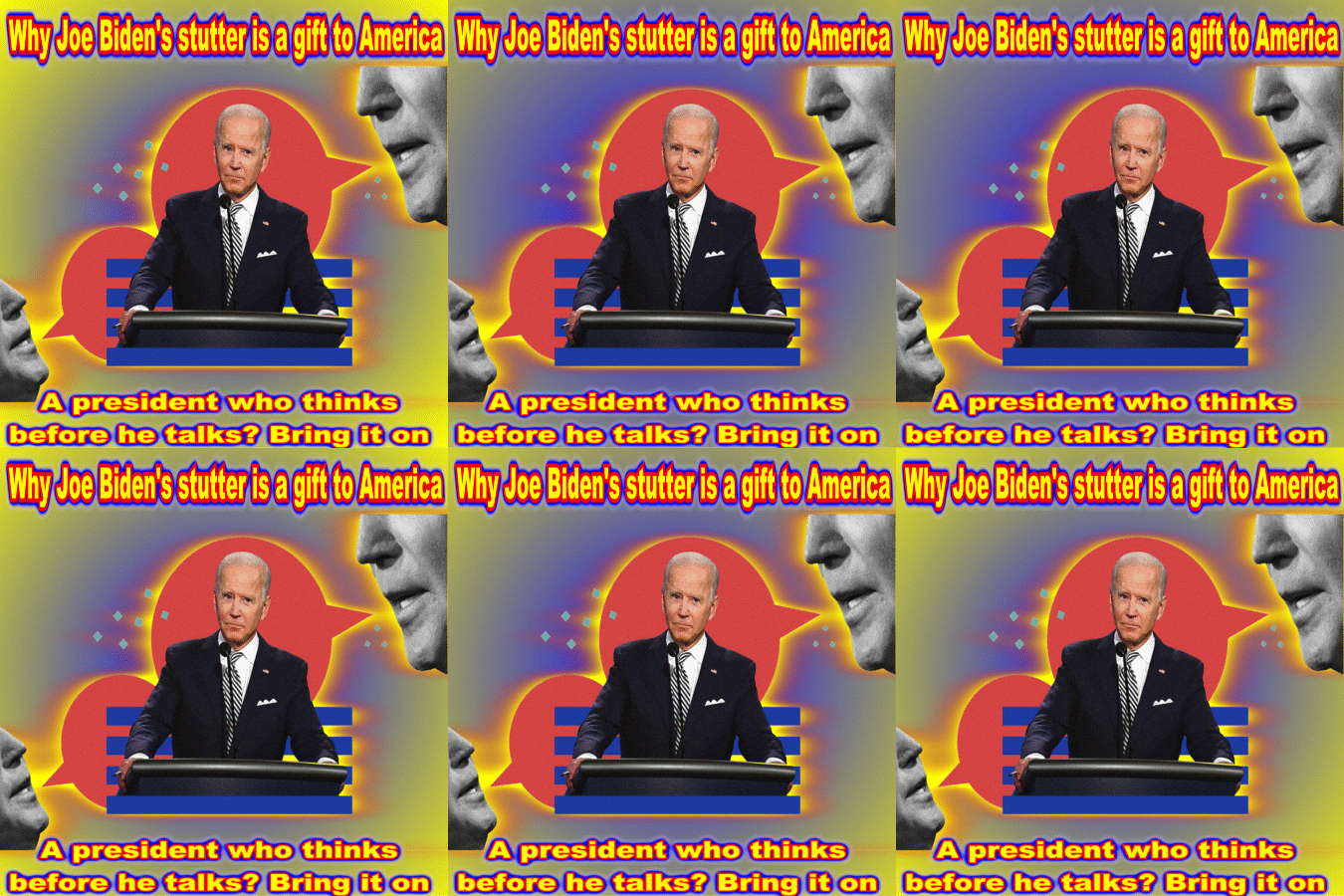
Why Joe Biden's stutter is a gift to America | Salon.com

Why Joe Biden's stutter is a gift to America | Salon.com
Why Joe Biden's stutter is a gift to America
A president who thinks before he talks? Bring it on


In the clip, Donald Trump is standing before a throng of his worshippers, musing about character and how it is shaped by circumstances. "Can you imagine if that happened to me?" he asks, throwing out a hypothetical. "Man, would I be a bad guy. I would be the meanest man in history." It is February of 2020, and he is speaking of the man who will defeat him in nine months. "Biden is angry. Biden is angry, everything is anger," Trump continues, adding, "and that's what happens when you can't get the words out. That's what happens when you can't get the words out. You get angry." Donald Trump, who sees himself as a not angrynot badnot mean individual, is apparently imagining himself here horribly warped by a characteristic the president-elect himself wears with pride: his stutter.

That one of the most important communications positions in the world will soon be held by a man who grew up with a speech disorder is, on the surface, an achievement. It definitely takes some of the air out of the mockery, 

misunderstanding and snide derision Biden has endured in past several years, notably from Trump's inner circle. In January, Lara Trump declared that "Every time he comes on stage, I'm like, 'Joe, can you get it out? Let's get the words out, Joe." When confronted about it later on CNN, she did not improve the narrative by insisting that what she meant was that Biden has "very clearly a cognitive decline." Similarly, a year ago, Eric Trump sneered to Fox News that "Biden can't get through two sentences without stuttering." CONTINUE READING: Why Joe Biden's stutter is a gift to America | Salon.com

Sunday, December 6, 2020

America's children are facing a mental health crisis that no one is talking about | Salon.com

America's children are facing a mental health crisis that no one is talking about | Salon.com
America's children are facing a mental health crisis that no one is talking about
Mental health-related hospital visits for children are way up, as kids’ lives are disrupted by the pandemic


With a third wave of COVID-19 infections sweeping the United States and widespread infection around the world, some schools are grappling with how to stay open safely, while others remain shuttered with remote learning curricula. 

For many children, this new wave of infections will mean additional disruptions to their daily lives: reduced access to nutritious food, less physical activity, perhaps even limits on playtime with friends. Taken together, these and other overlapping impacts affect both their physical and mental health.

I've worked on health issues around the globe for decades, including during the Ebola epidemic and other crises. Though the pandemic has created global health challenges previously unseen, as president and CEO of UNICEF USA, I know that children are becoming the hidden victims of the pandemic.

A new CDC analysis finds that since 2019, the proportion of mental health-related emergency room visits for children aged 5 to 11 and 12 to 17 years increased approximately 24% and 31%, respectively. So why are more kids ending up in the emergency room for mental health issues? Part of the answer seems to be that critical mental health services, like counseling, are being disrupted by the pandemic. Indeed, a recent report found that 93% of countries worldwide are facing such disruptions. Many of those services are typically made available through schools and other community institutions, institutions that are now being forced to move online or adapt their programming.

I've seen firsthand — not just in the United States but in all corners of the globe, from Syrian refugees in Jordan to Sri Lanka — that psychosocial support for children in moments of crisis is the key to ensuring that critical years of learning are not lost. To help kids cope with this crisis today, and to reduce years of turmoil and future trauma and health impacts, governments, schools and nonprofit organizations must act urgently to expand equitable access to mental health services and other forms of psychosocial CONTINUE READING: America's children are facing a mental health crisis that no one is talking about | Salon.com

Friday, December 4, 2020

"Bye-bye, Betsy DeVos. You won't be missed," says Sanders to billionaire education secretary | Salon.com

"Bye-bye, Betsy DeVos. You won't be missed," says Sanders to billionaire education secretary | Salon.com
"Bye-bye, Betsy DeVos. You won't be missed," says Sanders to billionaire education secretary
Sanders calls DeVos "the worst education secretary in the history of America" as she attacks tuition-free college


Sen. Bernie Sanders late Tuesday called Betsy DeVos "the worst education secretary in the history of America" and made abundantly clear that he's not mourning her imminent departure after the billionaire school privatization zealot lashed out at popular proposals to cancel student loan debt and make public colleges and universities tuition-free.

"What do you call a billionaire who registered a $40 million, 164-foot yacht in the Cayman Islands to avoid $2.4 million in U.S. taxes, while undermining public schools? The worst education secretary in the history of America," tweeted the Vermont senator, a leading proponent of student debt cancellation and tuition-free higher education. "Bye-bye, Betsy DeVos. You won't be missed."

In a speech at an Education Department financial aid conference on Tuesday, the outgoing education secretary dismissed as "government gift-giving" proposals to forgive crippling student loan debt and eliminate tuition for public colleges and universities.

"We've heard shrill calls to cancel, to forgive, to make it all free. Any innocuous label out there can't obfuscate what it really is: Wrong," said DeVos, who last year proposed handing the federal government's $1.6 trillion student loan portfolio over to a "stand-alone government corporation." Critics slammed the proposal as an attempt to prevent the next president from canceling any of the debt.

President-elect Joe Biden has vowed to forgive a portion of the student debt held by tens of millions of Americans and make public colleges and universities tuition-free for families with incomes below $125,000 a year. The former vice president has not yet announced his pick to succeed DeVos. CONTINUE READING: "Bye-bye, Betsy DeVos. You won't be missed," says Sanders to billionaire education secretary | Salon.com