Latest News and Comment from Education

Showing posts with label COVID 19 RELIEF. Show all posts

Thursday, March 25, 2021

CURMUDGUCATION: Covid, Learning Loss, and Katrina 2.0

CURMUDGUCATION: Covid, Learning Loss, and Katrina 2.0
Covid, Learning Loss, and Katrina 2.0


Well, here we go.

Here's Morgan Polikoff in the Los Angles Times, explaining that we are in a terrible mess, that educational attainment, or at least test scores (as measured by another testing manufacturer) are dropping, that the mental health of children in the nation is a mess. And hurray for the Biden relief plan, which throws a pile of money at all these education. But. But but but. Our educational structures can't handle this, Polikoff argues. Too many districts with boards and parent groups and teacher unions and families and students and they just aren't up to "identifying what works and then providing it equitably to students and families." 

What does he think has to happen?

This is where state and national leaders simply must step in. They need to provide clear and specific guidance on the best ways to spend American Rescue Plan dollars to address the negative impacts of the pandemic on children and families. They must not leave decisions to local actors — burdening them with the task of figuring out what works and implementing it.

Local control is a bad thing, and it needs to be swept aside, as witnessed by the data we have so far.

Polikoff asserts that three things are needed going forward in this state-controlled education universe. And number one is measurement--academic tests, social and emotional well-being tests. And they should go on for years "so we can follow our progress well beyond the end of the pandemic." Oh, and the "measurement plans should be carefully constructed to ensure the results are directly CONTINUE READING: CURMUDGUCATION: Covid, Learning Loss, and Katrina 2.0

Sunday, March 14, 2021

Ed Notes Online: Outrage at Randi Grows -- Schumer and a Teachers’ Union Leader Secure Billions for Private Schools, NYT -- Oh, the Optics

Ed Notes Online: Outrage at Randi Grows -- Schumer and a Teachers’ Union Leader Secure Billions for Private Schools, NYT -- Oh, the Optics
Outrage at Randi Grows -- Schumer and a Teachers’ Union Leader Secure Billions for Private Schools, NYT -- Oh, the Optics


"This one is too much - good old Randi and Chuck" - Email from retired teacher

The pandemic relief bill includes $2.75 billion for private schools. How it got there is an unlikely political tale, involving Orthodox Jewish lobbying, the Senate majority leader and a teachers’ union president... NYT

Last year, Ms. Weingarten led calls to reject orders from Ms. DeVos to force public school districts to increase the amount of federal relief funding they share with private schools, beyond what the law required to help them recover.

Randi talking out of five sides of her mouth? I'm shocked there's gambling.

“We never anticipated Senate Democrats would proactively choose to push us down the slippery slope of funding private schools directly,” said Sasha Pudelski, the advocacy director at AASA, the School Superintendents Association, one of the groups that wrote letters to Congress protesting the carve-out. “The floodgates are open and now with bipartisan support, why would private schools not ask for more federal money?”

Among the Democrats who were displeased with Mr. Schumer’s reversal was Speaker Nancy Pelosi of California,

Randi Weingarten, who leads one of the nation’s most powerful teachers’ unions, acknowledged that the federal government had an obligation to help all schools recover from the pandemic. 

Oy vay, Randi. You mean those Orthodox communities with some of the highest COVID numbers in the city?  Let's reward them. 

[I know I will be called antisemitic or a self-hating Jew - one day I will talk about working in a school district where a religious CONTINUE READING: Ed Notes Online: Outrage at Randi Grows -- Schumer and a Teachers’ Union Leader Secure Billions for Private Schools, NYT -- Oh, the Optics

Union Leader Weingarten: Excluding Private Schools from $1.9 Trillion Relief Would Be a Shonda | The Jewish Press

Union Leader Weingarten: Excluding Private Schools from $1.9 Trillion Relief Would Be a Shonda | The Jewish Press - JewishPress.com | David Israel | 1 Nisan 5781 – March 13, 2021 | JewishPress.com
Union Leader Weingarten: Excluding Private Schools from $1.9 Trillion Relief Would Be a Shonda


The $1.9 trillion pandemic relief law, passed by the Democrats in both houses with zero Republican support, includes close to $3 billion earmarked for private schools – quite a surprise from the pro-public school Democrats. In fact, according to the NY Times, it was teachers’ union’s leader Randi Weingarten, a champion of public education, who supported Senate Majority Leader Chuck Schumer (D-NY) in acknowledging that the federal government was obligated to help all schools recover from the pandemic (Schumer and a Teachers’ Union Leader Secure Billions for Private Schools).

Weingarten, a graduate of Yeshiva University’s Cardozo School of Law, told the Times that “the nonwealthy kids that are in parochial schools, their families don’t have means, and they’ve gone through Covid in the same way public school kids have,” adding, “All of our children need to survive, and need to recover post-Covid, and it would be a shonda if we didn’t actually provide the emotional support and nonreligious supports that all of our children need right now and in the aftermath of this emergency.”


According to the Times, Schumer was lobbied by the Orthodox Jewish community in New York City, which upset other Democrats, mostly public school advocates, who fought the Trump administration’s efforts to use the last two Covid-19 relief bills to help private schools. CONTINUE READING: Union Leader Weingarten: Excluding Private Schools from $1.9 Trillion Relief Would Be a Shonda | The Jewish Press - JewishPress.com | David Israel | 1 Nisan 5781 – March 13, 2021 | JewishPress.com


Monday, March 8, 2021

What Biden’s COVID-19 Rescue Plan Will Mean for American Poorest Children and for Our Public Education System | janresseger

What Biden’s COVID-19 Rescue Plan Will Mean for American Poorest Children and for Our Public Education System | janresseger
What Biden’s COVID-19 Rescue Plan Will Mean for American Poorest Children and for Our Public Education System


On February 27, the U.S House of Representatives passed President Joe Biden’s American Rescue Plan COVID-19 relief bill, and on Saturday, the U.S. Senate passed its version of the House bill. Nancy Pelosi says the House will promptly enact the Senate’s version, and the bill will move later this week to the President for his signature. News reports have focused on big economic elements of the relief package—unemployment relief and one-time stimulus checks, but one of the most important things about this bill has been under-reported: what the President and Congress plan to do for America’s children and their public schools.

The American Rescue Plan Supports Public Schools and the State Governments that Fund Public Schools

There has been enormous and utterly confusing guidance coming from the CDC, the White House, and mayors of big cities, all of whom want to get all children back to school in-person. But it is rarely mentioned that when the COVID-19 pandemic struck, public schools had been struggling for years with inadequate funding. Yes, schools could reopen safely if ventilation were adequate, but lots of old schools have windows that don’t open. Yes, schools could reopen safely if classes were small enough that classrooms could house all the students in desks six feet apart, but in too many classes these days, one teacher works with more than 30—sometimes even 40—students. Running school buses with social distancing would require additional buses. Because most of us don’t spend our time inside schools where we can observe the realities children and their teachers live with every day, we like to imagine that reopening schools ought to be an easy process.  But the complexities can be overwhelming and the problems expensive to address—which is why many students are still learning remotely or attending school on complicated hybrid schedules.

The new stimulus package will help school districts address the complexities. The Washington CONTINUE READING: What Biden’s COVID-19 Rescue Plan Will Mean for American Poorest Children and for Our Public Education System | janresseger

Sunday, March 7, 2021

EdAction in Congress March 7, 2021 - Education Votes

EdAction in Congress March 7, 2021 - Education Votes
EdAction in Congress March 7, 2021


American Rescue Plan Act heads back to the House

The American Rescue Plan Act passed by the Senate is heading to the House for a final vote with NEA’s top priorities intact. The bill provides $170 billion in dedicated education funding to advance the process of safely returning to in-person instruction at K-12 school buildings. At the higher education level, the funding can be used to provide institutional and student support to address the health, safety, and financial challenges created by COVID-19. An additional $350 billion in state and local aid will help avoid further layoffs of educators and other essential public servants. The bill also provides $7 billion in emergency funding for the Federal Communications Commission’s E-Rate program to address the “homework gap” and students’ lost opportunities to learn.

Other provisions include funding for the Centers for Disease Control and Prevention (CDC) to test, track, and vaccinate people; larger Affordable Care Act premium subsidies; and extending supplemental unemployment benefits through early October.

Unfortunate changes made by the Senate include eliminating the proposed increase in the federal minimum wage—from $7.25 to $15 per hour by 2025—and shrinking $1,400 checks to zero more quickly for individuals making over $75,000 and married couples making over $150,000. The Senate bill also includes a $2.75 billion set-aside for private schools. Democrats aim to enact the American Rescue Plan Act before March 14, when unemployment benefits for more than 11 million workers begin to expire. TAKE ACTION


House takes initial steps to end police brutality

In a near party-line vote of 220-212, the House passed the George Floyd Justice in Policing Act (H.R. 1280) to help end police brutality, protect civil rights and liberties, and change the culture of law enforcement agencies. These measures \ are part of Justice for Black Lives, the call to action issued by NEA’s executive committee in the wake of George Floyd’s murder and national protests against disproportionate police brutality in Black and brown communities. They include ending racial and religious profiling and no-knock warrants, mandatory de-escalation training for police, prohibiting chokeholds and other potentially fatal maneuvers like the one that killed George Floyd, and requiring police to use dashboard and body cameras. Tell your senators to support the George Floyd Justice in Policing Act. TAKE ACTION


House passes the For the People Act

Educators rally to pass the Voting Rights Amendment ActThe For the People Act (H.R. 1), the most comprehensive democracy reform bill in decades, passed the House by a vote of 220-210 last week. The measure rests on three pillars: reaffirming and expanding voting rights, strengthening oversight to end big money in politics, and ensuring an ethical government. To achieve these goals, H.R. 1 would, among other things, institute automatic voter registration and voluntary public financing of campaigns, place new limits on partisan practices like gerrymandering and purging voter rolls, and require candidates for president and vice president to release their tax returns for the previous 10 years. H.R. 1 also makes a strong argument for the District of Columbia to become the 51st state. Tell your senators to support the For the People Act. TAKE ACTION


House prepares to vote on preventing gun violence

The House could vote as soon as this week on two common-sense gun reform bills: the Bipartisan Background Checks Act (H.R. 8), which would require a background check for every gun sold and most transfers, and the Enhanced Background Checks Act (H.R. 1446), which would extend the initial background check review period from 3 to 10 days.

Like most Americans, NEA members overwhelmingly support universal background checks. Firearms are the leading cause of death for African American children, and the second leading cause of death for all American children. Everytown for Gun Safety identified 549 incidents of gunfire on school grounds between 2013 and 2019. The U.S. government’s K-12 school shooting database shows a record number of incidents of gun violence in the last 3 years—the most since 1970, which is as far back as the data goes. Help keep our students safe by requiring a background check for every gun sold. TAKE ACTION


Cheers

Sen. Chris Murphy (D-CT) and Rep. Mike Thompson (D-CA) reintroduced the Bipartisan Background Checks Act (S. 529/H.R. 8) to require a background check for every gun sold, as well as most transfers.

Sen. Richard Blumenthal (D-CT) and House Majority Whip Jim Clyburn (D-SC) reintroduced legislation to close the “Charleston loophole” that allows gun ownership to be transferred after 3 days even if the background check is incomplete. The House bill is the Enhanced Background Checks Act (H.R. 1446) and the Senate bill is the Background Check Completion Act.

Sens. Richard Burr (R-NC), Shelley Moore Capito (R-WV), Bill Cassidy (R-LA), Susan Collins (R-ME), John Cornyn (R-TX), Deb Fischer (R-NE), Chuck Grassley (R-IA), Ron Johnson (R-WI), Mitch McConnell (R-KY), Lisa Murkowski (R-AK), Rob Portman (R-OH), Mitt Romney (R-UT), Marco Rubio (R-FL), and Thom Tillis (R-NC) joined their Democratic colleagues in voting to confirm Dr. Miguel Cardona as U.S. Secretary of Education.

Michigan Democratic Reps. Rashida Tlaib, Debbie Dingell, Andy Levin, and Haley Stevens sent a letter urging the U.S. Department of Education “to approve and issue waivers for any federal testing requirements for all states who request them for this school year.”

Reps. Jared Golden (D-ME) and Ron Kind (D-WI) voted against the George Floyd Justice in Policing Act.


33 Republican senators voted against confirming Dr. Miguel Cardona as U.S. Secretary of Education.


Tuesday, March 2, 2021

NYC Public School Parents: Council Members Dromm and Treyger urge Congress to make sure while funding schools, NYS and NYC can't pull back their support at the same time

NYC Public School Parents: Council Members Dromm and Treyger urge Congress to make sure while funding schools, NYS and NYC can't pull back their support at the same time
Council Members Dromm and Treyger urge Congress to make sure while funding schools, NYS and NYC can't pull back their support at the same time


See the letter below, sent late last week from Council Members Danny Dromm and Mark Treyger, chairs of the Council Finance and Education Committees to New York Senators and our Congressional delegation, urging them to provide the additional funding our schools will need next fall to reopen safely and well, with the enhanced in-person support that students will require to recover from the huge losses they've suffered this year.

The letter also points out that the federal aid should be structured so that the state cannot simply cut education funding in the same amount as the additional aid districts receive from the federal government, as Governor Cuomo did last year with his "pandemic adjustment", cutting NYC's aid by nearly a billion dollars.

 As the Education Law Center and AQE point out in a new analysis, Cuomo threatened to do this again in his new Executive Budget, by slashing state aid by over half of the $3.85 billion in federal emergency relief funds in the previous funding passed by Congress, the Coronavirus Response and Relief Supplemental Appropriations (CRRSA) Act, funding that was meant to respond to the ongoing impacts of COVID-19, not to plug holes in state education budgets. 

At the same time, CM Dromm and CM Treyger also urged the Congress to make sure the city doesn't use these funds by withdrawing its support for schools as well:

" At the same time, include rigorous maintenance of effort provisions in the law, so that the city does not cut back on its own funding, as it is threatening to do with significant CONTINUE READING: NYC Public School Parents: Council Members Dromm and Treyger urge Congress to make sure while funding schools, NYS and NYC can't pull back their support at the same time

Friday, February 26, 2021

Audio: With One Move, Congress Could Lift Millions Of Children Out Of Poverty | 89.3 KPCC

Audio: With One Move, Congress Could Lift Millions Of Children Out Of Poverty | 89.3 KPCC
With One Move, Congress Could Lift Millions Of Children Out Of Poverty


The COVID-19 relief bill working its way through Congress is full of big ideas to help people. But there's one idea that's so big, it was politically unthinkable not that long ago.

President Biden and Democratic lawmakers want to fight child poverty by giving U.S. families a few hundred dollars every month for every child in their household — no strings attached. A kind of child allowance.

If this proposal survives the wrangling in Congress and makes it to Biden's desk, experts say it could cut child poverty nearly in half.

The idea even has some bipartisan support. Republican Sen. Mitt Romney, of Utah, has pitched his own, smaller version of a child allowance.

More than 10 million of the nation's children lived below the federal poverty line in 2019, according to the U.S. Census Bureau. And the pandemic has made life even harder for those already vulnerable families.

Over the past year, job losses have been especially concentrated among single mothers. And with so many school cafeterias still closed and unable to feed kids experiencing food insecurity, researchers are seeing alarming levels of child hunger.

Compared to other wealthy nations, the United States does little to reduce child poverty. According to the Organisation for Economic Co-operation and Development, the U.S. ranks 37th among OECD nations — barely ahead of last-place Turkey — for how little it spends on family benefits: just 0.6% of gross domestic product in 2019.

"Right now, less than 3% of families [in the U.S.] receive any kind of cash assistance," says C. Nicole Mason, who heads the Institute for Women's Policy Research. "The social safety net has all but eroded and dissipated over the last two decades or so."

To begin to repair that safety net, Democrats would give caregivers $300 a month for each child under 6, and $250 a month for older kids — for at least the next year. Romney's benefit would last beyond the one-year window and be more generous for CONTINUE READING: Audio: With One Move, Congress Could Lift Millions Of Children Out Of Poverty | 89.3 KPCC

Wednesday, February 24, 2021

Foundation Leaders Should Use Their Cash and Connections to Advocate for a Federal Racial-Equity Stimulus | Schott Foundation for Public Education

Foundation Leaders Should Use Their Cash and Connections to Advocate for a Federal Racial-Equity Stimulus | Schott Foundation for Public Education
Foundation Leaders Should Use Their Cash and Connections to Advocate for a Federal Racial-Equity Stimulus


With the stroke of a pen less than a week after his inauguration, President Biden did something no amount of philanthropic dollars could accomplish. He signed four executive orders to combat racial inequity. In quick succession, these measures strengthened anti-discrimination housing policies, ceased new federal contracts with private prisons, increased tribal sovereignty, and initiated government efforts to fight xenophobia against Asian Americans and Pacific Islanders.

These were just first steps toward the administration’s larger efforts to promote racial justice in the United States, but they should send a signal to philanthropy: All the increased giving to address systemic racism, as welcome as it is, can never substitute for the power and purse strings of the federal government. Nor should it.

Instead, philanthropic leaders should heed the words of President Franklin Roosevelt when a prominent labor and civil-rights activist urged him to take bold action against the Depression-era economy: Go out and make me do it.

At the same time, as philanthropy increases its own investments in racial equity, it can use its influence to insist on the bold solutions and government spending needed to close deep racial disparities in wealth, health, and education and put an end to discriminatory policies and practices in our criminal-justice system.

That bold action should stop at nothing short of a major federal racial-equity stimulus package.

Historically, when our nation has faced challenges so severe that normal self-correction was nearly impossible, policy makers have infused cash into the economy to stave off financial hardship and alleviate American suffering.

A little over a decade ago, the more than $800 billion American Recovery and Reinvestment Act helped pull the country out of the worst economic crisis since the Depression. The Biden administration’s $1.9 trillion coronavirus relief package, if passed by Congress, will bring total federal pandemic stimulus spending to nearly $5 trillion in less than a year.

‘More Difficult Than Rocket Science’

Eliminating 400 years of systemic racism certainly deserves a targeted economic stimulus of its own. Achieving such massive change requires a significantly greater level of resources than philanthropy has at its disposal. During the Clinton CONTINUE READING: Foundation Leaders Should Use Their Cash and Connections to Advocate for a Federal Racial-Equity Stimulus | Schott Foundation for Public Education

Monday, February 15, 2021

Biden’s Relief Package Moves Along—Including Child Tax Credit to Ameliorate Child Poverty | janresseger

Biden’s Relief Package Moves Along—Including Child Tax Credit to Ameliorate Child Poverty | janresseger
Biden’s Relief Package Moves Along—Including Child Tax Credit to Ameliorate Child Poverty


Last week, while America was reliving the January 6, 2021, insurrection at the Capitol and listening to an impeachment trial in the U.S. Senate, the U.S. House continued marking up President Joe Biden’s proposed $1.9 trillion COVID relief package. In a society that has, over the past four years, not even managed to name widespread child poverty as a problem, the new President has—by  getting to work and immediately proposing a comprehensive COVID relief package—managed entirely to change the national conversation. I clipped seven different articles last week alone on Biden’s proposed provisions to reduce child poverty.

First Focus on Children’s Bruce Lesley explains: “(T)here were 12 million children in the United States living in poverty in 2019… Even before the pandemic and recession, the kids were not alright. In an international comparison, our nation is well behind other wealthy nations in a report by UNICEF on dozens of child well-being measures, including child poverty and child mortality.  In that report, the United States ranks… 36th out of 38 countries—behind countries like Romania, Estonia, Slovakia, Latvia, Greece, Poland, Lithuania, and Malta.”  Leslie points out that 31 percent of U.S. children live below the poverty line.

Leslie highlights a key provision in the President’s proposed COVID-19 relief plan, “What stands out is the Biden-Harris proposal to make the Child Tax Credit fully refundable to help… one-third of all our kids… whose parents make too little to qualify for the full child benefit, which is $2,000 annually under current law. The legislation also raises the amount of the Child Tax Credit to $3,600 to families with children 5 and under ($300 per month) and $3,000 to families with children 6-17 years-of-age ($250 per month).”

The Child Tax Credit is exactly that: a tax credit. It works by reducing a parent’s federal CONTINUE READING: Biden’s Relief Package Moves Along—Including Child Tax Credit to Ameliorate Child Poverty | janresseger

Friday, February 12, 2021

NANCY BAILEY: $100M For Children “Learning Faster Than Ever Before” In Tennessee?!

$100M For Children “Learning Faster Than Ever Before” In Tennessee?!


Tennessee lawmakers just signed off on a $100 Million program called Reading 360. Sixty million is federal Covid-19 relief money and $40 million federal grant money. What is this? Why Tennessee? Will other states follow? While the media bombards the public with learning loss warnings, this program is about acceleration.

Fast-Track

Here’s what the brochure says. Tennessee is now in a position to not just protect students, teachers, and schools in the face of an unprecedented global pandemic, but to accelerate student learning further and faster than ever before.

Accelerate doesn’t mean catching up or identifying where a child’s working developmentally. It doesn’t mean helping children with reading difficulties.

Accelerate means hurry, hasten, quicken, rush, and fast-track.

Accelerating learning seems to be an obsession among some policymakers, and it’s hard CONTINUE READING: $100M For Children “Learning Faster Than Ever Before” In Tennessee?!

Sunday, February 7, 2021

A few thoughts on School Funding and Pandemic Relief – School Finance 101

A few thoughts on School Funding and Pandemic Relief – School Finance 101
A few thoughts on School Funding and Pandemic Relief


I keep getting asked the same questions regarding my thoughts on the current stimulus proposals for schools. So here’s a quick attempt at summarizing my thoughts.

The pandemic has had at least three different types of effects on school funding.

First, the pandemic has highlighted the need for a short term infusion of resources to make existing schools safer and healthier for existing staff and students, increasing expenses for things such as cleaning supplies, PPE and technology expansion for increased remote access. While these things can add up, they are still probably the smallest among these financial issues facing schools and states in this moment. Still, they must be addressed, both for short term purposes and so that we learn better how to handle similar situations in the future.

The second issue is the fact that the pandemic has created significant shortfalls in state budgets which have yet to be resolved by an appropriately structured federal stimulus package. When state budgets take a hit like this, and income and sales tax revenues dip, there’s usually a large sharp dip for 1 to 3 years, followed by a long slow recovery. We learned a lot from the last great recession. This one is, and will be different in some ways. State budgets and by extension general aid to local school districts will need significant general support for ongoing expenses for the CONTINUE READING: A few thoughts on School Funding and Pandemic Relief – School Finance 101

Tuesday, February 2, 2021

Republicans Want to Slash Funding for Schools in COVID Relief Bill | Diane Ravitch's blog

Republicans Want to Slash Funding for Schools in COVID Relief Bill | Diane Ravitch's blog
Republicans Want to Slash Funding for Schools in COVID Relief Bill


Politico reports that Republicans have come up with a “compromise” COVID relief bill that slashes funding for schools. President Biden has proposed a $1.9 trillion relief bill, that includes $170 billion for schools. Republicans have offered a COVID relief bill of $600 billion with a dramatic cut for schools, reducing the school aid to $20 billion. In the previous COVID relief (the CARES Act), charter schools, private schools, and religious schools received far more funding per-pupil than public schools. Republicans want public schools to reopen without the resources to reopen safely.

SENATE GOP PLAN WOULD SLASH BIDEN’S REQUEST FOR SCHOOL FUNDING: A group of 10 Republican senators is set to unveil the details today of a $600 billion counterproposal to Biden’s $1.9 trillion relief plan, and Biden plans to hear them out. White House press secretary Jen Psaki announced on Sunday evening that Biden had invited the group to the White House early this week. Her statement also touted the “substantial investment in fighting COIVD and reopening schools” in the administration’s original proposal. 

— The GOP lawmakers, led by Sen. Susan Collins (R-Maine), requested the meeting to make the case for a bipartisan deal — even as Democratic congressional CONTINUE READING: Republicans Want to Slash Funding for Schools in COVID Relief Bill | Diane Ravitch's blog

Friday, January 22, 2021

President Biden’s Proposed Economic Stimulus Plan Would Help Public Schools and Begin to Alleviate Child Poverty | janresseger

President Biden’s Proposed Economic Stimulus Plan Would Help Public Schools and Begin to Alleviate Child Poverty | janresseger
President Biden’s Proposed Economic Stimulus Plan Would Help Public Schools and Begin to Alleviate Child Poverty


President Joe Biden has proposed a new pandemic relief package, his “American Rescue Plan,” which includes essential support for public education.

For the clearest overall summary of Biden’s new COVID-19 relief plan, please read the two page statement from Sharon Parrott, the new president of the Center on Budget and Policy Priorities. Parrott explains that Biden’s relief proposal addresses the needs of individual workers and families and finally begins to relieve the budget pressures on states, tribal governments and cities resulting from the pandemic-caused economic recession.  You will notice that Parrott pays particular attention to the ways Biden’s plan addresses the needs of America’s poorest children. Here is a very quick extract:

“President… Biden’s emergency relief proposal is a substantial, responsible plan that would significantly reduce the hardship that millions of people across the country are now facing… The President’s proposal would extend a series of important relief measures…. expanded unemployment benefits for millions… the federal moratorium on evictions….  additional funding for the Low Income Home Energy Assistance Program…. (and) the recently enacted increase in SNAP benefits…. Rates of food hardship are particularly high among children.”  President Biden’s plan also temporarily expands the Child Tax Credit and Earned Income Tax Credit (EITC), which would help millions of low-income families with children and workers without minor children at home make ends meet…. The proposal would increase the amount of the Child Tax Credit and make the full credit available to the 27 million children who currently don’t get the full credit (or in some cases, any credit at all) because their incomes are too low… The plan calls for substantial additional child care funding, to supplement the funds provided in the year-end relief package. This funding could help child care providers cope with reduced enrollment due to the pandemic and with increased costs to keep children and staff safe.  It also could provide needed help to families to afford child care as more people are able to return to work.” “The proposal includes much-needed state and local government CONTINUE READING: President Biden’s Proposed Economic Stimulus Plan Would Help Public Schools and Begin to Alleviate Child Poverty | janresseger

Friday, January 15, 2021

Biden to ask for tens of billions of dollars to help open schools - The Washington Post

Biden to ask for tens of billions of dollars to help open schools - The Washington Post
Biden, aiming to reopen schools, set to request infusion of cash


President-elect Joe Biden will ask Congress for $130 billion to help K-12 schools reopen, plus billions more to implement rapid coronavirus testing in schools, a far more aggressive response than anything lawmakers have approved to date.

Another plank of Biden’s proposal, announced Thursday, aims to mount a national vaccination plan that could facilitate school reopening as well, with vaccinated teachers more willing to return to classrooms.

The proposals are part of a $1.9 trillion “rescue plan” that also includes $1,400 stimulus checks to most households and other aid to state and local governments, transition officials said. A senior official called it a “bold and historic emergency package to change the course of the pandemic.”

For schools, Biden says his goal is to have a majority open for in-person classes within 100 days of his inauguration. It’s unclear how he will measure success, and some research suggests the nation may have achieved his goal.
The Trump administration has not kept track of how many schools or school districts are open for in-person classes, and a transition spokesman said the new administration will work to improve data collection.

Biden reiterated Thursday that he would do everything he could to safely reopen “a majority of our K through 8 schools” by the end of his first 100 days.

“We can do this if we give the school districts — the schools themselves, the communities, the states — the clear guidance they need as well as the resources they need that they can’t afford right now,” he said.

Biden hopes to achieve his goal with the help of a hefty federal aid package. At $130 billion, the K-12 schools piece of his proposal is more than twice the $64 billion provided to date over two previous relief CONTINUE READING: Biden to ask for tens of billions of dollars to help open schools - The Washington Post

Tuesday, January 5, 2021

Should Private and Religious Schools Receive COVID Funds Meant to Save Small Businesses? | Diane Ravitch's blog

Should Private and Religious Schools Receive COVID Funds Meant to Save Small Businesses? | Diane Ravitch's blog
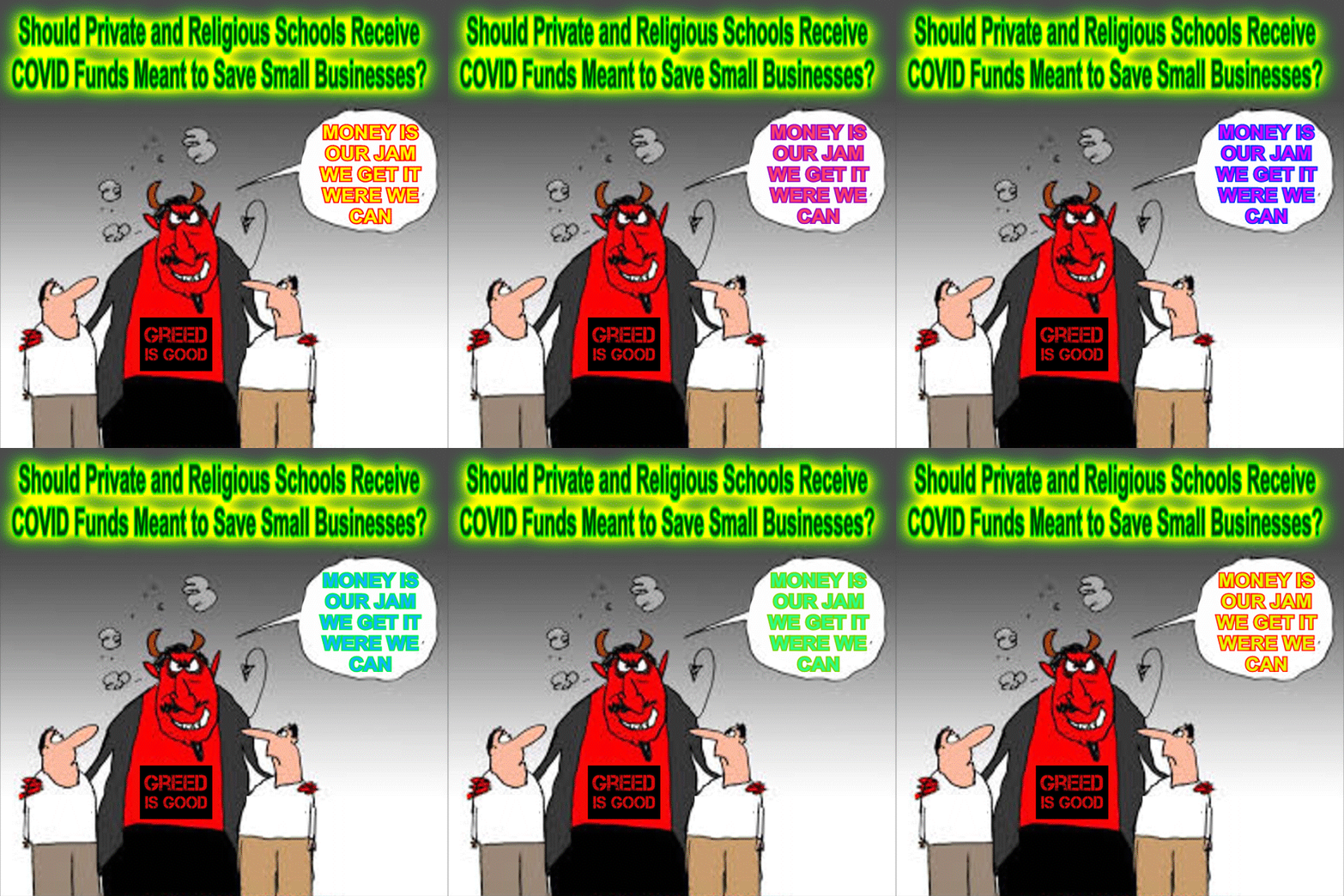
Should Private and Religious Schools Receive COVID Funds Meant to Save Small Businesses?


Last spring, when the pandemic began crippling the economy, Congress passed the $2.2 trillion CARES Act (Coronavirus Aid, Relief, and Economic Security Act). It was a rare moment of bipartisan action. Included in the act was the Paycheck Protection Program, which offered $660 billion to help small businesses weather an economic catastrophe in which many would be forced to close their doors and lay off their employees. The PPP would enable these businesses to pay their employees and survive the pandemic.

However, in the inevitable lobbying, someone added nonprofits to the list of organizations eligible to receive government aid under the PPP.

The PPP grants are called loans, but they are forgivable if used for payroll, rent, heating, and other expenses. It’s unlikely that any will be repaid.

Public schools were not eligible to apply for PPP, because they received a fund of $13.2 billion, which they were required to share with charter schools. Charter schools, however, were eligible to apply for PPP as “nonprofits,” meaning they could double dip into both funds. Over 1,200 charter schools got very generous CONTINUE READING: Should Private and Religious Schools Receive COVID Funds Meant to Save Small Businesses? | Diane Ravitch's blog