Tuesday, March 31, 2020

Teacher Tom: Teachers Are the Leading Experts on Education

Teacher Tom: Teachers Are the Leading Experts on Education

Teachers Are the Leading Experts on Education
We live in uncertain times. No one, even pandemic experts, knows what's going to happen. Yet, all day, every day, we're being offered advice, warnings, admonitions, and opinions, some of which are spot on, but most of which are, at best, partially based on incomplete knowledge, while a huge percentage of it is pure BS, including much of what's coming from the mouths of our elected leaders.


How do we know who to listen to? We check credentials, we research their backgrounds, we assess their motivations, and we check with other experts for comparison. Just the other day, I shared an opinion piece on Facebook from a well respected media outlet that offered a narrative on our current Covid-19 crisis that seemed to offer a way forward while minimizing the economic impact. Immediately after sharing it, I decided to do some quick research into the doctor who wrote it. The first four search engine search results used the word "quack" to describe him. At best he's a controversial figure, so I removed the post. I should have done the research before sharing it in the first place.

What hooked me was that what he wrote sounded perfectly reasonable to my non-expert ears. It played into some of my hopes and fears, shining with the veneer of some of the things I'd already been thinking, but done so with some CONTINUE READING: 
Teacher Tom: Teachers Are the Leading Experts on Education


Monday, March 30, 2020

How Did America’s Schools Cope with Spanish Flu vs. Coronavirus? | gadflyonthewallblog

How Did America’s Schools Cope with Spanish Flu vs. Coronavirus? | gadflyonthewallblog

How Did America’s Schools Cope with Spanish Flu vs. Coronavirus?

They say history repeats itself.
And if you’ve read any accounts of the bygone days of yesteryear, the current crisis certainly appears like a rerun.
Look at all the closed businesses, frightened people venturing out wearing face masks or self quarantined in their homes. It sure looks a lot like 1918.
The Spanish Flu epidemic that swept the nation a little more than a century ago bares more than a passing resemblance to COVID-19, the coronavirus. And the ways we are trying to cope with the situation are in many cases modeled on what worked a hundred years ago.
That’s one of the major reasons many of us today are shut in our homes waiting this whole thing out. We want to give the hospitals a chance to deal with the cases that come in without people all getting sick at once and making a run on ventilators.
However, history has less to say about how we handle things like education.
After all, our forebears didn’t have as unified a response.
In general, closing schools was better to stop the spread of disease than keeping CONTINUE READING: How Did America’s Schools Cope with Spanish Flu vs. Coronavirus? | gadflyonthewallblog

San Diego Unified Asks the State for Tens of Millions More

San Diego Unified Asks the State for Tens of Millions More

San Diego Unified Asks the State for Tens of Millions More
New costs to shift all students to online learning amid the coronavirus pandemic are expected to pile up, according to the superintendents of the San Diego Unified and Los Angeles Unified school districts, who asked state legislators for more emergency funds totaling $3 billion statewide this week.


This post originally appeared in the March 27 Sacramento Report. Get the Sacramento Report delivered to your inbox.
New costs to shift all students to online learning amid the coronavirus pandemic are expected to pile up, according to the superintendents of the San Diego Unified and Los Angeles Unified school districts, who asked state legislators for more emergency funds totaling $3 billion statewide this week. If granted, San Diego Unified would receive roughly $51.5 million in additional emergency funds for 103,000 students.
The request received a generally warm reception from some members of the San Diego delegation, including Senate President Pro Tem Toni Atkins, Assembly Republican Leader Marie Waldron and Assemblyman Todd Gloria, who expressed the most support. Assemblywoman Lorena Gonzalez had a chillier response and wanted to see the schools’ plan before writing a check.
San Diego’s superintendent Cindy Marten along with Los Angeles Unified chief Austin Beutner requested an extra $500 per student Monday, beyond their routine funding and the $100 million in state emergency funds already given to schools statewide for cleaning and protective gear.
Details about what exactly the districts want to spend that money on are scant, though Los Angeles Unified said in the press release it’s already spending $100 million to purchase 150,000 devices and provide internet for students who don’t have it, and online training for educators CONTINUE READING: San Diego Unified Asks the State for Tens of Millions More

Wired: Billionaire Philanthropists Should Not Be Responsible for Solving Public Problems | Diane Ravitch's blog

Wired: Billionaire Philanthropists Should Not Be Responsible for Solving Public Problems | Diane Ravitch's blog

Wired: Billionaire Philanthropists Should Not Be Responsible for Solving Public Problems

Rob Reich and Mohit Mookim write in “Wired” about the efforts by Bill Gates, the Chan Zuckerberg Initiative, and Chinese billionaire Jack Ma to step in and do what the federal government has failed to do in responding to the coronavirus pandemic.
They warn:
Public health is a paradigmatic public good. We should never be dependent on the whims of wealthy donors—as philanthropy is increasingly dominated by the wealthy—for our collective health and well-being.
That would be a betrayal of democracy. Rather than democratic processes determining our collective needs and how to address them, the wealthy would decide for us. We wanted rule by the many; we may get rule by the rich.

The coronavirus pandemic presents us with an immediate need for a response and it reminds us of the importance to invest so that we avoid preventable disasters in the future. At the moment, it’s all hands on deck for the emergency. But this is not what big CONTINUE READING: Wired: Billionaire Philanthropists Should Not Be Responsible for Solving Public Problems | Diane Ravitch's blog

Pushing Out Black Students With Disabilities Under COVID-19 - LA Progressive

Pushing Out Black Students With Disabilities Under COVID-19 - LA Progressive

Pushing Out Black Students With Disabilities Under COVID-19


Over the past two turbulent weeks, empty public schools and barren playgrounds have become stark symbols of how COVID-19 has exacerbated structural inequality. Massive layoffs, food insecurity, and lethal gaps in sick leave, healthcare, childcare provision, housing, and transportation have always been a way of life for people of color, but the pandemic has further exposed this Rubicon as a neoliberal nightmare—the spectral chickens of Reaganomics come to roost.

The recent wave of district-wide school closures highlights their importance as some of the few remaining public “sheltering” spaces where vulnerable children can receive wraparound social welfare services.

The recent wave of district-wide school closures highlights their importance as some of the few remaining public “sheltering” spaces where vulnerable children can receive wraparound social welfare services. The shutdowns not only impact classroom instruction, but the mental health care provided by scores of psychiatric social workers, nurses, healthy start coordinators, speech therapists, and other support staff who do their work on the precipice of budget cuts and Orwellian government bureaucracy.
For this reason, the COVID breakdown has already proven to be disastrous for children with disabilities. These youth are criminally underserved when it comes to quality classroom instruction in real time. Although they are confronted with a huge technology gap in the COVID age, the gap in instructional time and support services remains a primary issue because special needs students are even more prone to being isolated and pushed out when school schedules are disrupted.
Nationwide, approximately 67% of students with disabilities graduate from high school, versus 84% of students without disabilities. Due to deeply ingrained racist cultural expectations, poverty, and “lower” high stakes test scores, African American students are more likely to be identified as having learning disabilities. However, they typically do not receive the wraparound services that they need to support their learning and social-emotional development (there is recent datacontested by researchers at the Center for CONTINUE READING: Pushing Out Black Students With Disabilities Under COVID-19 - LA Progressive

The Pandemic Reminds Us of the Value of Public Schools | Diane Ravitch's blog

The Pandemic Reminds Us of the Value of Public Schools | Diane Ravitch's blog

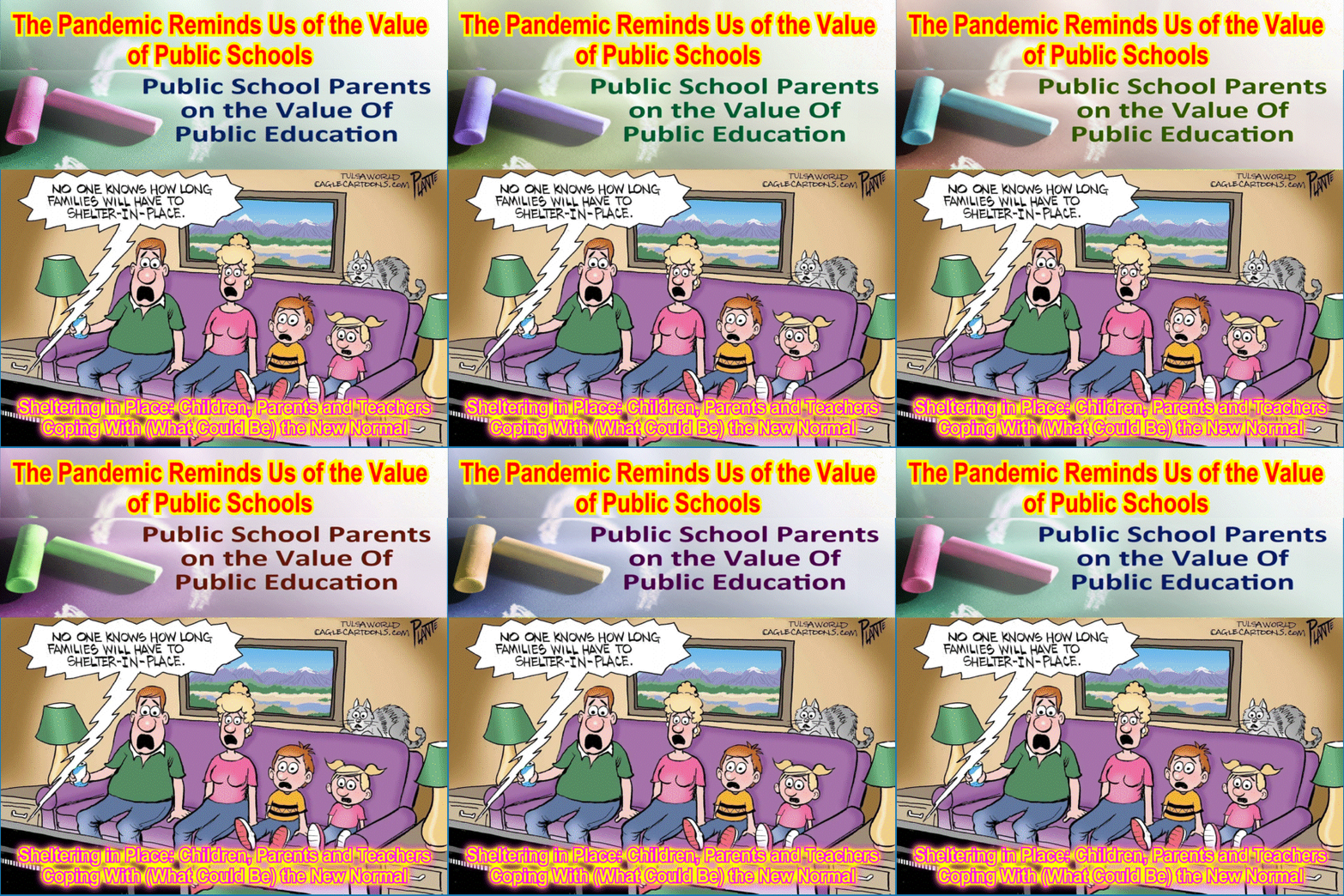
The Pandemic Reminds Us of the Value of Public Schools


The global coronavirus pandemic reminds us of the importance and value of strong, effective public institutions. We are all in this together. “Everyone for himself” is a recipe for disaster. None of us can solve the problems on our own. The only way to address the disease is by collective action and public leadership.
The widespread closure of schools has made parents and communities aware of the crucial importance of these institutions.
Donald Cohen of the nonpartisan “In the Public Interest” asks why school districts were reluctant to close the schools.
He answers:
It’s simple. Public schools are public goods. They provide basic educational, social, emotional, and even physical needs to not only students and families but also entire communities. Closing them has effects that ripple out beyond school doors. As Erica Green wrote in the New York Times, mass school closings could “upend entire cities.”
Just look at the numbers:


The nation’s public school system serves more than 50 CONTINUE READING: The Pandemic Reminds Us of the Value of Public Schools | Diane Ravitch's blog

Four things you need to know about the new reading wars

Four things you need to know about the new reading wars

Four things you need to know about the new reading wars


reading wars
A child reads a book at an elementary school in Mississippi. Kids who read more tend to score higher on reading assessments but research hasn’t been particularly supportive of using classroom time for unstructured, independent reading. Credit: Terrell Clark for The Hechinger Report
The reading wars are back, reignited by radio journalist Emily Hanford of APM Reports, who in 2018 began arguing that too many schools are ignoring the science of reading and failing to teach phonics. My news organization, The Hechinger Report, recognized the importance of Hanford’s reporting and immediately republished a print version of the story.
The debate has elicited passions, vindication for proponents of phonics and distress for defenders of a so-called “balanced” approach to reading instruction. I’ve been obsessed with the renewed controversy over how to teach reading, consuming research and talking to scholars and educators. As a journalist who regularly covers education research, I wanted to boil down the key points of what we know from the research on reading and answer the big questions that people have been asking me.
 1. Is phonics really better?


Yes, but proponents of phonics sometimes overstate how much more effective it is to teach kids the sounds that letters make. “Phonics is marginally better,” said Timothy Shanahan, a professor emeritus at the University of Illinois at CONTINUE READING: Four things you need to know about the new reading wars
Teaching children to read isn’t easy. How do kids actually learn to read? - 
teaching children to read

Week 2 – Teaching Remotely – NYC in Pandemic | JD2718

Week 2 – Teaching Remotely – NYC in Pandemic | JD2718

Week 2 – Teaching Remotely – NYC in Pandemic


There’s a lot to worry about today. Medical supplies, and infection rates. Emergency rooms. Goods in stores. Mortgage. Rent. Politics. Am I going to get it?
In the midst of all this, tens of thousands (how many are we? sixty-thousand? seventy-thousand?) New York City teachers, and thousands more counselors, therapists, paraprofessionals – we’ve reached your kids – set up something like classes – made an attempt to teach. (Also supporting – parent coordinators, school secretaries. Administrators and central staff are also involved, most support us, though some have gotten in our way, that’s a different post).
What we are doing is strange. There are elements of classes, but your kids are home. Watch a video? That’s homework. Answer questions? That’s homework. Interact with a teacher live on one of many platforms (I use Zoom and Google Meetup)? That’s homework. It’s an all-homework, all-the-time model of schooling.
(Nothing could make starker the inequities in our system than an “all-homework” school – when 10% of our students do not have a home – but that’s another discussion)
Some teachers are loud – there are things wrong, and they must be addressed. There was evil done by CONTINUE READING: Week 2 – Teaching Remotely – NYC in Pandemic | JD2718

NYC Public School Parents: How Pearson's revision of the EdTPA teacher certification process will create inequities for teachers being trained in districts with poor students by John Elfrank-Dana

NYC Public School Parents: How Pearson's revision of the EdTPA teacher certification process will create inequities for teachers being trained in districts with poor students by John Elfrank-Dana

NYC Public School Parents: How Pearson's revision of the EdTPA teacher certification process will create inequities for teachers being trained in districts with poor students by John Elfrank-Dana 

In order for NY teachers to get certification to teach, they have to produce a performance portfolio, called an EdTPA (Education Teacher Performance Assessment) administered by Pearson, an for-profit corporation who his handing the administration of this exam across the country. They charge the student teachers $300 to process their EdTPA.
Since the closure of schools throughout the states, these teacher candidates cannot complete their EdTPA in the normal way, that is via teaching lessons in the classroom, videoing some of the lessons to submit along with extended responses to questions in the assessment. Now, Pearson has said that under these novel circumstances, that student teachers may submit evidence of teaching practice via social media of their schools’ platform that links students at home with their teacher, that show video recordings of teachers engaging students in online live and asynchronous activities from home that address the standards in the EdTPA rubrics. 
This modification by Pearson presupposes these schools and districts, let alone the students, have access to high speed internet with relatively new laptops with web cams and their district a subscription to services like Google Classroom to provide the platform, which many do not. We have heard of the “digital divide”, the fact that many are not able to participate in the social media, Web 2.0, virtual world. That is still with us, as is evidenced by the need of NYC to hand out hundreds of thousands of devices (tablets and laptops) to students who do not have access. Add to that reports from some of my student teachers in NYC and Poughkeepsie that they are told by the mentor teachers in those districts that transitioning to online is not possible. Either the teachers were never trained on how to do online CONTINUE READING: NYC Public School Parents: How Pearson's revision of the EdTPA teacher certification process will create inequities for teachers being trained in districts with poor students by John Elfrank-Dana

Ditch the desk, ignore the clock and more advice on helping your kids learn -- from a teacher and former homeschooler - The Washington Post

Ditch the desk, ignore the clock and more advice on helping your kids learn -- from a teacher and former homeschooler - The Washington Post

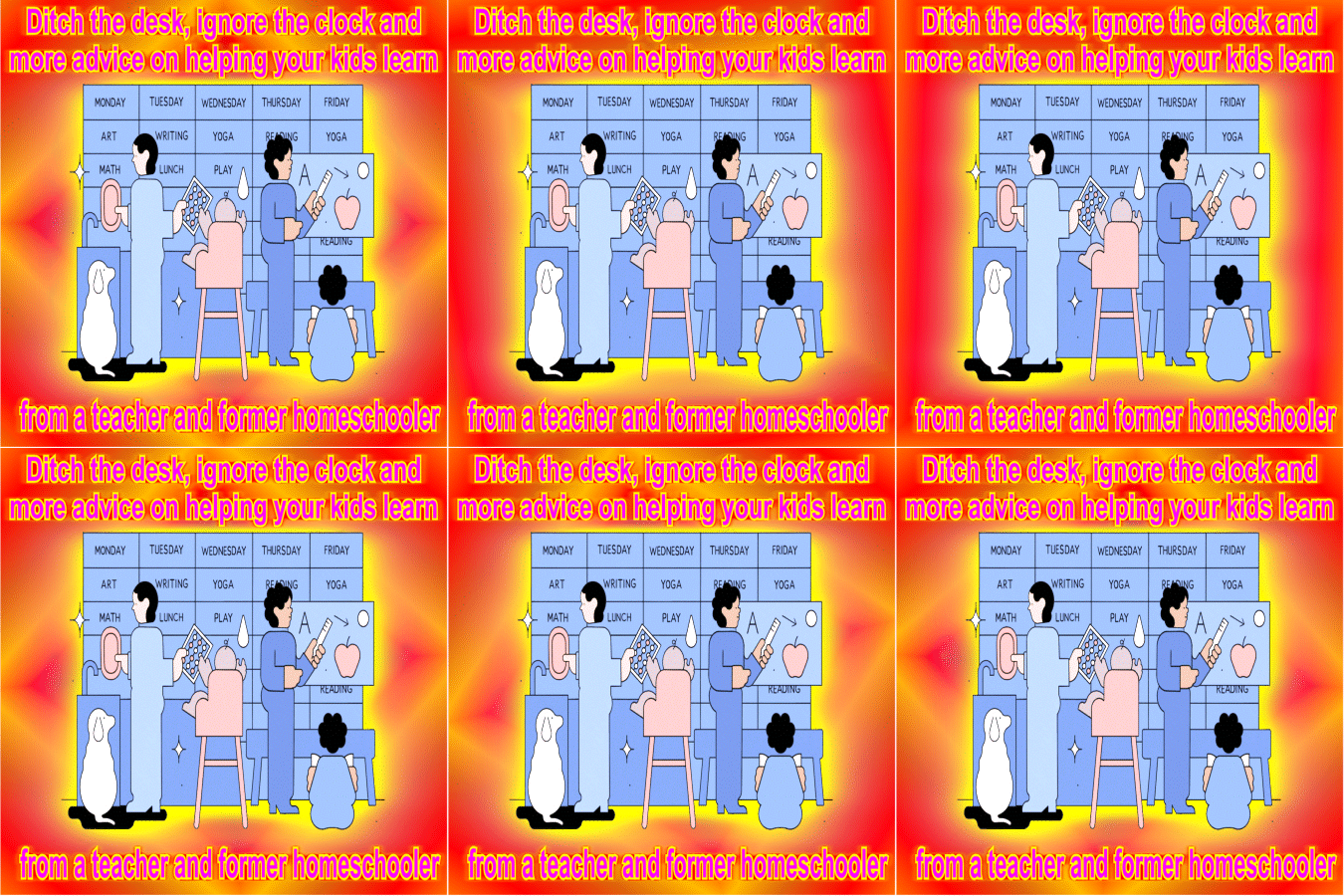
Ditch the desk, ignore the clock and more advice on helping your kids learn — from a teacher and former homeschooler


There is plenty of advice on the Internet for parents who are suddenly at home with their children because of the coronavirus crisis, trying to be good stewards of their education but not really knowing how.
And as usual with advice, you can find some that fits your own perceived ideas about how to be an impromptu teacher. Keep the kids on a strict schedule? You can find that. Don’t keep kids on a strict schedule? You can find that too. Insist your children do every assignment right away? Or don’t? It’s all there.


So what do people who have been on both sides of this — a classroom teacher and a parent who taught their children out of the classroom — actually say to do?
Here is some advice from Paula Prosper, a math teacher at Cooper Middle School in McLean, Va. She is also a mother of two children, one a high school senior and another a college sophomore. She home-schooled her children for three years when her family lived and traveled on a sail boat. From August 2016 through June 2018, her daughter was in grades 6-8 and her son was in grades 8-10.
By Paula Prosper
School at home is a new and daunting world for many of us, but a shift in perspective and expectations can help. I’m a veteran public school math teacher, but I’ve also been a home-schooler, teaching my two kids during some of their middle and high school years while we lived on our small sailboat. The coronavirus quarantine has thrown teachers and families alike into roles they were not prepared for, and many are reeling. This new learning structure is clearly not ideal. But it actually offers some ways to improve our kids’ educational experience if we adjust our thinking about it.
It’s important to differentiate between home schooling and distance learning. Those of you who sent your kids off to school each day did not sign up to be a home-school parent, so there should be no CONTINUE READING: Ditch the desk, ignore the clock and more advice on helping your kids learn -- from a teacher and former homeschooler - The Washington Post

Kevin Huffman Promotes Entrepreneurial School Agenda in Commentary about Pandemic-Driven School Closings | janresseger

Kevin Huffman Promotes Entrepreneurial School Agenda in Commentary about Pandemic-Driven School Closings | janresseger

Kevin Huffman Promotes Entrepreneurial School Agenda in Commentary about Pandemic-Driven School Closings


Kevin Huffman begins his recent Washington Post column with a warning about problems he expects to result from the widespread, coronavirus-driven school closures: “As the coronavirus pandemic closes schools, in some cases until September, American children this month met their new English, math, science and homeroom teachers: their iPads and their parents. Classes are going online, if they exist at all. The United States is embarking on a massive, months-long virtual-pedagogy experiment, and it is not likely to end well.”
This is pretty harsh. While in many places teachers are going to enormous lengths to create interesting projects to challenge children and keep them engaged, virtual schooling is a challenge. Online efforts school districts are undertaking to meet children’s needs during this long break are likely to be uneven.  Huffman describes Stanford University research on the problems with virtual schooling, problems that are being exacerbated today by inequitable access to technology.
But what Kevin Huffman neglects to tell readers is that his purpose is not entirely to analyze his subject—the ongoing shutdown of schools.  At the same time as he discusses the widespread school closure, he also manages to share the agenda of  his current employer, The City Fund, a relatively new national group that finances the election campaigns of of charter school advocates running for seats on local school boards, supports the rapid expansion of charter schools, and promotes portfolio school reform. And when the Washington Post tells CONTINUE READING: Kevin Huffman Promotes Entrepreneurial School Agenda in Commentary about Pandemic-Driven School Closings | janresseger

The New Education: Finding ways to smile in hard times–Diary of a Teacher During the Coronavirus Crisis, Entry #4 – I AM AN EDUCATOR

The New Education: Finding ways to smile in hard times–Diary of a Teacher During the Coronavirus Crisis, Entry #4 – I AM AN EDUCATOR

The New Education: Finding ways to smile in hard times–Diary of a Teacher During the Coronavirus Crisis, Entry #4


What a week.
The mounting COVID-19 crisis is wreaking havoc around the world. As of this writing there are about 726,187 confirmed cases of COVID-19 in the world and the U.S. has the highest number at 140,458–including my over 60-year-old cousin in New Orleans who I worry deeply about. Hospitals around the world are being filled beyond capacity and in places like New York City many healthcare workers don’t have enough Personal Protective Equipment to guard themselves against the disease. U.S. unemployment claims rose by 3 million this week and economy is in free fall. Many millions of students are home due to mass school closures, along with millions of their parents who are sheltering in place and/or lost their jobs.
As a teacher who is homebound due to the mass school closures, my life has changed dramatically. As readers of my ongoing diary of these times know, I am exploring in these writings what it means to turn to educating my own two elementary school kids at home—like so many millions around the country and the world. 
I have been working to find ways to continue to educate my kids without overburdening them with trying to keep them on track with their regular schooling.  The truth is our whole society and education system is on an entirely different track now—no, better put, we are off the rails all together. So instead CONTINUE READING: 

Please help stop looming budget cuts to schools! | Class Size Matters

Please help stop looming budget cuts to schools! | Class Size Matters Please help stop looming budget cuts to schools! | A clearinghouse for information on class size & the proven benefits of smaller classes
Please help stop looming budget cuts to schools!


Dear folks:  Hope you and your families are figuring out how to cope with all the new restrictions on life as we used to live it, as well as the new regime of remote learning – if that’s what your child’s school is trying to do.
1. Meanwhile, NY Governor Cuomo has signaled that he is preparing to make huge cuts in the education budget for next year and will be successful unless the State Legislature stands in his way.   The deadline on finalizing the state budget is supposed to happen this Tuesday by midnight.
Please send a message to your state legislators nowNOT to cut vital education funding, as the state can raise revenue in a variety of ways:  by increasing taxes on ultra-wealthy individuals, by taxing the carried interest income of hedge funders the same as regular income, and imposing sales taxes on the purchase of yachts and private planes, without hurting our students and schools. In most districts, schools haven’t even recovered from the 2008 recession in terms of the loss of services and increases in class size — they can’t afford to lose even more ground.  The evidence does not support the claim that this will cause millionaires and billionaires to move out of state.
 Just click here to send a message; feel free to revise it any way you like by adding your own thoughts.
2. Also, this Wed., April 1 at 10 AM, on my weekly WBAI radio show Talk out of School, we will interview Randi Weingarten, President of the American Federation of Teachers.  We will ask her about her idea that during this crisis, schools should be assigning capstone projects to students instead of following the regular curriculum.  We will also discuss  the threat of looming state and local budget cuts, the risk to student privacy of online learning, and whether she’s worried that the ed tech industry will try to use the sudden disruption of our education system  to accelerate their takeover of instruction in schools.
Please tune in at 99.5FM or online at wbai.org and call in with your questions.   Last week’s show was fascinating, which featured Akil Bello of FairTest explaining about how the  pandemic has affected standardized testing in NY and elsewhere; you can download the podcast and listen here.
Keep safe and healthy,  Leonie
Please help stop looming budget cuts to schools! | Class Size Matters Please help stop looming budget cuts to schools! | A clearinghouse for information on class size & the proven benefits of smaller classes

Mike Klonsky's Blog: Trump's crashing. Govs leading. Where's Biden?

Mike Klonsky's Blog: Trump's crashing. Govs leading. Where's Biden?

Trump's crashing. Govs leading. Where's Biden?

According to today's Washington Post-ABC poll, Trump and Biden are running neck-and-neck. One can only wonder how big a lead Biden would have if he was running as serious a campaign against DT as he is against Bernie Sanders and the party's left-wing? Since capturing the lead against Sanders in recent primaries, Biden has retreated to the sidelines as President Trump has stolen the spotlight with daily coronavirus briefings. 

But now, Trump's numbers are crashing over his handling of the coronavirus. His approval ratings have plunged a net 13 points in less than a week. At this hour of crisis, with an anxious public desperately looking for leadership, the grifter president is proving once again to be a divisive and dismal failure. Now seems like the time for Dems to take the offensive.

Latest polls also indicate:

Near-universal support for social distancing. People want it to continue as long as public health experts say it's necessary. Republicans are already trying to walk back Trump's asinine calls for "reopening the economy" by Easter and CONTINUE READING: Mike Klonsky's Blog: Trump's crashing. Govs leading. Where's Biden?

Schools Matter: Mutual Parasitism: Coronavirus and Charter Virus

Schools Matter: Mutual Parasitism: Coronavirus and Charter Virus

Mutual Parasitism: Coronavirus and Charter Virus


When Kevin Huffman left Tennessee after four years of running down the State's public schools the way his ex-wife, Michelle Rhee, did prior to being run out of Washington, DC, Tennessee's teachers and superintendents were overjoyed.  Under Huffman's toxic reign as Commissioner of Education,

[m]ore than 50 superintendents . . . publicly questioned his leadership, several teachers unions expressed "no confidence" . . .; and . . . a group of 15 Republicans . . . called for his resignation.
Many believed that Huffman's poisonous reputation among schoolmen and schoolwomen in Tennessee would guarantee him a leading role in the ongoing efforts by billionaires to monetize and privatize public education.  And sure enough, just like the vastly unpopular Chris Barbic, who mismanaged Tennessee's charter school hothouse, the Achievement School District, before he left under a cloud, Huffman landed a leading role as Partner with City Fund.

City Fund is generously supported by the same group of oligarchic high rollers who have been working to destroy public schools for the past twenty years:


. . . the [Reed] Hastings Fund, Laura and John Arnold Foundation, the Dell Foundation, and the Bill and Melinda Gates Foundation were funding the effort. The Walton Family Foundation and the Ballmer Group are also funders . . .
No doubt Huffman is now hoping for a big shipment of federal coronavirus relief dollars to his portfolio of CONTINUE READING: Schools Matter: Mutual Parasitism: Coronavirus and Charter Virus

Sunday, March 29, 2020

CATCH UP WITH CURMUDGUCATION + ICYMI: What Day Is This Edition (3/29)

CURMUDGUCATION: ICYMI: What Day Is This Edition (3/29)


What Day Is This Edition (3/29)

I feel like retirement gave me a head start, but yes-- after a while, the days kind of blend together. Still, we have some reading from the week. Remember, share safely.

The Biggest Obstacle To Moving America's Public Schools Online
Susan Adams, my editor at Forbes, takes a look at some of the problems with just tossing school onto the interwebz.

Baghian and Vallas candidates for LA state ed chief job
The indispensable Mercedes Schneider shows us once again that there is no failure that some of these reformsters can't walk away from, their reputations and careers intact and rising. Why the hell would anyone hire Paul Vallas? It's a mystery.

Misreading the main idea about reading
God bless Paul Thomas for repeatedly wading back into the current iteration of the reading wars, and thank heavens he's willing to add his expertise to the conversation.

What do we need to teach now?
A reminder from Deborah Cohan at Inside Higher Ed that we shouldn't get so distracted by the challenging how of the current situation that we lose sight of the what.

Where left and right agree on civics education.
From Education Next, a fairly well-balanced look at where the left and the right do and don't disagree when it comes to civics education.

Physical distance, social collective mourning
A personal dispatch from the JLV in NYC, where pandemic death has already hit the education community in the gut.

Online education is not winning over college students
One of the seventy-gabillion notes this week that some folks do not love the computer fed education life. From Hechinger Report.

Online Privacy Concerns
From EdWeek, a compendium of the many privacy concerns being raised as everyone rushes hook students to screens.

How about a national teacher plan?
Nancy Flanagan and friends with some important thoughts about this crisis-forged moment of opportunity. If we could rebuild from scratch, what would we build...?

Real learning in a virtual classroom is difficult 
Chris Lee, writing for Ars Technica, opens with a quote from his wife, a high school English teacher: "Remote teaching sucks. It's yucky, and it's not the future of education." He ends with a quote from one of his kidfs-- "I fucking hate it." In between some pretty thoughtful stuff about why this is not the future.

CURMUDGUCATION: ICYMI: What Day Is This Edition (3/29)

CATCH UP WITH CURMUDGUCATION

Why Teach Literature Stuff: #4 Books Versus Video
When I was teaching, and I had extra time on my hands, I would reflect on the work--the whys and hows and whats. So in solidarity with my former colleagues, I'm going to write a series about every English teacher's favorite thing-- teaching literature, and why we do it. There will be some number of posts (I don't have a plan here). Also, it would be nice to write and read about something positive
When Tech Makes Educational Decisions
"The internet is a bad place. Young people really shouldn't use it at all." The speaker was not some cranky parent or enraged luddite. It was the guy in charge of maintaining the network in my high school. In other words, the guy responsible for making sure it was possible for our students to access the internet. This was many years ago, but it slapped me upside the head with the realization that

MAR 27

Business and Humanity (When People Tell You Who They Are)
It has been a central conflict in education for decades now. Should education be organized around the needs of the business world, guided by the invisible hand in service to The Economy. We've heard it over and over again. Business is the customer for the product created by schools, so schools should be organized around cranking out the kinds of meat widgets that corporations want . And while we'r

MAR 26

Why Teach Literature Stuff: #3 Knowing Stuff Is Useful
When I was teaching, and I had extra time on my hands, I would reflect on the work--the whys and hows and whats. So in solidarity with my former colleagues, I'm going to write a series about every English teacher's favorite thing-- teaching literature, and why we do it. There will be some number of posts (I don't have a plan here). Also, it would be nice to write and read about something positive

MAR 25

Where Is Teaching's Dr. Fauci?
There are Dr. Fauci fan clubs already thriving around the country, in honor of the physician who has managed to thread the thorny needle that is being a nation's medical guide in these challenging times. He's a trusted voice, an expert in his field. He's a reminder that "leading US physician" is a thing, like the Surgeon General is a thing. So where is the Dr. Fauci for teaching? This came up in a
Why Teach Literature: #2 Humanity
When I was teaching, and I had extra time on my hands, I would reflect on the work--the whys and hows and whats. So in solidarity with my former colleagues, I'm going to write a series about every English teacher's favorite thing-- teaching literature, and why we do it. There will be some number of posts (I don't have a plan here). Also, it would be nice to write and read about something positive

MAR 24

Protecting Students In The Screen Age: An Action Tool For Parents And Teachers
It has been just a month since this piece ran at Forbes.com, but what a month. In some ways, the protections for students regarding screens are even more important. It has been a decade since I was introduced to the idea of a 1:1 classroom—a school in which every single student carried a computing device—and I never regretted it for a moment. Having those tools always at my students’ fingertips w

MAR 23

Why Teach Literature Stuff: #1 What Is It?
When I was teaching, and I had extra time on my hands, I would reflect on the work--the whys and hows and whats. So in solidarity with my former colleagues, I'm going to write a series about every English teacher's favorite thing-- teaching literature, and why we do it. There will be some number of posts (I don't have a plan here). Also, it would be nice to write and read about something positive
The Ed Tech Vultures Circle
Some ed tech companies and their investors are busily imagining that the coronaviral hiatus may be their Katrina. Natural disaster plus government botch job equals the board being swept clean, allowing players a golden opportunity to move in and clean up. I see folks on Twitter wondering where Betsy DeVos is, why the USED isn't offering more guidance to schools as they navigate this mess. Could be

MAR 22

Virus and Vouchers
US education has essentially ground to a halt. Districts have announced that no work done distantly will count, largely out of fear that they cannot properly serve IEP students and therefor distance schooling would be illegal (aka "likely to prompt a lawsuit from a special ed family's lawyer). Where distance learning is occuring, the gap between haves and have-nots is being highlighted as it grows
ICYMI: Stay In Place Edition (3/22)
Well, here we all are, in place (except for some of you who think this is a fake and some of you who think nothing should interfere with spring break). Frankly, the reading this week has been a bit....well, repetitive. But here are some things to peruse while you're holding down your couch. An Open Letter To Seniors Louisiana's teacher of the year has some thoughts for high school seniors, whose b

MAR 21

AI Is Not Going To Drive Trucks (Or Your Classroom)
From Jalopnik, we get this report from the world of self-driving truck s. Mark it the gazillionth cautionary tale for folks who believe that AI will be able to take over critical human functions any time soon. The article takes a look at Starsky Robotics, a company that was in the business of producing unmanned semis for public highways. Now it's just in the business of shutting down. The co-found

MAR 20

Don't Ever Forget How Much Some Folks Hate Public Education
Interesting piece this week in the Washington Post , penned by Stuart Stevens , a GOP non-Trump fan consultant with a book coming out. The whole piece, about how the GOP has morphed into the kind of party ripe for something like 
CURMUDGUCATION - http://curmudgucation.blogspot.com/