Latest News and Comment from Education

Monday, March 2, 2020

"What will it take to fully resource Safe and Supportive Schools in SFUSD?" - SF PUBLIC SCHOOL MOM

"What will it take to fully resource Safe and Supportive Schools in SFUSD?" - SF PUBLIC SCHOOL MOM

“What will it take to fully resource Safe and Supportive Schools in SFUSD?”


More readers weigh in on Restorative Practices…

Since I last reblogged a letter (read it in my last post) I received in response to my questioning of SFUSD staff about the Safe and Supportive Schools Policy at a recent Board Meeting, I have received even more feedback. I really respect the time, thoughtfulness and courage they shared in responding to my question: What will it take to fully resource this important policy in our district?
If you haven’t been following this topic, I’d suggest you start at the previous post in this series. I’ve also created a new category: “Safe Schools” and tags: “Restorative Practices” “Safe and Supportive Schools” and “Bullying” so readers can follow all content I post on these topics.

The first response comes from an SFUSD educator. It reads:

“Another experienced teacher seconding every point the letter writer makes. RP on the cheap – which is what we have now – is not restorative or just.

I had a very strong negative reaction to the district seeming to claim implementation is going just great, training the trainers is the way to go, etc. because I feel like they are being disingenuous.

I know from discussions with colleagues who have limited training in RP that this message is not what they want to hear. And people who oppose RP for whatever reason hear this from the district and conclude that RP is unworkable/no consequences. Which thereby decreases support for restorative justice.

There is also no support for getting staff to use restorative practices for staff discussions and issues. When I was originally trained, the importance of staff internalizing the process and building capacity/trust/belief was strongly recommended as a first step. I don’t think this happened.

My experience of RP training is that restorative justice can surface implicit white supremacy, and that naming it and pushing back (using restorative CONTINUE READING: 
"What will it take to fully resource Safe and Supportive Schools in SFUSD?" - SF PUBLIC SCHOOL MOM

Sac City Unified Approves Motion To Lay Off More Than 50 Teachers – CBS Sacramento

Sac City Unified Approves Motion To Lay Off More Than 50 Teachers – CBS Sacramento

Sac City Unified Approves Motion To Lay Off More Than 50 Teachers


SACRAMENTO (CBS13) – The Sacramento City Unified School District could soon be laying off dozens of teachers.
In a Thursday night meeting, the district approved a motion to lay off 82 full-time equivalent positions. Of those positions on the chopping block, 54 are kindergarten to twelfth-grade teachers. Another 24 of those positions are already vacant.
District officials say they expect to send out only about 33 layoff notices due to anticipated resignations or retirements.
The motion comes as the school district faces a projected budget shortfall of nearly $20 million for the 2021-22 fiscal year.
Final layoff notices are expected to go out by May 15.

A Visit with the Mother of the Resistance, Karen Lewis | Diane Ravitch's blog

A Visit with the Mother of the Resistance, Karen Lewis | Diane Ravitch's blog

A Visit with the Mother of the Resistance, Karen Lewis


Last week, I had a whirlwind visit to Chicago to talk about my new book. Fortunately before my flight to Charleston, West Virginia, I had time in the morning to visit Karen Lewis at an assisted living facility where the care is excellent.
Karen is a brilliant charismatic woman who taught science in the Chicago public schools for more than 20 years. In 2010, Karen led a faction of the Chicago Teachers union called the Caucus of Rank and File Educators, which swept to victory in the union elections. She became president of the CTU. She was a strategic organizer who worked to build alliances with parent and community groups. In 2012, the CTU voted to strike. The legislature, egged on by Gates-funded Stand for Children, passed a law that they thought would make a strike impossible by requiring a vote of 75% of the membership. Karen and her team won the approval of about 90% of the members and led a successful strike that had the support of parents and communities because they understood that teachers were striking for their children.
Karen was an articulate and greatly admired visionary. She planned to run for mayor against Rahm Emanuel in 2015, and her own polling suggested that she would beat him handily.
Tragically, Karen was diagnosed with a brain tumor in October 2014. Since then, she has had a series of setbacks, including a stroke. Life is so unfair. Karen is only 66.
When I saw her, she was happy that I visited. As I CONTINUE READING: A Visit with the Mother of the Resistance, Karen Lewis | Diane Ravitch's blog

TIME: How Michael Bloomberg Undermines Democracy by Big Spending in Local School Board Races | Diane Ravitch's blog

TIME: How Michael Bloomberg Undermines Democracy by Big Spending in Local School Board Races | Diane Ravitch's blog

TIME: How Michael Bloomberg Undermines Democracy by Big Spending in Local School Board Races


One of the themes of my new book SLAYING GOLIATH is that billionaires are disrupting education by buying control of school districts and states. That, in conjunction with the federal government’s mean-spirited and useless mandate for annual standardized testing (no high-performing nation tests every child every year in grades 3-8), has posed a mortal threat to public schools.
TIME magazine published an article showing how one of our best known billionaires, Michael Bloomberg, has undermined democracy by buying local school board races and making it impossible for local people to compete with his spending.
The article begins:
School board elections are usually local affairs, with candidates soliciting money from neighbors at pizza parties and dragging along friends to knock on doors and ask for votes.
That’s what Chris Jackson expected when he decided to run for the school board in Oakland, Calif., in 2016. He’d previously been elected to the board of the City College of San Francisco and thought he knew how to build the ground game to win in Oakland. He started gathering CONTINUE READING: TIME: How Michael Bloomberg Undermines Democracy by Big Spending in Local School Board Races | Diane Ravitch's blog


A (Brief) History Of State Takeover Of OUSD

A (Brief) History Of State Takeover Of OUSD

A (Brief) History Of State Takeover Of OUSD


For years, It is no news for residents of Los Angeles’ Oakland Unified School District (OUSD) being an experimental lab for the reformers of the corporate education system in assaulting public education
It was at the peak of its trend in 2003 at a crucial point when the OUSD came under the control of the state of California.
It was handed over to Los Angeles billionaire Eli Broad who was renowned for advocating a rather more convenient business model for education. Since then the OUSD has been transferred from one Broad graduate to another.

This transfer of control to the state of California happened because of a $37 million deficit.
Broad has an institute called the Broad’s Urban Superintendents Academy in which he had an intern named Randolph Ward, a state-appointed administrator to whose hands he vested all the powers.
An election campaign was also run for the same and ideally funded by Broad who was also asked to name the state administrator.
Thereon, Ward got in residents from Board to cater to finance, labor relations and even small school incubators and further down the memory lane is history, when CONTINUE READING: A (Brief) History Of State Takeover Of OUSD


Challenges for America’s Forgotten and Overlooked Rural Public Schools | janresseger

Challenges for America’s Forgotten and Overlooked Rural Public Schools | janresseger

Challenges for America’s Forgotten and Overlooked Rural Public Schools

Incompetence and bureaucratic rigidity in Betsy DeVos’s U.S. Department of Education is denying the nation’s poorest rural schools the delivery of federal money these districts have already budgeted for essential services.
The NY Times‘ Erica Green reported last week: “More than 800 schools stand to lose thousands of dollars from the Rural and Low-Income School Program because the department has abruptly changed how districts are to report how many of their students live in poverty. The change, quietly announced in letters to state education leaders, comes after the Education Department said a review of the program revealed that districts had ‘erroneously’ received funding because they had not met eligibility requirements outlined in the federal education law since 2002.  The department said it would strictly enforce a requirement that in order to get funding, districts must use data from the Census Bureau’s Small Area Income and Poverty Estimates…. For about 17 years, the department has allowed schools to use the percentage of students who qualify for federally subsidized free and reduced-price meals, a common proxy for school poverty rates, because census data can miss residents in rural areas.”
Senators from rural states—Maine’s Susan Collins, Montana’s Jon Tester—have protested, and it looks as though Congress and the Education Department will find a way to solve the problem.  But here is what happened in the school districts that received the notice: “The department’s notifications rattled rural districts, which have come to rely on the program to supplement the costs of services that are far less accessible to rural students, like technology, mental health and guidance counselors, and full-day kindergarten. Congress created the Rural Education Achievement Program, recognizing that rural schools lacked the resources to CONTINUE READING: Challenges for America’s Forgotten and Overlooked Rural Public Schools | janresseger

The City Fund Spending Prolifically to Privatize Public Education | tultican

The City Fund Spending Prolifically to Privatize Public Education | tultican

The City Fund Spending Prolifically to Privatize Public Education


By Thomas Ultican 3/2/2020
The City Fund has joined the Walton Foundation, the Broad Foundation, and the Chan Zuckerberg Initiative (CZI) in the upper echelon of spending to privatize public education. (Gates is in a spending zone of his own.)  City Fund grants are of the same magnitude as CZI’s and approximately half the size as those from the Walton foundation. Since its establishment in July, 2018, City Fund reports issuing $110 million in large grants defined as more than $200,000; smaller grants not accounted for. Founders John Arnold and Reed Hastings have also provided the associated political action group, Public School Allies, with $15 million.

Reorganizing and Retooling the Attack on Public Schools

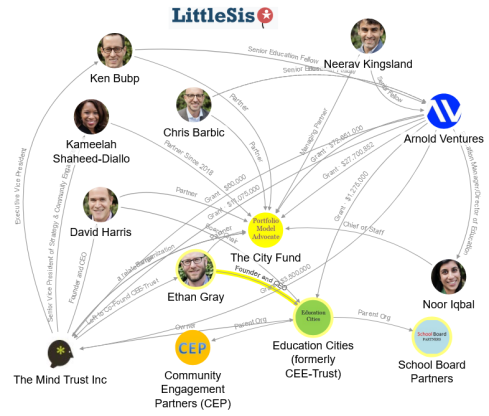
Little SiS City Fund Map
Reorganizing the Attack Little Sis Map
On the ides of March, the Indy Star reported that David Harris the CEO of Mind Trust in Indianapolis was leaving to join a new national organization. Since Julius Caesar’s assassination, events linked to the ides of March are often viewed with alarm. This event portended a reorganized attack on public education and a new billionaire financed entity dedicated to establishing the portfolio model of public school management throughout America.
Until February of 2020, the secretive City Fund did not even have a web site. On July 31, 2018, City Fund Managing Partner Neerav Kingsland took to his blog and made public The City Fund – a new non-profit – and named its founding CONTINUE READING: The City Fund Spending Prolifically to Privatize Public Education | tultican

NYC Public School Parents: Testimonies of four mothers, speaking about how their children have been affected by the unacceptably large classes in city schools

NYC Public School Parents: Testimonies of four mothers, speaking about how their children have been affected by the unacceptably large classes in city schools

Testimonies of four mothers, speaking about how their children have been affected by the unacceptably large classes in city schools


The testimonies of parents, educators and advocates at the class size hearings at City Hall on Friday were so powerful that I am going to post many of them on this blog.  Here is video of the proceedings -- nearly six hours.  The hearings would have lasted even longer if many of the parents who wanted to testify hadn't been shut out because the room was too crowded. Here's an article about the hearings from Chalkbeat.

Below are the heartbreaking statements of four mothers, Alexa Aviles, Emily Hellstrom, Karen Sprowal and Naila Rosario. Two of these mothers have children with special needs; but none of their kids were served adequately because of the unacceptably large classes in the city's public schools.

The plight of English language learners is also mentioned in Alexa Aviles' testimony, who asked, can you imagine such a child in a class of 32? It would be like trying to learn in Times Square on New Year's Eve.

Karen Sprowal's statement is especially illuminating as she points out how much the city is now paying  for her son to attend a private school where he could be provided with the smaller classes he needs -- $93,000 per year. The expense to the city of private school placements for special needs kids is growing fast -- this year more than  $325 million,  a direct result of the large classes in the city's schools that parents are so desperate to get their children out of.

As Karen put it, "Even as class size reduction may be costly, I would like the DOE and our elected officials to think about the costs of NOT lowering class size."  CONTINUE READING: 
NYC Public School Parents: Testimonies of four mothers, speaking about how their children have been affected by the unacceptably large classes in city schools


My Book, A Practical Guide to Digital Research, Is Now Available! | deutsch29

My Book, A Practical Guide to Digital Research, Is Now Available! | deutsch29

My Book, A Practical Guide to Digital Research, Is Now Available!


I just received the news in a congratulatory email from Denny Taylor of Garn Press:
My latest book, A Practical Guide to Digital Research: Getting the Facts and Rejecting the Lies, is now available for purchase on Amazon.
About the book:
In A Practical Guide to Digital Research, Schneider draws on her years of experience as an educational researcher to offer an easy-to-read, easy-to-digest, concise tutorial for equipping both novice and more experienced researchers in navigating numerous research sources. These include nonprofit tax form search engines, newspaper archives, social media sites, internet archives, campaign filings/ethics disclosures, teaching credential search engines, and legal filings. Also covered are tips on conducting both email and in-person interviews, filing public records requests, and conducting pointed, fruitful Google searches.This powerful, practical text is built upon a foundation of actual examples from Schneider’s own research in education—examples that she dissects and explains as a means of teaching her readers how to effectively make these valuable lessons their own. Though Schneider’s own research is chiefly in the education reform arena, the resources, skills and techniques offered in A Practical Guide to Digital Research transcend any single research field and are indispensable for confronting a variety of research queries. Useful as a classroom text or for independent research study, the book provides foundational learning for those new to research investigation as well as surprising, valuable lessons for more experienced researchers challenging themselves to learn even more.

For those interested, Amazon allows readers to view the book, including its table of contents.
The the idea for this book stems from a presentation I participated in with colleagues Andres Gabor and Darcie Cimarusti on tracking the funding related to the promotion of market-based education reform titled, “Where Did All This Money Come From??: Locating and Following the Dark Money Trail” at the 2018 Network for Public Education (NPE) conference in Indianapolis.
In preparing for our presentation, Darcie asked me to send her the information I wished to include on my presentation slides. In a moment, I thought, “To do this information justice, I would need to write a book.”
A Practical Guide to Digital Research is that book and then some.
Many thanks to Denny Taylor and Garn Press for their support and belief in the value of my work. 

How does the coronavirus and the stock market correction/dip/slide/plunge impact teachers and education? | Ed In The Apple

How does the coronavirus and the stock market correction/dip/slide/plunge impact teachers and education? | Ed In The Apple

How does the coronavirus and the stock market correction/dip/slide/plunge impact teachers and education?


The sudden outbreak of the coronavirus reverberated in the stock market. Over the past week the stock market, as measured by the Dow-Jones has taken a hit, meaning a drop of over three thousand points, more than 10%, a drop reminiscent of the beginning of the 2008 recession.
The economies of China, the European Union and the United States are irrevocably intertwined.  Cell phones, computers, refrigerators, thousands upon thousands of products are made in China; lower wages mean lower prices for the end use consumer. The longer the Chinese economy is stalled the greater the shortages, the higher the prices, that old supply and demand thing.
In uncertain times corporations and individuals are wary, they stash dollars in interest-bear accounts, they decide not to buy the house or buy a car or expand a business. The entire economy stalls, jobs begin to dry up as expansion moves to contraction.
How does this crisis impact schools and teachers?
If the economy slows tax revenues slow, states, and localities collect fewer dollars and state and local budgets are reduced.
In a month New York State will agree on a budget for the 20-21 year, and, the governor and the legislature are bickering over how to address a 6.1 billion dollar increase in Medicaid funding. The State Department of Education asked for a $2 billion increase in state aid,  the governor’s budget only included $800 million. CONTINUE READING: How does the coronavirus and the stock market correction/dip/slide/plunge impact teachers and education? | Ed In The Apple

Sunday, March 1, 2020

CATCH UP WITH CURMUDGUCATION + ICYMI: Making Up My Mind Edition (3/1)

CURMUDGUCATION: ICYMI: Making Up My Mind Edition (3/1)


Making Up My Mind Edition

I've held onto the privilege of not having to make up my mind about the Dem race, but more and more I find myself gravitating to Elizabeth Warren. Not perfect, but none of them are. I like her combination of policy, plan and temperament. And the whole smartness thing. Anyway. I figured you were just dying to know. Here's some reading from the week.

The Myths of Learning Styles  
From the Atlantic, a reminder that learning styles are bunk.

Budget Turmoil at Philly's Second Largest Charter School   
One more example of how charters manage to go off the rails, and avoid transparency while they're doing it.

Who's Behind America's Superintendents and School Transformation
Nancy Bailey takes a look at what's going on when the nation's school administrators get together. It is not encouraging.

We Need To Change the Law on Cyber Charter Schools
At PennLive, an op-ed arguing for PA's cyber charter policy makeover.

Michael Bloomberg's Disastrous Public Education Legacy
Plenty of New Yorkers have stepped forward to talk about what a disaster Mayor Bloomberg was. Leonie Haimson takes a particularly thorough look at how he trashed public education.

Democrats Are Asking the Wrong Questions To Protect Charter School Students
Adam Laats in the Washington Post providing another useful history lesson about clever education ideas.

Public oversight of Michigan charter school inadequate, report says
A Michigan-based research group has  issued a "scathing" report showing that Michigan's charters are seriously unmoored from necessary oversight and accountability.

Kids Don't Need To Stay 'On Track' To Succeed 
Madeline Levine in the Atlantic reminding us that success is not a straight line from A to B.

A Primer on Voucher Misinformation  
A look at the talking points for voucher fans in Ohio (and elsewhere), with a calm clear explanation of why these points don't hold water.

Public Education: A Love Story    
Finally, Nancy Flanagan with a personal reflection for Public Schools Week. Your must-read of the week.


CURMUDGUCATION: ICYMI: Making Up My Mind Edition (3/1)

CATCH UP WITH CURMUDGUCATION


What Ever Happened To AltSchool?

You remember AltSchool, the miraculous Silicon Valley technoschool that was going to Change the Game. We've checked in on them from time to time, and it's time to see what has happened since the Altschool ship ran aground on the shores of reality a while ago. After two years of tinkering and tweaking, AltSchool burst on the scene with a flurry of PR in 2015 . Founded by Max Ventilla, formerly of G

FEB 27

How Do High Expectations Change A Classroom

Teachers know that expectations matter. They know that having high expectations in a classroom can both support (“I know you can do this”) and spur (“I’m not going to accept your bare minimum effort”) students. The power of teacher expectations is part of every college’s Teacher 101. But modern education reform has weaponized the term. “The soft bigotry of low expectations,” coined by Michael Ger
6 Things To Know About The Trump-DeVos Education Freedom Plan

As expected, Trump used a chunk of his State of the Union Address to plug a voucher-style program that Secretary of Education Betsy DeVos has been pushing for months under the name “Education Freedom.” The Houston Chronicle reports that Ted Cruz pitched the plan to Trump ; Cruz has taken the lead on trying to turn DeVos’s dream into actual legislation . In fact, the Trump budget proposal favors t
Schools And Other Shared Public Spaces

One of my first jobs in education was minding the cassette player. The actual job was assistant marching band director, and my duties included chaperoning the freshman/sophomore bus to away games. It was the mid-80s, and the "good" schoolbuses in our district had built-in cassette players, and the students brought their favorite music, vying for control of the stereo that everyone had to listen to

FEB 25

Call for Federal Charter Transparency Law

We've been here before. For instance, in 2015 while Congress was wrestling with what would eventually become ESSA, Sherrod Brown introduced the Charter School Accountability Act , which had some modest goals-- require greater charter transparency, mandate some reporting from charter authorizers, and compel charter operators to talk to the community before opening up. The bill was promptly sent to

FEB 24

Montana and the Wall Between Church and State

Sarah Vowell is a fave of mine, with a fabulous grasp of US history and that special gift of being able to illuminate big ideas with the perfect specific detail, plus she has the gift of balance, of being able to recognize the god and the not-so-good, and most of, the gift of recognizing the humanity of the people she writes about. Her writing about colonial US history is excellent-- if you need

FEB 23

ICYMI: So Long, February Edition (2/22)

A reminder that you can help amplify the voices that you think need to be heard. Go to the original post and share with your network. Do your part to make sure folks are heard whose message speaks to you. Now for this week's list. Borrowing a Literacy Strategy from Band An interesting notion from Edutopia. After all, reading music is readin. "Reading in band has an additional hitch: Students have

FEB 22


Social and Emotional Learning Is Drawing Fire

I told you so. If you are of a Certain Age, you remember Outcome Based Education, the Next Big Education Thing of the 1990s . Its basic idea was to reduce education to observable behaviors-- all those lesson plans with "The Student Will Be Able To...," are artifacts of OBE. The architects were intent on reducing all learning to something cold, hard and observable instead of fuzzy objectives like "
CURMUDGUCATION - http://curmudgucation.blogspot.com/