Saturday, October 12, 2019

‘Visibly Pregnant’ Is Not What Matters Most in National Conversation around Women in Teaching | Teacher in a strange land

‘Visibly Pregnant’ Is Not What Matters Most in National Conversation around Women in Teaching | Teacher in a strange land

‘Visibly Pregnant’ Is Not What Matters Most in National Conversation around Women in Teaching

Like most women of a certain age, I identified strongly with Elizabeth Warren’s story of being shown the door once ‘visibly pregnant’—not to mention the alternative certification that got her into a classroom, and her ultimate decision to leave teaching and go to law school, rather than hurdle the licensure barriers in returning to a special education position. Millions of us have stories about becoming parents while teaching, and a lot of them aren’t pretty.
And millions of us agree with Joan Walsh: The Warren story matters because it plays into the way we’ve all been socialized to see women as untrustworthy, which, honestly folks, is gonna make it hard to elect our first woman president. Precisely.
I am gratified that so many testified that yes, Virginia, women—up through and even past the 1980s—have experienced discrimination because they were pregnant or new mothers. Other first-world nations have vastly better maternity leave practices than the United States. The thought that we might soon have a high-level champion for bringing the United States into the 21st century, vis-à-vis equitable child-bearing/rearing policy, is encouraging, even thrilling.
Still, I don’t think Elizabeth Warren represents teaching any more than I thought Laura Bush was a bona fide literacy expert, or that Karen Pence is a reliable source for policy on human rights in education. Just because you’ve been in a K-12 classroom for a CONTINUE READING: ‘Visibly Pregnant’ Is Not What Matters Most in National Conversation around Women in Teaching | Teacher in a strange land
14148971785_2bcd2f6d30_b

Rev/Dr. Anika Whitfield on Arkansas Decision to Crush Little Rock Teachers’ Union | Diane Ravitch's blog

Rev/Dr. Anika Whitfield on Arkansas Decision to Crush Little Rock Teachers’ Union | Diane Ravitch's blog

Rev/Dr. Anika Whitfield on Arkansas Decision to Crush Little Rock Teachers’ Union


Yesterday the Arkansas State Board of Education voted to return control of the Little Rock School District to the people of Little Rock. This followed massive demonstrations and demands by the citizenry. At the same meeting, the board voted unanimously to deny recognition to the Little Rock Educators Association, which represents 60% of the teachers in the district.
Rev/Dr. Anika Whitfield, an activist in Grassroots Arkansas, was outraged by the latter decision. She is a podiatrist and an ordained minister. For her volunteer fight for public schools and democracy, she is one of the heroes in my new book SLAYING GOLIATH.
She wrote the following response to the board’s stripping of the teachers’ right to join as a union.
October 10, 2019 will be a day marked in Arkansas history as the enslavement of LRSD teachers and educators, a day when democracy and liberation was denied to them.
The Auditorium in the Arkansas Department of Education was overflowing with concerned community members from the LRSD.  People who took leave from work to lend their voices for a people’s democracy to a nine member board appointed by a republic/empire run by billionaires and millionaires who maintain their wealth primarily from the economy of persons who earn the lowest compensation.  With the help of Gov. Asa Hutchinson, the Walton Family Foundation, Stephen’s, Inc. and Walter Hussman have been siphoning money from the people in our state who are the most CONTINUE READING: Rev/Dr. Anika Whitfield on Arkansas Decision to Crush Little Rock Teachers’ Union | Diane Ravitch's blog

The Have You Heard Graduate Student Research Contest is Back! – Have You Heard

The Have You Heard Graduate Student Research Contest is Back! – Have You Heard

The Have You Heard Graduate Student Research Contest is Back!


Are you a graduate student whose research on K-12 or higher education is ready for the podcast limelight? Then we have 30 minutes of prime audio real estate with your name on it.

Have You Heard is a biweekly education policy podcast, featuring scholar Jack Schneider and journalist Jennifer Berkshire. Seeking to move past the headlines and the talking points, the show presents important academic research in a humorous, easy-to-listen-to format. It may not be peer-reviewed, but Have You Heard does reach thousands of listeners with each episode, giving graduate students an audience many times larger than even the biggest AERA conference room!

To learn more about the show, check out the Have You Heard blog. Or better yet, pick your way through the show’s archives on iTunes, Soundcloud or wherever you get your podcasts. Be sure to check out the episode with last year’s contest winner, Elise Castillo (UC Berkeley).
To apply, send a brief (200-300 word) description of your research. Then, in no more than two sentences, make the case for why you think it belongs in a podcast. Tell us, too, where you’re in school and what program you’re enrolled in. A round of finalists will be invited to submit full versions of their research, and the winner of the Graduate Student Research Contest will appear on a spring 2020 episode.
Deadline: December 1st, 2019
Contact: Karalyn_McGovern@student.uml.edu (our great grad assistant!)
The Have You Heard Graduate Student Research Contest is Back! – Have You Heard

Over $3M in Out-of-State Cash Poured into La. BESE Election; Waltons Pay $1.3M | deutsch29

Over $3M in Out-of-State Cash Poured into La. BESE Election; Waltons Pay $1.3M | deutsch29

Over $3M in Out-of-State Cash Poured into La. BESE Election; Waltons Pay $1.3M

Seven seats for Louisiana’s Board of Elementary and Secondary Education (BESE) are among the contests to be decided by Louisiana voters on Saturday, October 12, 2019.
(Usually eight of the eleven seats are on the ballot, but this election one BESE member, Tony Davis of District 4, is unopposed. Davis is an ed-reform favorite. The remaining three BESE seats will be filled by the governor, a contest also on the October 12, 2019, ballot.)
For the 2011 and 2015 BESE elections, the out-of-state billionaire-enabled, corporate-ed-reform cash flowed freely.
Such is the case in 2019, as well.
money in safe
First of all, here is who the out-of-state, corporate-ed-reformer financiers want as Louisiana’s 2019 BESE board:
  • James Garvey (Dist 1)
  • Kira Orange-Jones (Dist 2)
  • Sandy Holloway (Dist 3)
  • Tony Davis (Dist 4– unopposed)
  • Ashley Ellis (Dist 5)
  • Ronnie Morris (Dist 6)
  • Holly Boffy (Dist 7)
  • Preston Castille (Dist 8)
  • Image result for out of state billionaires
According to its 09/10/19 filing, Oregon-based Stand for Children’s Louisiana-financed PAC, Stand for Children Louisiana (SFC LA) IEC, spent $168K in August on six BESE candidates (all of the above except Orange-Jones). However, according to SFC LA IEC’s October 10, 2019, filing, not only has Orange-Jones been added to the list; its Oregon main office has spent an additional $383K in September 2019 on the Louisiana’s BESE candidates it prefers, including $231K on CONTINUE READING: Over $3M in Out-of-State Cash Poured into La. BESE Election; Waltons Pay $1.3M | deutsch29


Tim Jackson: Why Little Rock Parents Cannot Trust Arkansas’ Governor or State Board | Diane Ravitch's blog

Tim Jackson: Why Little Rock Parents Cannot Trust Arkansas’ Governor or State Board | Diane Ravitch's blog

Tim Jackson: Why Little Rock Parents Cannot Trust Arkansas’ Governor or State Board 

Tim Jackson is a parent with children in the Little Rock School District and an active member of Grassroots Arkansas, which has been fighting for the restoration of democratic control of the LRSD public schools. He is also a film-maker. He attended the state school board meeting that theoretically restored local control.
He wrote this account:
ARKANSAS STATE BOARD OF EDUCATION MEETING – 10.09.19
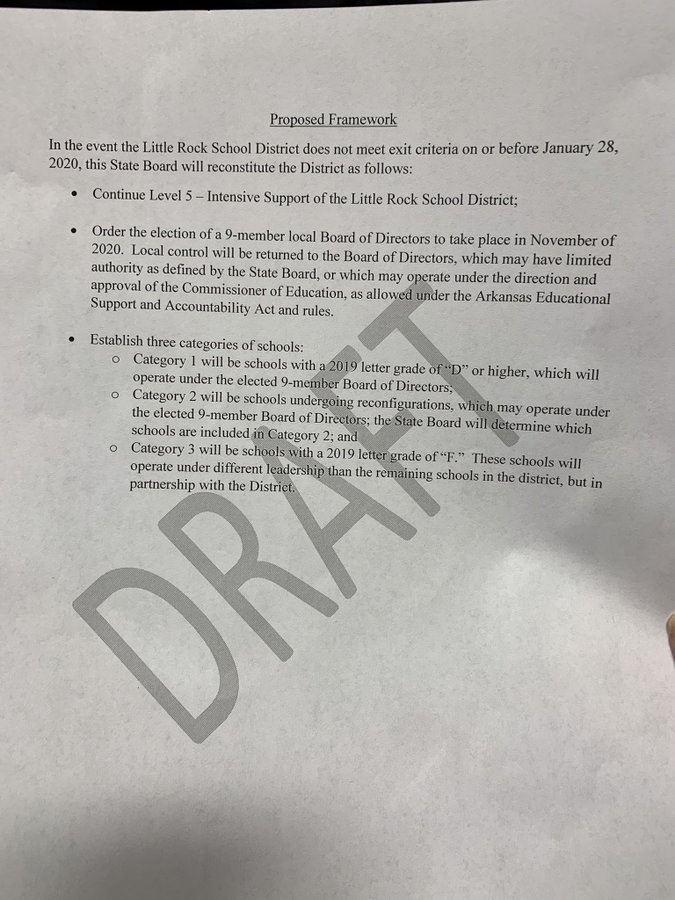
Yesterday’s meeting of the Arkansas State Board of Education was another exercise in futility for the true stakeholders in the Little Rock School District. Don’t believe the headlines that local control of the district has been returned or will be retuned anytime soon to an elected school board. All the State Board did yesterday was trash an ill conceived and inequitable framework for reconstituting the district that it announced last month but could not sustain in the face of political and public opinion headwinds.
Board Chairman Diane Zook made it clear – much to the chagrin of Board members who were trying to appear conciliatory – that nothing changed yesterday. And Zook has no intention for things to change until the District is recreated in the image of the prevailing “business knows best” education model that bedevils American public education. As if American public education needed CONTINUE READING: Tim Jackson: Why Little Rock Parents Cannot Trust Arkansas’ Governor or State Board | Diane Ravitch's blog

Please Sign our Petition Urging AG James to Investigate Illegal College Board Activities | Class Size Matters

Please Sign our Petition Urging AG James to Investigate Illegal College Board Activities | Class Size Matters 

Please Sign our Petition Urging AG James to Investigate Illegal College Board Activities


Good news! After I published an oped in the Washington Post about how the NY State Education Dept. had proposed regulations that would allow the sale of student data and its use for marketing purposes, and after more than 600 of you sent in comments opposing this attempt to undermine the strong prohibition against selling data in our student privacy law,  NYSED officials withdrew this language from the proposed regs. The revised regulations without that provision will soon be posted for a third round of public comments and will be voted on by the Regents, probably in January.
Then, just last night, it was reported that Illinois legislators have urged their state Attorney General to investigate the College Board practice of selling student data, which violates their state student privacy law as well. A spokesperson for the AG has said that he is “looking into the matter.”
Please sign this petition to Attorney General Letitia James, urging her to investigate the College Board and ACT practice of selling student data, which violates our state student privacy law. The College Board also engages in consumer fraud and deceptive practices, since they falsely claim on their data privacy web page that “the College Board does not sell student information” while in reality, they do sell it for 47 cents per student.
Also important! For those of you whose children will soon  take the PSAT, SAT, AP or ACT exams, we now have a one-page flyer with instructions on how to prevent their personal data from being sold.  The flyer is embedded in a longer background piece about this issue on our blog here.
Please share the flyer and the background information with other parents to alert them to this important issue.
Thanks for your support as always, Leonie
Leonie Haimson
Executive Director
Class Size Matters
124 Waverly Pl.
New York, NY 10011
phone: 212-529-3539/917-435-9329
leonie@classsizematters.org
Follow on twitter @leoniehaimson
Subscribe to our newsletter for regular updates on class size and related issues at http://tinyurl.com/kj5y5co
Subscribe to NYC education list: email nyceducationnews-subscribe@yahoogroups.com
Please Sign our Petition Urging AG James to Investigate Illegal College Board Activities | Class Size Matters 

With gloves off, Elizabeth Warren attacks Betsy DeVos — and the education secretary hits back - The Washington Post

With gloves off, Elizabeth Warren attacks Betsy DeVos — and the education secretary hits back - The Washington Post

With gloves off, Elizabeth Warren attacks Betsy DeVos — and the education secretary hits back


Education Secretary Betsy DeVos and Elizabeth Warren, the U.S. senator from Massachusetts seeking the Democratic presidential nomination, sparred on Twitter this week after a federal judge criticized DeVos for flagrantly violating a court order to stop collecting loan payments from students of a for-profit college that closed amid scandal.
On Tuesday, Magistrate Judge Sallie Kim of the U.S. District Court in San Francisco said in a court filing that she was “deeply disturbed” by the Education Department’s “lack of compliance with the injunction … and the sheer scale of violations.” Kim said possible punishment could include a finding of contempt and monetary sanctions.


A day earlier in a hearing, the judge had gone further: “I’m not sending anyone to jail yet, but it’s good to know I have that ability. I’m most concerned with helping the people who were harmed by this — this problem that the government created.”
The Education Department did not respond to a request for comment about what the judge said or about Warren’s comments.
The judge’s warnings prompted Warren to tweet this, along with a link to a Bloomberg News article: “Secretary @BetsyDeVosED is such a failure at @usedgov that she may be held in contempt for refusing to follow the law & stop punishing scammed students. Think about that: she’d rather risk sanctions or even jail than do her job to help America’s students.”
And this: “A federal judge was ‘astounded’ by @BetsyDeVosED’s treatment of student borrowers. She said ‘At best it is gross negligence, at worst it’s an intentional flouting’ of judicial orders to help students.”
And this: “@usedgov needs to follow the law & cancel the student loans of scammed Corinthian CONTINUE READING: With gloves off, Elizabeth Warren attacks Betsy DeVos — and the education secretary hits back - The Washington Post


THIS WEEK Education Research Report

Education Research Report


THIS WEEK 
Education Research Report


New Report Releases Data on Postsecondary Tuition, Fees and Degrees

Between 2016–17 and 2018–19, the average tuition and required fees at 4-year public institutions increased 1 percent for in-state and decreased 0.2 percent for out-of-state students (after adjusting for inflation). During that same time period, tuition and required fees increased 1.4 percent at 4-year nonprofit institutions and decreased by 3.7 percent at for-profit institutions. The National Cen
Community colleges: Balancing College andWork

How can community colleges support students' goals of finding success in the workforce, both today and the future? This issue brief builds upon ACCT's previously published report Partnerships for a Future-Ready Workforce . This brief is the first in a four-part series that will further examine strategies through which community colleges can support students' efforts to achieve their career goals

OCT 10

The associations between teachers’ perceptions of preschoolers’ school readiness and actual academic readiness

Using a nationally representative dataset of young children in the United States (the Early Childhood Longitudinal Study–Birth Cohort), the purpose of this study was to test the associations between teachers’ perceptions of preschoolers’ ( N = 3350) school readiness and actual academic readiness levels, as measured by math and reading assessments. The dimensions of readiness included social/emoti
Legacy and Athlete Preferences at Harvard

The lawsuit Students For Fair Admissions v. Harvard University provided an unprecedented look at how an elite school makes admissions decisions. Using publicly released reports, this study examines the preferences Harvard gives for recruited athletes, legacies, those on the dean’s interest list, and children of faculty and staff (ALDCs). Among white admits, over 43% are ALDC. Among admits who are
To learn English, bilingual children need robust vocabulary from parents and caregivers

The way a highly proficient speaker of English talks to a child is different from the way a less proficient speaker does. Even for two-year-olds, these differences matter in how they acquire and develop language skills. Early language exposure provides the foundation for children's language development. Therefore, the factors that shape that language exposure, shape language development. A new st
How School Districts Are Responding to ESSA’s Evidence Requirements for School Improvement

In the spring of 2019, the Center on Education Policy (CEP) at the George Washington University conducted interviews with leaders from five school districts that differed in key characteristics. The aim was to learn about districts’ efforts to implement the requirements of the Every Student Succeeds Act (ESSA) for using evidence-based approaches to improve lowperforming schools. Under ESSA, state
This analysis finds that 30 percent of community college students transfer to another school

Complete report For years, federal data essentially ignored the outcomes of the typical community college student. The official Integrated Postsecondary Education Data System (IPEDS) graduation rate counted only students who had enrolled in college for the first time and attended full time. It did not count transfer students or part-time students, even though 65 percent of community college stude
Supporting College Student Mental Health: Parents’ Perspectives

Parents of today’s college students are showing a heightened concern about mental health on campus, with 76 percent calling the issue very or somewhat serious and a majority going so far as to say that access to mental health services was an important factor in the college selection process. The nationally representative survey , which polled over 1,000 parents of students between the ages of 18-
Black students face 'accumulation of disadvantage'

Complete report Since the 2001 enactment of No Child Left Behind (NCLB), considerable attention has been paid to the persistence of racial disparities in academic achievement. However, despite a series of reform initiatives, many children throughout the United States continue to under-perform on standardized assessments, and the effort to close the so-called achievement gap remains a national cha

OCT 09

Dress Coded II: Protest,Progress,and Power in D.C. S c hoo l s

In April 2018, the National Women’s Law Center released Dress Coded: Black Girls, Bodies and Bias in D.C. Schools. Co-authored by 21 students who live and learn in Washington, D.C., public schools, this groundbreaking report exposed how racist and sexist enforcement of dress codes unfairly targets Black girls, promotes rape culture and fuels school pushout. The report ignited student and parental

OCT 08

Children's language skills may be harmed by social hardship

Children from disadvantaged backgrounds are three times more likely to develop difficulties with language than those from more affluent areas, research suggests. Researchers say the findings highlight the need for policies to address the social factors that can hamper speech, language and communication (SLC) development. Failing to do so means children might not fully develop the language skills
Screening kindergarten readiness

Starting kindergarten can be a challenging time for children as many are leaving home and learning to interact with others for the first time. As such, it is important for kindergartners to receive proper support from their teachers. Now, University of Missouri College of Education researchers have found that a readiness test can predict kindergarteners' success in school after 18 months. Melissa
End disparities in stem for English learners

Although non-native English speaking students are just as capable as their peers of learning subject matter in STEM (science, technology, engineering, mathematics) fields, they face additional barriers because of a misalignment in the way K-12 schoolwork is taught. Referred to as English learners, these students are learning the English language in tandem with other coursework. However, English l
African American bachelor's degrees see growth in physical sciences, engineering

African Americans are seeing growth in many engineering and physical sciences fields, but they are not progressing at the same rate when compared to the general population. A report from the American Institute of Physics (AIP) Statistical Research Center (SRC) examined the number of bachelor's degrees earned from 2005 to 2015 and separated out the numbers for African Americans from the rest of th
There is also abundant evidence suggesting a causal link between test scores and later life outcomes

The use of test scores as a performance measure in high-stakes educational accountability has become increasingly popular since the enactment of the No Child Left Behind Act of 2001 (NCLB), which imposed sanctions such as the threat of losing federal funds unless a state implemented a school accountability system that measures student progress continuously. Since then, many in the education commu
Teachers’ perceptions of racially dissimilar students vary by experience in the teaching profession.

A growing body of research has documented the important benefits teachers of color bring to students of color, including higher expectations. Separately, researchers have shown that teachers improve student achievement with increasing effectiveness over their careers. This study bridges these two streams of research by examining the extent to which teachers’ perceptions of racially dissimilar stu
Why We Really Need to Track Educational Equity

Full report with charts In September, the National Academies of Sciences, Engineering, and Medicine released Monitoring Educational Equity , a consensus report designed to better describe that status quo. The report identifies a set of equity indicators that can highlight disparities, in order to explore causes and monitor change. Such consensus reports are influential because they focus on the
Policy Reversals on Evaluation Systems for Teachers and Principals

Since the 2015 passage of the Every Student Succeeds Act (ESSA), a large number of states have backed away from recently enacted policies that were designed to breathe new life into moribund teacher and principal evaluation systems. No fewer than 30 states have recently withdrawn at least one of the evaluation reforms that they adopted during a flurry of national activity between 2009 and 2015. T
An Analysis of State Postsecondary Governance Structures

For policymakers to successfully pursue their state’s education and workforce goals, it is imperative to have a keen understanding of their unique postsecondary education governance system. Earlier this year, the Education Commission of the States released a 50-State Comparison, individual state profiles and a data visualization tool to assist policymakers and the broader education community in e

OCT 07

OTC medications commonly used in cases of attempted suicide by self-poisoning in youth

A higher rate during school months A new study from Nationwide Children's Hospital and the Central Ohio Poison Center found rates of suicide attempts by self-poisoning among youth and adolescents are higher in rural communities, higher during the academic school year and involve common medications found in many households. The study, published online today in Clinical Toxicology , expands on prev
Human Capital Specialization and the College Gender Wage Gap

This paper explores the importance of pre-market human capital specialization in explaining gender differences in labor market outcomes among the highly skilled. Using new data with detailed undergraduate major information for several cohorts of American college graduates, the authors establish many novel facts. First, the authors show evidence of a gender convergence in college major choice over
Aligning English Language Proficiency Standards With Content Standards

The Every Student Succeeds Act of 2015 mandates that English language proficiency (ELP) standards align with content standards. As the fast-growing population of English learners (ELs) is expected to meet college- and career-ready content standards, the purpose of this article is to highlight key issues in aligning ELP standards with content standards. The overarching question is how to align ELP
The Impact of English Learner Reclassification on High School Reading and Academic Progress

This study estimates the causal impact of 8th grade English learner (EL) reclassification on high school English language arts (ELA) standardized test scores, SAT (Scholastic Aptitude Test) reading, and on-track to graduate status. The estimated effects of eighth grade reclassification on 9th, 10th, and 11th grade ELA test scores were statistically insignificant. The negative effect on SAT readin
High School Course Access and Postsecondary STEM Enrollment and Attainment

This report studies the effects of access to high school math and science courses on postsecondary science, technology, engineering, and mathematics (STEM) enrollment and degree attainment using administrative data from 


Education Research Report