Latest News and Comment from Education

Sunday, June 2, 2019

Leonie Haimson: Join Us for a Rally and a Party! | Diane Ravitch's blog

Leonie Haimson: Join Us for a Rally and a Party! | Diane Ravitch's blog

Leonie Haimson: Join Us for a Rally and a Party!

Dear Friends-
1. Save the date! On Tuesday June 11 at noon at City Hall we will be rallying for smaller classes, urging the Mayor and the City Council to allocate funds in this year’s budget for class size reduction. Please come and bring your kids – they have the day off from school! Co-sponsored by Class Size Matters, NYC Kids PAC and the Network for Public Education. A flyer to post & distribute in your schools will be ready soon.
2. Last week in court we won a terrific victory when DOE withdrew its proposal to close PS 25, a small school in Bed Stuy. Because of very small classes, experienced teachers and a collaborative principal, PS 25 outperforms the city and the state in test scores, despite enrolling 100% low-income kids, 100% Black and Latino, 27% students with disabilities and about 30% homeless. From the bench, Judge Katherine Levine urged DOE to support the growth of this excellent school while ensuring that its class sizes remain small. She said, “You don’t have to be a rocket scientist to see one of the reasons the school has made so much progress is because of its small class sizes.”  More about this wonderful news on my blog and in the Brklyner.
3. Finally, please remember to buy a ticket to our Annual Skinny Award Dinner on Wednesday June 19; honorees include our amazing Attorney General Tish James and NYC Kids PAC.
And please forward this message to others who care, Leonie
Leonie Haimson
Executive Director
Class Size Matters
124 Waverly Pl.
New York, NY 10011
212-529-3539
Make a tax-deductible contribution to Class Size Matters now!
Subscribe to NYC education list by emailing nyceducationnews-subscribe@yahoogroups.com
Leonie Haimson: Join Us for a Rally and a Party! | Diane Ravitch's blog

LAUSD says it needs the Measure EE tax. Skeptics say the district has a spending problem - Los Angeles Times

LAUSD says it needs the Measure EE tax. Skeptics say the district has a spending problem - Los Angeles Times

LAUSD says it needs the Measure EE tax. Skeptics say the district has a spending problem
The pitch for raising taxes for schools used to be images of cracked asphalt playgrounds, leaking classroom roofs and jammed year-round campuses.
But at STEAM Legacy High School in South Gate, Exhibit A is the impressively equipped engineering classroom of teacher Mario Ibarra.
He’s got 3D printers, a laser cutter, an embroidery machine and other gear that his students use to make robots, marble-sorting machines and hydrogen-powered mini-cars. These students, 90% from low-income families, already are success stories in the making. So for Principal Carla Barrera-Ortiz, the question is what more could be accomplished if voters approve Measure EE, a parcel tax on Tuesday’s ballot.
“Just like Mario is very passionate about how can we make this better for students, what weighs on my shoulders every day is how can I make this better for the lives of the community I serve,” Barrera-Ortiz said. “And these students are our community.”
Measure EE would charge property owners 16 cents per year per square foot of interior space, excluding parking areas. For a 1,500-square-foot home that works out to $240. The tax would raise an estimated $500 million annually over its 12-year life, a sizable boost for the nation’s second-largest school system, which spends about $13.7 billion a year.
Seniors and those living on disability payments can apply to be exempt from the tax.
Ibarra’s outfitted classroom is an outlier, the result of extraordinary resourcefulness in applying for grants and partnering with industry. Most district students don’t have anything like these resources under the current funding structure. But more of them would benefit CONTINUE READING: LAUSD says it needs the Measure EE tax. Skeptics say the district has a spending problem - Los Angeles Times

What Will Happen to the Public Schools in Rochester, N.Y.? | Diane Ravitch's blog

What Will Happen to the Public Schools in Rochester, N.Y.? | Diane Ravitch's blog

What Will Happen to the Public Schools in Rochester, N.Y.?


The Mayor of Rochester, Lovely Warren, has called upon the New York State Education Department and the Board of Regents to take over the city’s public schools, oust the elected board, and appoint a different board of its choosing. She claims that Commissioner MaryEllen Elia has a plan, but apparently this is not the case. To say this is incoherent is an understatement. The state has not expressed a desire to take control of Rochester city schools. Mayor Warren apparently has decided to throw them under the bus, abandon local control, and let the state take responsibility.
Here is another point of view, from journalist Rachel Barnhardt. She explains that the negative and misinformed attitudes of public officials guarantee that the children will not get the support they need to succeed in school.
She writes:
We don’t blame the mayor for poverty, so why do we blame the school board?
The Rochester City School District is the worst in the state. It’s also the district with the highest concentration of children who live in poverty. The research is clear: poverty impacts educational outcomes.
Mayor Lovely Warren says poverty is no excuse. Poor children can learn. Black children can learn. We must do CONTINUE READING: What Will Happen to the Public Schools in Rochester, N.Y.? | Diane Ravitch's blog

Why Teachers Need Their Freedom (Ashley Lamb-Sinclair) | Larry Cuban on School Reform and Classroom Practice

Why Teachers Need Their Freedom (Ashley Lamb-Sinclair) | Larry Cuban on School Reform and Classroom Practice

Why Teachers Need Their Freedom (Ashley Lamb-Sinclair)


This article appeared in The Atlantic September 10, 2017.
Ashley Lamb-Sinclair “is a high-school instructional coach. She is the 2016 Kentucky Teacher of the Year and the founder and CEO of Curio Learning.”
Image result for FREEDOM TO TEACH
My co-teacher and I met in the parking lot before school and stared into my car trunk at the costumes and props we had gathered over the weekend. We were giddy with excitement and nervous because neither of us had tried anything like this before. We also taught in the kind of school where one wrong move in the classroom could lead to disastrous results because of our students’ intense behavioral and learning needs.
The co-teacher, Alice Gnau, had found a book called Teaching Content Outrageously by Stanley Pogrow, which explained how secondary classrooms can incorporate drama into any content to engage students in learning—incorporating the element of surprise, for example, or developing role-play or simulation experiences to teach content and standards. The book inspired us to change how we taught our seventh-grade language-arts students in a high-poverty school that struggled with test scores, especially reading and math.
The sense of urgency in the building was palpable, and the pressure on teachers to increase student achievement was often overwhelming. The district required us to teach a curriculum rigidly aligned with a 15-year-old reading textbook containing outdated articles about Ricky Martin, ice fishing, and cartography in an attempt to provide relevant, entry-level reading for students. I refused to teach from this text on the grounds that it was both condescending and uninteresting. But district personnel insisted that teachers use the textbook, citing evidence that it brought up test scores.
Alice and I decided to take the risk and apply Pogrow’s advice. The mandated CONTINUE READING: Why Teachers Need Their Freedom (Ashley Lamb-Sinclair) | Larry Cuban on School Reform and Classroom Practice


To Understand Teach for America, See Who Funds The Organization | Diane Ravitch's blog

To Understand Teach for America, See Who Funds The Organization | Diane Ravitch's blog

To Understand Teach for America, See Who Funds The Organization


Follow the money is a basic principle.
To understand an organization, see who funds it.
Take Teach for America.
It presents itself to the public as a noble charity.
Unfortunately, it promotes the bad idea that anyone with five weeks of training can teach. That has the effect of undermining teaching as a profession.
Does anyone believe that five weeks of training is adequate to become a doctor or lawyer or architect or engineer?
TFA supplies the workforce for a large proportion of charter schools, 90% of which are non-union.
TFA simultaneously undermines the teaching profession and teacher unionism, which assures that teachers have rights and voice in the workplace.
Who would promote these goals? .
Wendy Kopp proposed the idea for Teach For America in her Princeton University undergraduate thesis in 1989. In 1990, a charter corps of 500... more »
Donors


Who funds  Teach for America? 

Hanna Skandera: Her Consulting Firm and Her Mystery “Initiative” | deutsch29

Hanna Skandera: Her Consulting Firm and Her Mystery “Initiative” | deutsch29

Hanna Skandera: Her Consulting Firm and Her Mystery “Initiative”

Former New Mexico chancellor of education, Hanna Skandera, has been trying to re-establish herself as an ed reform name since her June 2017 departure from the New Mexico ed department.
hanna skandera
Hanna Skandera

In April 2018, she produced a Walton-funded video about the “next step” for ed reform to “connect to real-life issues and needs,” words in step with the Walton goal of trying to appear grass roots rather than top-down (see the Walton Family Foundation 2015 report and my October 2015 post about the report for more). (The 74 is also credited with funding Skandera’s video, though the Waltons also fund The 74; so, it’s like the Waltons are paying themselves.)
In June 2018, Skandera became editor-in-chief of The Line, a K12 ed publication whose former editor-in-chief was former Los Angeles schools superintendent, John Deasy.
According to the Colorado secretary of state, on January 18, 2018, Skandera filed articles of incorporation for Mile High Strategies, LLC (limited liability company). The organization is in good standing (filing up to date): however, it is unclear whether Mile High Strategies is anything more than Skandera alone offering consulting.
On her Linkedin bio, Skandera also advertises herself as founder of Pathway 2 Tomorrow: Local Visions for America’s Future. The organization’s website advertises $100,000 grants and 72 “partners,” including the following:
  • Education Commission of the States,
  • Education Trust,
  • National Alliance for Public Charter Schools,
  • College Board,
  • ACT,
  • Chiefs for Change,
  • Democrats for Education Reform,
CONTINUE READING: Hanna Skandera: Her Consulting Firm and Her Mystery “Initiative” | deutsch29


Breaking. Illinois legislature repeals 3% cap on pensionable teacher salaries. A win. – Fred Klonsky

Breaking. Illinois legislature repeals 3% cap on pensionable teacher salaries. A win. – Fred Klonsky

BREAKING. ILLINOIS LEGISLATURE REPEALS 3% CAP ON PENSIONABLE TEACHER SALARIES. A WIN.

Screen Shot 2019-06-01 at 4.51.38 PM
In the final hours of last year’s legislative session, Democratic Party leaders literally snuck language at the last minute into the budget bill that lowered the cap on teacher pensionable salary raises from a 6% cap to a 3% cap.
IFT and IEA leaders all said they had no time to mobilize opposition.
An IFT alert was actually sent out after the vote by the House.
IEA members were in the dark.
This session a repeal of the 3% salary cap was included in a bill aimed at addressing the state’s teacher shortages.
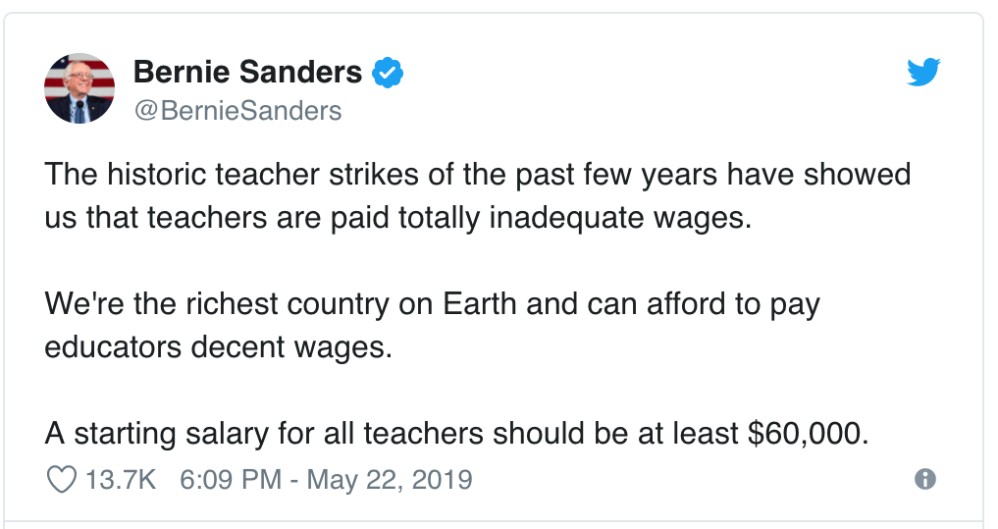
The Illinois legislature passed a bill raising the state’s minimum pay to $40 thousand a year.
Ironically, presidential candidate Bernie Sanders just said that no teacher in America should be paid less than $60 thousand a year.
Too bad Bernie isn’t in charge of the IEA’s Government Relations department. That’s the lobbying department.
At the moment I wish he were an Illinois legislator. But I need to look at the big picture.
Anyway, I received word the other day that the repeal of the 3% cap had been dropped CONTINUE READING: Breaking. Illinois legislature repeals 3% cap on pensionable teacher salaries. A win. – Fred Klonsky