Tuesday, February 26, 2019

Education Research Report: Nonwhite school districts get $23 Billion less than white districts despite serving the same number of students

Education Research Report: Nonwhite school districts get $23 Billion less than white districts despite serving the same number of students

Nonwhite school districts get $23 Billion less than white districts despite serving the same number of students


The story of our communities can in many ways be told through the lens of the school districts that serve our children. More than organizations that enable learning, school districts are geographic boundaries that serve as magnifying lenses that allow us to focus on issues of race and wealth. They are both a statement of “what is” and “what could be” in our society.

School districts determine the extent to which we can integrate children in a classroom. Their borders can be used to either help remedy or further entrench a deep history of housing segregation. We can draw lines that equalize inherent disparities, or we can allow communities to isolate themselves behind unseen walls of wealth and prosperity—ensuring privilege remains solely within the grasp of the lucky few. Far too often, we choose the latter path.

The racial and economic segregation created by gerrymandered school district boundaries continues to divide our communities and rob our nation’s children of fundamental freedoms and opportunity. Families with money or status can retain both by drawing and upholding invisible lines. Many families do just that. This, in conjunction with housing segregation, ensures that—rather than a partial remedy—district geographies serve to further entrench society’s deep divisions of opportunity.

Good schools can’t solve structural inequality on their own, but neither can it be solved without them. Without an effective education, our children’s futures are all but guaranteed to succumb to the imposed conditions of their lineage and location. And even after Brown v Board, even after decades of school finance litigation meant to equalize the playing field, and even after accounting for wealth disparities, the wrenching reality endures—the United States still invests significantly more money to educate children in white communities.

Taken together, these facts lay bare a simple truth: We haven’t gone far enough.
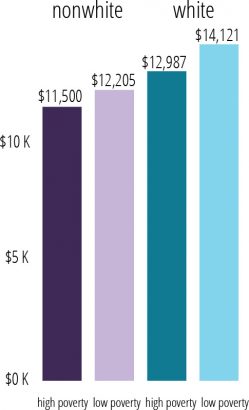
Image result for Non White school districts get $23 Billion less than white districts despite serving the same number of students

The national story

Despite more than a half-century of integration efforts, the majority of America’s school children still attend racially concentrated school systems. This is reflective of the long history of segregation—policies related to everything from voting to housing—that have drawn lines and divided our communities. 

27% of students are enrolled in predominantly nonwhite districts. * 26% of students are enrolled in predominantly white districts. †
Race and class are inextricably linked in the U.S. When comparing the poverty level of racially concentrated systems, a clear divide emerges. Predominantly white districts are far better off than their heavily nonwhite peers. These statistics confirm what we know about income inequality and the effects of segregation. 

In the United States, 20% of students are enrolled in districts that are both poor and nonwhite,* but just 5% of students live in white districts that are equally financially challenged.†
Small districts can have the effect of concentrating resources and amplifying political power. Because schools rely heavily on local taxes, drawing borders around small, wealthy communities benefits the few at the detriment of the many. 

White districts enroll just over 1,500 students— half the size of the national average, and nonwhite districts serve over 10,000 students— three times more than that average. 

For decades, courts have endorsed the idea of “local control” by demanding that states fill in the financial gaps created by district gerrymandering. In doing so, they have ignored—or even endorsed—the CONTINUE READING: Education Research Report: Nonwhite school districts get $23 Billion less than white districts despite serving the same number of students


Are these standardized test questions too hard for kids? - The Washington Post

Are these standardized test questions too hard for kids? - The Washington Post

Are these standardized test questions too hard for kids?


Texas Monthly published a story — “Are Texas Kids Failing? Or Are the Tests Rigged?” — which raises questions about whether questions on the state’s high-stakes standardized English Language Arts tests are written above grade level for many children. One Texas lawmaker, state Rep. Mary Gonzalez (D), quickly called for an investigation into the exams.
The article cites a 2012 report by two associate professors at Texas A&M University at Commerce, who analyzed English Language Arts exam reading passages and found that many were written at least two grades above grade level.
This is not a story unique to Texas, nor are the consequences of poorly worded, culturally biased or otherwise inappropriate questions on high-stakes tests. We’ve heard, for example, about problem questions for years from different states, including the infamous “talking pineapple” questions on a 2012 New York state test. Problems in New York didn’t stop, as you will learn below.
The Texas Monthly story starts this way:
Over the last few years, something strange has been happening in Texas classrooms. Accomplished teachers who knew their kids were reading on grade level by virtually all other measures were seeing those same kids fail the STAAR, the infamous State of Texas Assessments of Academic Readiness test.
The effect on students was predictable: kids who were diligently doing their homework and making good grades in class were suddenly told they were failing in the eyes of the state, which wasn’t so great for their motivation. Parents were desperate to find out why their once high-performing kids were suddenly seen as stumbling. Teachers felt like failures too but had no idea what they were doing wrong, after years of striving to adopt practices proven in successful schools across the country. What’s more, the test results were quickly weaponized by critics of Texas public schools, many of whom advocate state-funded vouchers that would allow parents to send their kids to religious and other private schools.
The stakes of such exams are perilously high. The STAAR test, developed by the Educational Testing Service in Princeton, New Jersey, had replaced one provided by the British firm Pearson, which Texas officials considered too easy. The STAAR test is used to evaluate students, teachers, individual schools and principals, school districts, and, by extension, the entire enterprise of public education in Texas. Fifth and eighth graders who fail the test can be forced to repeat a grade; high school students may not graduate if they don’t pass three of the five CONTINUE READING: Are these standardized test questions too hard for kids? - The Washington Post

Green Book Is Not Our Story – Sam Chaltain

Green Book Is Not Our Story – Sam Chaltain

GREEN BOOK IS NOT OUR STORY

Image result for GREEN BOOK IS NOT OUR STORY


It has been more than fifty years since James Baldwin first named the knotted pathology that has ensnared White and Black America in an intimate dance of mutual self-destruction for, well, ever. “The failure to look reality in the face diminishes a nation as it diminishes a person,” he wrote. America has failed, he said, because it has come to believe its own myths: The Dream. Equal Justice. The Melting Pot. And America’s greatest crime is its ongoing disinterest in any meaningful introspection. “If we are not capable of this examination,” Baldwin warned, “we may yet become one of the most distinguished and monumental failures in the history of nations.”
Which brings us to Green Book — which is, at its root, yet another story that invites us to whitewash our collective imagination in a soothing balm of Bizarro-harmony, one in which the white guy is now the driver, and the black CONTINUE READING: Green Book Is Not Our Story – Sam Chaltain


Monday, February 25, 2019

State superintendent intervenes in contract talks on Day 3 of Oakland teachers strike #Unite4OaklandKids #WeAreOEA #WeAreCTA #strikeready #REDFORED

State superintendent intervenes in contract talks on Day 3 of Oakland teachers strike

State superintendent intervenes in contract talks on Day 3 of Oakland teachers strike
Officials say Tony Thurmond will try to help both the district and the union find common ground.


CLICK HERE if you are having a problem viewing the photos on a mobile device
OAKLAND — State Superintendent of Public Instruction Tony Thurmond is stepping in today to try to settle contract talks between Oakland Unified and the local teachers union, which is striking for a third day.
Bargaining extended into the weekend, but broke down when the union’s representatives refused to lower their original demand of a 12 percent raise over three years. The district contends it can’t afford that amount because of an ongoing structural deficit, and has offered a 7 percent retroactive raise plus a 1.5 percent bonus.
Thurmond, who was endorsed and financially backed as a candidate by the California Teachers Association, will meet with both parties “to find common ground,” California Teachers Association spokesman Mike Myslinski told the Bay Area News Group.
Also over the weekend, fiscal oversight trustee Chris Learned expressed he would rescind any agreement granting the union’s proposed 12 percent raise over three years due to the district’s financial situation. Learned was appointed to oversee district financial decisions after the district went into state receivership in 2003. Though the district is no longer under receivership, it still owes the state more than $30 million from when it was. Learned has the power to veto financial decisions until the district fully pays back the loan.
“I will stay or rescind any agreement that would put the District in financial distress; A 12 percent salary increase would do just that,” Learned said in a statement released Sunday. “What the District has on the table now is what the District can afford.”
Oakland teachers are among the lowest paid in Alameda County and neighboring counties, causing a “retention crisis” in the district, a state arbitrator found. The average annual salary for Oakland teachers was $63,149 during the 2017-18 school year, according to a report from the state’s Department of Education. Salaries range from $46,570 to $83,724
Thousands of teachers, counselors and nurses took to the picket lines Thursday and Friday, and picketing resumed Monday morning. Teachers and supporters will rally at Frank Ogawa plaza around 12:30 p.m. Monday, and former U.S. Labor Secretary Robert Reich will give a speech — Reich is not involved in the contract talks, Myslinksi said. The union members will return to the picket lines around 2:30 p.m.
The district recruited fill-in teachers and assigned administrators to lead classes at its schools, although many of Oakland Unified’s 37,000 students have not attended during the strike. The union estimates only 3 percent of students attended school on Friday; the district has not released any enrollment figures for Thursday or Friday. CONTINUE READING: State superintendent intervenes in contract talks on Day 3 of Oakland teachers strike


Public Education Department plans to scrap A-F grading system | Education | santafenewmexican.com

Public Education Department plans to scrap A-F grading system | Education | santafenewmexican.com

Public Education Department plans to scrap A-F grading system


The New Mexico Public Education Department aims to scrap the state’s A-F grading system for public schools, which critics have said puts too much emphasis on student test scores.
Under proposed changes to the state’s plan to comply with the federal Every Student Succeeds Act, the agency says it will replace an accountability system that identifies schools as failing with one that classifies them by the amount of state and federal support they require.
“This is a shift in philosophy from seeing schools as failing to seeing a call to action,” said Tim Hand, deputy secretary of the education department. “This underscores how we see that our role at the Public Education Department is to lead with support.”
The effort comes as Democratic state lawmakers have introduced two measures — Senate Bill 229 by Sen. Mimi Stewart and House Bill 639 by Rep. G. Andrรฉs Romero — that would repeal a law creating the A-F grading system.
While the House version has not yet had its first committee hearing, SB 229 has cleared the Senate Education Committee and Public Affairs Committee and is headed to the Senate floor.
But the education department won’t wait for a repeal of the school grading law to begin moving forward with its new rating system, Hand said.
“If the A-F is still in statue, then we would have to run that system,” he said. “But this is still something we can do independently.”
The agency also will be releasing a new digital dashboard in which CONTINUE READING: Public Education Department plans to scrap A-F grading system | Education | santafenewmexican.com

Shorting The Lives of Children: No Small Matter – Wrench in the Gears

Shorting The Lives of Children: No Small Matter – Wrench in the Gears

Shorting The Lives of Children: No Small Matter

As I wrote in a previous post, “Don’t Let Impact Investors Capture the Non-Profit, Activist Media,” documentary film has been hijacked to advance the social impact investment agenda. I touched on it in a piece about Ted Dintersmith’s, Most Likely to Succeed. Dintersmith launched a Sundance-affiliated program, the Catalyst Fund, matching social justice minded filmmakers with venture capitalist backers. Other “impact” films making the rounds are Invisible Heart, raising awareness around social impact bonds and No Small Matter, a film the Pritzker-backed Choose Children campaign screened widely in advance of California’s elections last fall.
This post unpacks the financial interests behind the latter documentary, which at first glance seems like an innocuous vehicle promoting the importance of early childhood education. That “cradle to career” human capital pipeline Strive has planned? The one intended to move hundreds of millions of “social benefit” venture capital? Well, someone has to rough in plumbing to the nursery, and that’s the job No Small Matter is meant to do. Investors hope strategic screenings for audiences primed to receive their carefully crafted messages will put voters in the proper mindset to act with a sense of urgency when intended legislation surfaces. When targeted bills come up, these influencers will be eager to press their elected officials to pass them.
The transactional nature of the financial arrangements between documentary filmmakers and social entrepreneurs is made clear in a panelpresentation from the 2012 Social Enterprise Conference, which was held at Columbia Business School. During the panel, “Media as Catalyst: Story Telling and Social Action,” Diana Barrett, former Harvard Business School professor and founder of the film production venture The Fledgling Fund, articulated her strategy. The Fledgling Fund backed the Invisible Heart SIB  CONTINUE READING: Shorting The Lives of Children: No Small Matter – Wrench in the Gears

The Year of the Public School: 2019! | Diane Ravitch's blog

The Year of the Public School: 2019! | Diane Ravitch's blog

The Year of the Public School: 2019!

This is  a message from theNetwork for Public Education.
2019 will be the year of the public school, with your help and support.
“From West Virginia to California teachers are boldly standing up for themselves, their students and their schools. Teachers are walking out due to a lack of sufficient funding, which has resulted in the deterioration of salaries, fewer services for children and increased class size.
“They are also making it clear that they understand why public school funding has been drained. Privatization schemes like charters and vouchers have made school funding a competition, not a public obligation.
“As Oakland Education Association President, Keith Brown, told the Washington Post:
More than $50 million is diverted every year to charter schools while our students have a 1,750 to 1 ratio for students to school nurses and 600 to 1 for guidance counselors. The charter schools that capture our dollars lack financial transparency and accountability standards…
“In West Virginia, teachers and school service workers had a two-day walk out to show their opposition to provisions in proposed legislation that would have created the state’s first charter schools and allowed vouchers in the form of education savings accounts (ESAs).”
Open the link to find the NPE toolkit, which shows how YOU can make 2019 the year of the public school.
CHECK IT OUT

Big Education Ape: Help NPE-Action Keep Score on the 2020 Presidential Candidates | Diane Ravitch's blog - http://bigeducationape.blogspot.com/2019/02/help-npe-action-keep-score-on-2020.html


New study casts doubts on effectiveness of personalized learning program in New Jersey - The Hechinger Report

New study casts doubts on effectiveness of personalized learning program in New Jersey - The Hechinger Report

New study casts doubts on effectiveness of personalized learning program in New Jersey
Results highlight debate over how to measure what's working in the classroom when kids are learning different things


In the fall of 2015, five schools in the industrial port city of Elizabeth, New Jersey, dumped their usual math curriculum and started teaching their middle school students through a computerized system called “Teach to One.” It was an experiment in so-called “personalized learning,” where algorithms churned out customized lessons for each student. Many of the kids were behind their grade level and spent hours reviewing third-grade arithmetic while others could jump ahead to eighth-grade algebra.


But after three years of learning this way, the Teach to One students in grades six through eight scored no better on New Jersey’s annual math tests than other Elizabeth students who had learned math the usual way with the whole class on the same topic at the same time. “I can’t rule out that Teach to One had no effects” on student’s math achievement, said Doug Ready, a professor at Teachers College, Columbia University and lead author of a January 2019 study of the program.
The study highlights an ongoing conflict between personalized learning and the required annual tests that schools to give students.  Joel Rose, the chief executive of the nonprofit organization that sells Teach to One to schools, is convinced that students who take the time to go back and master foundational concepts in math will be better off in the long run. “Math is cumulative,” he said. “You just can’t learn linear equations if you don’t know how to multiply.”
But the annual state tests that were used in this study don’t measure how much a student has caught up on things he or she should have learned years ago. For example, an 11-year-old student who jumped from third to fifth grade math in one year might still bomb the sixth-grade test and do no better than an equally weak student who was CONTINUE READING: New study casts doubts on effectiveness of personalized learning program in New Jersey - The Hechinger Report


Whatever Happened to Media Literacy in Schools? | Larry Cuban on School Reform and Classroom Practice

Whatever Happened to Media Literacy in Schools? | Larry Cuban on School Reform and Classroom Practice

Whatever Happened to Media Literacy in Schools?


Far more policy talk than classroom action is the short answer. The long answer is below in the questions I ask.
Where and When Did the Idea Originate?
Having students become media literate across school subjects has been talked about since the early 1960s in Europe and the U.S. but has hardly made a dent in lessons that most teachers teach. In Britain, Canada, and other nations there has been far more policy talk and even some action (media literacy Europe/Canada ). For example, in the United Kingdom, the 2003 Communications Act required the government to promote media literacy in British schools. David Buckingham and colleagues tells the story of what happened since then (see here and here).
Much less has happened in the U.S. with its decentralized system of public schools in 50 states, over 13,000 districts, and nearly 100,000 schools. A timeline for media literacy, broadly defined, begins in the 1960s.
The earliest U.S. classroom materials that I have found were created in 1972 as a Media Now kit of lessons and activities that teachers could use in their classrooms. Based on the work of media analyst Marshall McLuhan and psychologists Jerome Bruner’s Process of Education and Benjamin Bloom’s Taxonomy of Educational Objectives , Ron Curtis and others developed a self-directed learning kit containing 50 individual packages divided into seven modules for teachers to use. The source I used claimed that it was used in over 600 schools.
There has been much state activity in promoting media literacy in schools  since (see above timeline) but no mandated courses as far as I can determine. For CONTINUE READING: Whatever Happened to Media Literacy in Schools? | Larry Cuban on School Reform and Classroom Practice


Badass Teachers Association Blog: Protect the Mental Health of Students and Teachers

Badass Teachers Association Blog: Protect the Mental Health of Students and Teachers

Protect the Mental Health of Students and Teachers

As February comes to an end, we’ve been reflecting on the important movements in education 

highlighted this month. The Black Lives Matter at School movement is fighting for racial 
justice in schools across the country. Teachers Against Child Detention highlights the 
educators’ role as mandated reporters and exposed the U.S. government’s awful policy of 
detaining immigrant children in detention centers. The one-year anniversary of the Parkland 
school shooting reminds us of the students and teachers who turned their trauma and grief 
into a crusade to end gun violence, calling out the despicable inaction of our politicians. 
When children in our country do not have culturally relevant curriculum or counselors, when 
children are imprisoned, when children fear for their lives in school, we are damaging them. 
Our children need our advocacy more than ever before. While teachers have always been 
passionate champions for their students, 2018 was a year when they demanded that our 
leaders listen to them. We have seen first-hand how NOT listening has had serious 
consequences for our nation’s children. The truth is that teachers are fighting daily against a 
system of education policies forced on schools by non-educators that does more to add trauma 
to children’s lives than to reduce it. Teachers are witnesses and first responders to the harm 
that is being caused. 
NBC news recently reported that the increase of children showing up in emergency rooms 
due to a mental health crisis is “staggering.” The American Academy of Pediatrics also 
reported that children’s admissions to hospitals for suicidal thoughts and self-harm more than 
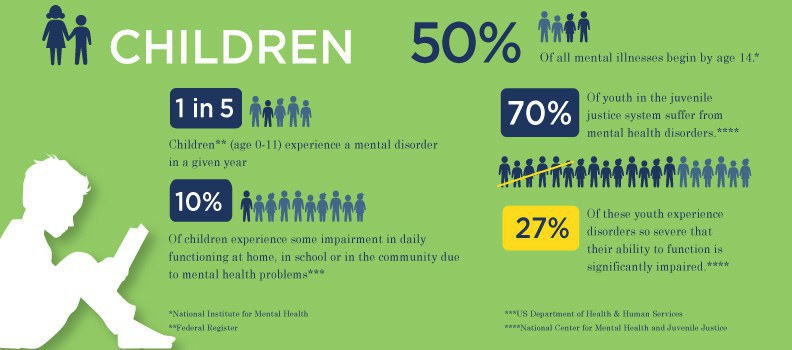
doubled from 2008 to 2015. Additionally, serious behavioral issues in schools have CONTINUE READING:
Badass Teachers Association Blog: Protect the Mental Health of Students and Teachers

Image result for Mental Health of Students and Teachers

CURMUDGUCATION: OH: Lorain CEO's Purge Announcement Raises Fury

CURMUDGUCATION: OH: Lorain CEO's Purge Announcement Raises Fury

OH: Lorain CEO's Purge Announcement Raises Fury


Last Thursday night, David Hardy, the state-appointed takeover CEO for Lorain City Schools told the public that all teachers at the high school would have to reapply for their jobs.

If you want to read about how they arrived at this point, that story is here. This is just the next chapter in the story.


After telling the public, Hardy then sent a letter to staff (because when you want to drop this kind of bomb on your staff, you definitely want them NOT to be the first to know). It does not particularly clarify the action. Having created four categories for the schools of Lorain (because a good plan requires specialized new jargon) -- excellent, innovation, improvement and empowerment schools. No schools were ranked excellent, and only the high school was ranked "empowerment." Hardy has not made public the process by which these judgments are made, though they appear to be linked closely to state test results.

Why exactly do teachers need to re-apply? Per the letter:

"...because we know that transformations this large can only happen with a completely unified and committed team, we’re giving leaders at Empowerment Schools the autonomy to choose their staff. "

At the high school, that would be the team led by Executive Director Daniel Garvey.* Garvey is one of Hardy's hires; he graduated from Ohio State with a BA in International/Global studies then, spent two years Teach for America as an English teacher, then three years handling phone interviews for CONTINUE READING: 
CURMUDGUCATION: OH: Lorain CEO's Purge Announcement Raises Fury


Let's Make 2019 "The Year of the Public School." - Network For Public Education

Let's Make 2019 "The Year of the Public School." - Network For Public Education

Let’s Make 2019 “The Year of the Public School.”


From West Virginia to California teachers are boldly standing up for themselves, their students and their schools. Teachers are walking out due to a lack of sufficient funding, which has resulted in the deterioration of salaries, fewer services for children and increased class size.
They are also making it clear that they understand why public school funding has been drained. Privatization schemes like charters and vouchers have made school funding a competition, not a public obligation.
As Oakland Education Association President, Keith Brown, told the Washington Post:

More than $50 million is diverted every year to charter schools while our students have a 1,750 to 1 ratio for students to school nurses and 600 to 1 for guidance counselors. The charter schools that capture our dollars lack financial transparency and accountability standards…
In West Virginia, teachers and school service workers had a two-day walk out to show their opposition to provisions in proposed legislation that would have created the state’s first charter schools and allowed vouchers in the form of education savings accounts (ESAs).
The week of March 25-29 is Public Schools Week. Let’s make 2019 The Year of the Public School.

Here is how you can help: CONTINUE READING: Let's Make 2019 "The Year of the Public School." - Network For Public Education

CHECK IT OUT

Big Education Ape: Help NPE-Action Keep Score on the 2020 Presidential Candidates | Diane Ravitch's blog - http://bigeducationape.blogspot.com/2019/02/help-npe-action-keep-score-on-2020.html


Sunday, February 24, 2019

Fla GOP making schools separate and unequal again - YouTube

Fla GOP making schools separate and unequal again - YouTube

Fla GOP making schools separate and unequal again 


Florida Senate Republicans unveiled their education plan this week, and it’s looking very much like the governor’s.
Among the proposals, an expansion of the school voucher program, allowing general revenue taxes, which provide public school funding, to be spent on private school tuition.
The Florida Supreme Court already determined in 2006 that general funds could not be used on vouchers, because they create “an alternative system of private schools that are not subject to the ‘uniformity’ requirements for public schools.”
https://www.courtlistener.com/opinion...
Lawmakers have gotten around the ruling by issuing tax credits for companies that contribute to non-profits that, in turn, fund the scholarships.
The recent appointment of three conservative justices to the state supreme court almost guarantees a favorable ruling for vouchers this time around.
Public schools are graded based on how well students score on highly controversial, scientifically unfounded standardized tests. But private schools don’t have to do that.
No accountability means private schools can claim a 100% graduation rate and not have to prove students have learned anything.
“The Orlando Sentinel [has] published stories detailing how private schools that take state money used fraudulent fire and health reports and even hired untrained teachers, some with criminal records. These private schools also freely discriminate based on religion, disability, language skills, and even sexual orientation.”
https://communitynewspapers.com/pinec...
Of course, this whole plan reeks of Education Secretary Betsy DeVos and former Florida Governor Jeb Bush, who for decades have preached their school privatization gospel to Wall Street. Their network of education profiteers have spent $100s millions on political action committees and public disinformation campaigns. All so that a small group of wealthy investors can get even richer.


Article IX of the Florida constitution says that it is “a paramount duty of the state to make adequate provisions for the education of all children.”
But which children are we talking about here? Certainly not the ones who were denied an education from private schools last year for wearing a natural Black hairstyle, or for being gay, or for getting pregnant, or for no reason at all. At least not one they’ll admit to aloud.
And for once I’d like to see private schools take the disproportionate number of students with disabilities that public schools are required to service.
Oh! All of the sudden there’s a waiting list.
Funny how that works.


Fla GOP making schools separate and unequal again - YouTube