Wednesday, December 19, 2018

BIG EDUCATION APE WILL BE OFF FOR THE NEXT SEVERAL DAYS CELEBRATING THE HOLIDAYS HAPPY SOLSTICE EVERYONE

Winter solstice: Why pagans celebrate the shortest day of the year (a day late)


BIG EDUCATION APE WILL BE OFF FOR THE NEXT SEVERAL DAYS 
CELEBRATING THE HOLIDAYS

HAPPY SOLSTICE EVERYONE


Winter solstice: Why pagans celebrate the shortest day of the year (a day late)
Image result for HAPPY winter solstice SURFING


The December solstice happens at the same instant for everyone, everywhere on Earth – and this year the winter solstice occurs on Friday December 21st 22:23 GMT in the Northern Hemisphere.
The winter solstice happens every year when the Sun reaches its most southerly declination of -23.5 degrees. In other words, it is when the North Pole is tilted farthest away from the Sun, delivering the fewest hours of sunlight of the year.
The Sun is directly overhead of the Tropic of Capricorn in the Southern Hemisphere during the December solstice and is closer to the horizon than at any other time in the year, meaning shorter days and longer nights.
The shortest day of the year lasts for 7 hours 49 minutes and 41 seconds in Britain, which is 8 hours, 49 minutes shorter than the June Solstice. As such, Thursday December 20th is the longest night of the year with the sun not rising until 08:03 GMT on Friday morning.
The day after the winter solstice marks the beginning of lengthening days, leading up to the summer solstice in June.
In the Southern Hemisphere, the opposite is true. Dawn comes early, and dusk comes late. The sun is high and the shortest noontime shadow of the year happens there. In the Southern Hemisphere, people will experience their longest day and shortest night.

Does the winter solstice always occur on December 21st?

While it more often than not falls on December 21st, the exact time of the solstice varies each year. In the Northern hemisphere the winter solstice is the shortest day of the year, because it is tilted away from the sun, and receives the least amount of sunlight on that day.
However, the earliest sunset does not occur on the solstice, because of the slight discrepancy between 'solar time' and the clocks we use.
The shortest day of the year often falls on December 21st, but the modern calendar of 365 days a year - with an extra day every four years - does not correspond exactly to the solar year of 365.2422 days.
The solstice can happen on December 20, 21, 22 or 23, though December 20 or 23 solstices are rare.
The last December 23 solstice was in 1903 and will not happen again until 2303.

What does 'solstice' mean?

The term 'solstice' derives from the Latin word 'solstitium', meaning 'Sun standing still'. On this day the Sun seems to stand still at the Tropic of Capricorn and then reverses its direction as it reaches its southernmost position as seen from the Earth.
Some prefer the more teutonic term 'sunturn' to descibe the event.

Is the solstice the first day of winter?

The answer might vary depending on who you ask. There are two types of winter: astronomical and meteorological.
Astronomical winter typically begins on December 21st, with the winter solstice, and ends on March 19th. Meteorological winter always begins on December 1st and ends on February 28th (February 29th during leap years).
While astronomical winters are determined by the Earth's orbit around the sun, meteorological winters are the three calendar months with the lowest average temperatures.
The Met Office tend to use the meteorological definition of the seasons.

Stonehenge and the solstice

Stonehenge, the prehistoric monument located in Wiltshire, is carefully aligned on a sight-line that points to the winter solstice sunset (opposed to New Grange, which points to the winter solstice sunrise, and the Goseck circle, which is aligned to both the sunset and sunrise).
Archaeologists believe it was constructed from 3000 BC to 2000 BC and it is thought that the winter solstice was actually more important to the people who constructed Stonehenge than the Summer solstice.
The winter solstice was a time when cattle was slaughtered (so the animals would not have to be fed during the winter) and the majority of wine and beer was finally fermented.
The only other megalithic monuments in the British Isles which clearly align with the sun are Newgrange in County Meath, Ireland and Maeshowe situated on Mainland, Orkney, Scotland. Both famously face the winter solstice sunrise.
You can also see the solstice sunrise around the world; this website shows Winter solstice: Why pagans celebrate the shortest day of the year (a day late)


Image result for winter solstice dance animated gif

DeVos' Solution to Mass School Shootings? Scrap the Rules Designed to End Discrimination Against Students of Color

DeVos' Solution to Mass School Shootings? Scrap the Rules Designed to End Discrimination Against Students of Color

DeVos' Solution to Mass School Shootings? Scrap the Rules Designed to End Discrimination Against Students of Color
"The Trump administration's response to school shootings is to make it easier (again) to suspend black kids."

Update:
The highly anticipated Final Report (pdf) from the Federal Commission on School Safety, led by Education Secretary Betsy DeVos, was released Tuesday—and includes a long-rumored recommendation that is alarming civil rights advocates: to rescind Obama-era policies crafted to end racial disparities in school disciplinary practices.
Formed after 17 people were gunned down at a Florida high school in February, the commission "took a horrendous year of school shooting tragedies and produced a report with a smorgasbord of recommendations—some of which we have championed for years—aimed at making our schools safer," said American Federation of Teachers president Randi Weingarten. "Unfortunately, the report doesn't address the root causes of the gun violence epidemic: too many guns in our communities and not enough investment in addressing the social-emotional health of our kids."
"But most curious and disappointing is the report's use of the tragedy at Marjory Stoneman Douglas High School to push an anti-civil rights agenda that won't keep schools safe," she added. Noting that the Obama-era measures "intended to help prevent the disproportionate suspension and expulsion of students of color, students with disabilities, and LGBTQ youth," she also pointed out that the Stoneman Douglas shooter "had in fact been expelled and reported to law enforcement; rescinding discipline guidance and kicking kids out of school doesn't prevent school shootings."
The Education Law Center, in a statement, said, "Claims that federal measures to address racial and disability disparities have caused lax discipline and triggered a wave of school violence are simply inaccurate and dishonest." The center concluded that the commission's recommendation to rescind the anti-discrimination measures sends a message that the Trump administration "does not care about children pushed out of school and does not care if schools discriminate."
Earlier:
A school safety commission formed after 17 people were murdered at a high school in Parkland, Florida in February plans to formally recommend that the Trump administration rescind "groundbreaking" Obama-era policies that aimed to prevent discrimination against students of color, according to the New York Times.
Expected to be officially announced in a joint letter by the Education and Justice CONTINUE READING: DeVos' Solution to Mass School Shootings? Scrap the Rules Designed to End Discrimination Against Students of Color

The 'dirty secret' about educational innovation - The Hechinger Report

The 'dirty secret' about educational innovation - The Hechinger Report

The ‘dirty secret’ about educational innovation
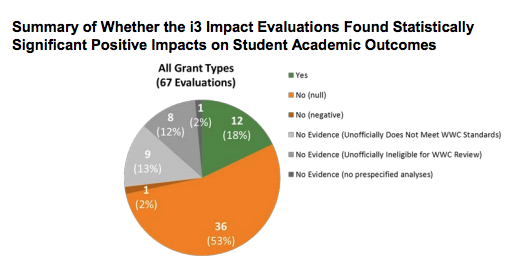
A 2018 federal report found that only 18 percent of the innovations funded by the Education Department lifted student achievement
As part of the federal recovery effort to boost the economy after the 2008 recession, the U.S. Education Department suddenly had a big pot of money to give away to “innovations” in education. Since then, more than $1.5 billion has been spent on almost 200 ideas because Congress continued to appropriate funds even after the recession ended.  Big chunks went to building new KIPP charter schools and training thousands of new Teach for America recruits to become teachers. Other funds made it possible for lesser known programs in reading, writing, math and science instruction to reach classrooms around the country. Many of the grant projects involved technology, sometimes delivering lessons or material over the internet. One “innovation” was to help teachers select good apps for their students. Another was for a novel way to evaluate teachers.
In order to obtain the grants, recipients had to determine if their ideas were effective by tracking test scores. Results are in for the first wave of 67 programs, representing roughly $700 million of the innovation grants and it doesn’t look promising.
Only 12 of the 67 innovations, or 18 percent, were found to have any positive impact on student achievement, according to a report published earlier in 2018. Some of these positive impacts were very tiny but as long as the students who received the “innovative treatment” posted larger test score gains than a comparison group of students who were taught as usual, it counted.
“It’s only a handful,” said Barbara Goodson, a researcher at Abt Associates Inc., a research and consulting firm that was hired to analyze the results of the Investing in Innovation (i3) Fund for the Department of Education. “It’s discouraging to everybody. We are desperate to find what works. Here was a program that was supposed to identify promising models. People are disappointed that we didn’t CONTINUE READING: The 'dirty secret' about educational innovation - The Hechinger Report


Disability Advocates Concerned By Plan To Axe School Discipline Guidance - Disability Scoop

Disability Advocates Concerned By Plan To Axe School Discipline Guidance - Disability Scoop

Disability Advocates Concerned By Plan To Axe School Discipline Guidance


A Trump administration school safety commission is recommending that federal officials rescind Obama-era guidance aimed at ensuring that minorities and students with disabilities aren’t unfairly disciplined.
In a 180-page report released Tuesday, the Federal Commission on School Safety said that the 2014 guidance issued jointly by the U.S. Department of Education and the Department of Justice should be abandoned.
The guidance outlined how schools should work to ensure that discipline isn’t administered in a way that disproportionately affects students from certain groups, noting that federal law prohibits “discriminatory discipline” based on race, disability and other factors.
The recommendation this week comes from a panel established by President Donald Trump following the shooting in February at Marjory Stoneman Douglas High School in Parkland, Fla. The commission, chaired by Secretary of Education Betsy DeVos, was tasked with recommending steps to improve school safety.At the time, the Obama administration highlighted statistics showing that kids in special education represented just 12 percent of students across the country, but accounted for about 20 percent of suspensions and expulsions and almost a quarter of school-related arrests.
“The commission is deeply troubled that the guidance, while well-intentioned, may have paradoxically contributed to making schools less safe,” the commission said in its report. “Significant concerns also remain regarding the legal framework upon which the guidance is based. These concerns, together with the repeated concerns expressed by many that disciplinary decisions are best left in the hands of classroom teachers and administrators, CONTINUE READING: Disability Advocates Concerned By Plan To Axe School Discipline Guidance - Disability Scoop


College Options for High School Grads with Low or Modest GPAs | deutsch29

College Options for High School Grads with Low or Modest GPAs | deutsch29

College Options for High School Grads with Low or Modest GPAs


In May 2018, Anna Wulick of ACT’s PrepScholar blog posted this informative entry for high school graduates who wish to attend four-year college but who have less-than-impressive GPAs.
For those high school grads whose GPAs are really low (like, “I walked the D-average line class after class, year after year”), the piece includes three institutions that base acceptance on criteria other than GPA:
If you have a low GPA but know that you are capable of so much more, three colleges now give you a totally different way to apply!
  • Goucher College: How about this for a revolutionary idea: you only submit a two-minute video about yourself. That’s it. No transcript, no test scores—just you explaining why you deserve admission.
  • Bennington College: Similar deal here in that there’s no need to submit a transcript or test scores. Instead, you’ll turn in a self-curated collection of your work that speaks to your creative and intellectual abilities.
  • Bard College: Even though Bard still requires a transcript, you can opt to answer several college-level essay questions. Just think: an amazing performance would be a surefire way to prove you can do better than your GPA suggests!
Next– for those with somewhat more to offer on the GPA front– the PrepScholar posting includes, as Wulick, states, “a list of the least competitive campuses in larger and more competitive state university systems”:
SchoolAverage HS GPA of Admitted ApplicantsAdmission Rate
Indiana University Northwest2.9679%
Louisiana State University Shreveport3.2981%
Penn State Schuylkill2.9073%
Rutgers Camden3.3058%
SUNY Potsdam3.2974%
Texas A&M Kingsville3.3582%
University of Arkansas at Little Rock3.2159%
University of Colorado at Colorado Springs3.3791%
University of Illinois at Chicago3.2577%
University of Louisiana at Monroe3.4194%
University of Maine at Presque Isle3.0477%
University of Maryland Eastern Shore2.8057%
University of Massachusetts Dartmouth3.2076%
University of Michigan at Flint3.2974%
University of Minnesota Crookston3.2178%
University of Missouri Kansas City3.3663%
University of Nebraska at Kearney3.4785%
University of North Carolina at Pembroke3.4074%
University of Pittsburgh at Bradford3.2258%
University of South Carolina Beaufort3.3963%
University of Tennessee at Chattanooga3.4879%
University of Texas at Brownsville3.0987%
University of Washington Tacoma3.2383%
University of Wisconsin Milwaukee3.1073%
Third, for those with minimal GPAs who wish to parlay their minimum into CONTINUE READING: College Options for High School Grads with Low or Modest GPAs | deutsch29

Why Change is Often Confused with Reform: The Multi-layered Curriculum | Larry Cuban on School Reform and Classroom Practice

Why Change is Often Confused with Reform: The Multi-layered Curriculum | Larry Cuban on School Reform and Classroom Practice

Why Change is Often Confused with Reform: The Multi-layered Curriculum


I published this post in 2012. I have updated both text and references.
After extensive deliberation and committee meetings, state and district officials publish curricular frameworks and courses of study in academic subjects from kindergarten through high school. This is called the intended curriculum (see here and here).
Consider science curriculum in California. The first science framework in 1990 laid out content standards, grade by grade, as to what teachers should teach and what students should learn. Since then, there have been revisions in the state framework (see scienceframework-1  for 2004 and 2016)
The purposes of the two science frameworks are stated clearly:
2004
Educators have the opportunity to foster and inspire in students an interest in science; the goal is to have students gain the knowledge and skills necessary for California’s workforce to be competitive in the global, information-based economy of the twenty-first century….
This framework is intended to (1) organize the body of knowledge that students need to learn during their elementary and secondary school years; and (2) illuminate the methods of science that will be used to extend that knowledge during the students’ lifetimes.
2016:
The goal of the California Next Generation Science Standards (CA NGSS)
is to prepare California students to be future citizens and future CONTINUE READING: Why Change is Often Confused with Reform: The Multi-layered Curriculum | Larry Cuban on School Reform and Classroom Practice

CURMUDGUCATION: OK: Another Rich Amateur Assault On Education.

CURMUDGUCATION: OK: Another Rich Amateur Assault On Education.

OK: Another Rich Amateur Assault On Education.

Image result for HELPING NOT HELPING


Hechinger Report elevated my blood pressure with a story that is a near-perfect microcosm of the state of public education and, really, democracy in 2018.


Looks like a fun guy.
Paul Campbell is a successful business guy. He put in over a decade with Rolls-Royce in Indiana, rising to the level of VP of customer business. He put in a few yers with Capstone, a manufacturer of micro-turbines. Then he jumped to Enviro Systems, a "supplier of environmental controls for some of the largest aircraft manufacturers in the world." Enviro was founded in 1979, and its parent company is Zodiac Aerospace, a French company with roots back ton 1896 (they started out with hydrogen balloons). Zodiac is huge-- 100 sites and 35,000 employees. Zodiac acquired Enviro in early 2015; in June of 2015, Campbell took over as President and CEO of Enviro. Enviro boasts 170 non-unionemployees.

Enviro is located in Seminole, Oklahoma, a town that ballooned to 25k people during an oil boom a century ago, but by 2000 had shrunk to under 7,000 people. It has since bounced back a bit, but it's a small town about an hour away from Oklahoma City; it's in those suburbs where Campbell actually made his new home-- not Seminole.

Campbell hadn't been at the company a year before he was complaining about the local schools-- specifically, that he couldn't recruit or retain good people for Enviro: "We can't get people to work here. The main reason we found is because of the local education system."

Seminole's schools, like all of Oklahoma's schools, suffer from a state government that is hostile to public education. But Campbell, who also became involved in the Chamber of Oklahoma, didn't start CONTINUE READING: 
CURMUDGUCATION: OK: Another Rich Amateur Assault On Education.


Monday, December 17, 2018

‘Choice’ has become an excuse for charter and voucher schools to discriminate | Alternet

‘Choice’ has become an excuse for charter and voucher schools to discriminate | Alternet

‘Choice’ has become an excuse for charter and voucher schools to discriminate
The evidence mounts: Not all families have equal access to the education opportunities advocated by Betsy DeVos.


When prominent advocates for “school choice,” such as U.S. Secretary of Education Betsy DeVos, talk about how a market-based approach for education works, the very stories they might cite as successes actually reveal serious shortcomings of charter schools and vouchers, especially about how they can have detrimental effects on parents, children, and communities. Take, for example, the case of Krystl Newton.
When the private Christian school Newton’s daughter attended closed, she was able to find a charter school near their home in Wake County, North Carolina, that provided a school culture similar to the private academy, with strict discipline, high academic standards, and none of the “gang stuff” (her words) she heard plagued the public schools.
Her daughter thrived in the new charter, so when Newton’s younger son reached kindergarten age, she was pleased the charter would enroll him under their family-members-first policy.
But after his kindergarten year, when he was ready to move to first grade, there was a problem.
Early in the boy’s development, Newton had observed symptoms of what she came to believe was a developmental disability resembling Tourette’s Syndrome. Although an official diagnosis of the disorder couldn’t be made until the child turned eight, Newton had already consulted specialists and gone to the trouble of developing an Individualized Education Program (IEP), a document that is developed for each public school child who needs special supports due to a physical, mental, or emotional disability. Because her daughter also had a mild form of disability when she enrolled in the charter, Newton assumed the charter would be fully accepting and supportive of her son’s situation too.
But the charter administrators felt otherwise.


“They wouldn’t accept our information,” she told me in a phone conversation, referring to her son’s IEP and other documents advising how to conduct his CONTINUE READING: ‘Choice’ has become an excuse for charter and voucher schools to discriminate | Alternet


The #RedforEd Wave Is Likely to Build, Not Subside, in 2019 - Progressive.org

The #RedforEd Wave Is Likely to Build, Not Subside, in 2019 - Progressive.org

The #RedforEd Wave Is Likely to Build, Not Subside, in 2019
Teachers unions are poised to strike across the country.


Earlier this year, #RedforEd campaigns took off around the country, from West Virginia to Oklahoma and points in between. Teachers and support staff, even in notoriously anti-labor states like Arizona, walked off the job and into state capitals, demanding better pay and more funding for schools, among other key issues.
With 2019 just around the bend, the wave of education activism shows no signs of ebbing.
On November 7, educators in Alabama, for example, held the state’s first #RedforEd rally with support from both the National Education Association and the American Federation of Teachers. Citing rising health insurance premiums as well as inadequate pay and minimal classroom funding, hundreds of Alabama teachers gathered on the steps of the state capitol in solidarity, despite the fact that Alabama has been a right-to-work state for decades. (Teachers in right-to-work states do not have the legal authority to strike.)
Teachers in Louisiana, too, are contemplating collective action in 2019, in defiance of their state’s restrictive labor laws. Average teacher salaries in Louisiana fall just under $50,000, according to news reports, and the Louisiana Federation of Teachers has put lawmakers on notice, advising them to either CONTINUE READING: The #RedforEd Wave Is Likely to Build, Not Subside, in 2019 - Progressive.org


UPDATE: Audit blasts Sac City Unified for budget mismanagement, warns of possible state takeover | The Sacramento Bee

Audit scolds Sac City Unified over $30 million deficit | The Sacramento Bee

Audit blasts Sac City Unified for budget mismanagement, warns of possible state takeover


The financial clock is winding down for the Sacramento City Unified School District.

An independent fiscal manager warned late Thursday that if the district fails to plug a $30 million budget hole, it could trigger a takeover by the state in six months.

The Fiscal Crisis and Management Assistance Team, a state-created financial adviser for school districts, faulted the district in an audit report for past mismanagement, communication failures, inexperienced staff and a staffing budget that could hinder its ability to solve the lingering budget problem.
The report concluded the district was at a high risk of insolvency by November 2019 and “without action, state intervention is certain.” CONTINUE READING:Audit scolds Sac City Unified over $30 million deficit | The Sacramento Bee
Sacramento City School District Rejects Teachers Association Budget Proposal « CBS Sacramento - https://cbsloc.al/2QPNtSk on /cbssacramento

Sacramento District Running Out of Money Denies Budget Proposal « CBS Sacramento - https://cbsloc.al/2Bloc8B on /cbssacramento


Tennessee US Sen. Lamar Alexander will not seek re-election in 2020

Tennessee US Sen. Lamar Alexander will not seek re-election in 2020

US Sen. Lamar Alexander will not seek re-election in 2020


After roughly a quarter century in elected office, U.S. Sen. Lamar Alexander will retire. 
The former Republican governor, who has served in the Senate since first being elected in 2002, said Monday that he will not seek a fourth term in the upper chamber.
“I will not be a candidate for re-election to the United State Senate in 2020,” said Alexander.

His decision means for the second time in two years, Tennessee will have an open U.S. Senate race.
Like U.S. Sen. Bob Corker, who last year declined to run for a third term, Alexander’s announcement will send shockwaves throughout Tennessee’s political landscape.  

Contenders will line up for 2020 campaign

Although it is not clear who may vie for the seat, contenders could include Gov. Bill Haslam and incoming U.S. Rep. Mark Green.
Haslam flirted with the idea of running for the Senate when Corker announced his retirement.
Others who could consider a bid include U.S. Rep. Diane Black and Knoxville entrepreneur Randy Boyd — both of whom unsuccessfully ran for the Republican nomination for governor earlier this year. CONTINUE READING: Tennessee US Sen. Lamar Alexander will not seek re-election in 2020


2019 Brings Exciting News and a Big Agenda for NPE - Network For Public Education

2019 Brings Exciting News and a Big Agenda for NPE - Network For Public Education

2019 Brings Exciting News and a Big Agenda for NPE


Happy holidays from the Network for Public Education! We are pleased to announce that in January, we will expand our Board of Directors and our staff.
Beginning February 1, Marla Kilfoyle, the former Executive Director of the BATS will join NPE as our Grassroots Liaison.  We will tell you more about Marla and her outstanding advocacy work for public education when we announce our new board members next month. NPE will also launch our new website to make it easier for you to find the information you need.
We will continue our fight against school privatization by increasing our action alerts, building alliances and issuing reports for policymakers, advocates and the public. First up will be a 50 State Report Card on Student Privacy co-published with the Parent Coalition for Student Privacy. And we will continue our work to support, protect and improve the pillar of our democracy, public education.
We will also inform the public at large about how charter schools and vouchers undermine true public schools with commentaries in newspapers and magazine. Please read and share this new piece in the Answer Sheet that outlines five serious flaws in the charter school model.
https://www.washingtonpost.com/education/2018/12/16/can-charter-schools-be-reformed-should-they-be/
Finally, you can expect new targeted actions to fight the billionaires' new pet project to undermine public education--the expansion of charter schools in our cities through the establishment of "portfolio" districts.
However, none of our new initiatives and expansions can happen without your help.
Please consider making an end-of-year donation to NPE. Your contribution is tax deductible.
You can send NPE a check to our new address (PO Box 227 New York City, NY 10156) or give online here.
As an additional incentive, if you donate before December 20th, your donation will be matched by a generous anonymous donor who has provided $10,000 in matching funds.
Thank you for all that you do. Diane, the NPE Board of Directors, Darcie and I wish you a wonderful holiday season full of joy, family and friendship. May we all see brighter days in 2019!
Executive Director
2019 Brings Exciting News and a Big Agenda for NPE - Network For Public Education