BHM Series #9: Three Simple Ways to Address Skin Color Bias with Kids
In honor of Black History Month, I’m reposting this previous series. A few years ago, (2015 to be exact!) I challenged myself to write 28 posts highlighting African-American History. This year I finally reached my goal!!! Check out my original post below which appeared on February 13, 2015. To see more posts in this series, click here.
This month, I am especially excited to learn more about the African-Americans who have made our country great. And, as I mentioned in post a while back, Black History Month isn’t just about celebrating the contributions of African-American heroes and heroines. It’s also about raising awareness about the harmful effects of racial inequality in our country.
One of the most powerful steps we can take this month is to examine the effects of internalized bias on the way we view the world and share these conversations with our loved ones and in our communities. In my search for knowledge, I am coming across some great resources that I’d like to share with you!
If you’ve been reading my blog, you know kids as little as 36 months show a preference for playing with lighter-skinned playmates. Toddlers are not too young to pick up subtle yet negative messages about race from neighbors, friends and family members, and from the media at large. Even if you live in a diverse city or send your kid to a diverse school, there is no guarantee that your child is not being exposed to 3 Simple Ways to Counteract Internalized Bias with KidsSF Public School Mom:
During Black History Month, learn about everyday American heroes who fought against inequality. Here's a great list of books for your child. The post BHM Series #11: Read about Everyday American Civil Rights Heroes appeared first on SF Public School Mom .
History books have improved a lot since my day, but I am sure they still gloss over the fact that our country was built , from its very first days, on the backs of enslaved Africans. The post BHM Series #10: Missing from President’s Day: The
SPREAD THE WORD! CALIFORNIA DREAM ACT APPLICATION DEADLINE—MARCH 2
HELP UNDOCUMENTED STUDENTS RECEIVE FINANCIAL AID FOR COLLEGE
The California Department of Education (CDE) and the California Student Aid Commission (CSAC) are hearing troubling reports that fear among undocumented students has kept many from filling out an application for the California Dream Act, which allows undocumented students to receive state financial aid. Applications for the California Dream Act are down significantly compared to the same time last year. For that reason, we believe it is important for all educators to remind students and their parents about the importance of filling out a California Dream Act application, which could open the door to a college education for many deserving students, and to remind them of the deadline, which is Thursday, March 2, 2017.
Students need to be reassured that the CSAC will take all available legal precautions to protect this information. The information provided via the California Dream Act Application is used solely to determine eligibility for state financial aid and is not shared with any other governmental agency.
It is also important to let students, parents, and educators know that the California Dream Act is separate from the federal Deferred Action for Childhood Arrivals (DACA) program so that there is no confusion about the two programs.
The CDE and CSAC understand that, in light of recent events, there could be confusion regarding the California Dream Act program, which allows certain undocumented and out-of-state students (“Dreamers”) to receive state financial aid while attending colleges in California. The California Dream Act is a state law, separate and distinct from the federal DACA program.
Regardless of what happens at the federal level, state financial aid for Dreamers remains legal in California. A Dreamer student does not need to be DACA-certified to be eligible for a public education or state financial aid. Losing DACA status will not affect state financial aid eligibility.
The opportunity represented by a college education in California is a pathway to success for Dreamers. We remain steadfast in our commitment to protecting students and families.
The CDE and CSAC are proud to stand with Governor Brown, leaders of the State Legislature, multiple local governments, and our state’s public and private colleges and universities in upholding the rights of California’s Dreamer students.
Should you have any questions, please contact the California Student Aid Commission by phone at 916-464-8271 or the California Department of Education, College Preparation and Postsecondary Programs Office, Career and College Transition Division by phone at 916-323-6398.
More information on the California Dream Act, including Frequently Asked Questions for High School Counselors, is available on the California Dream Act Web page at http://www.csac.ca.gov/dream_act.asp.
The California Dream Act application is available on the CSAC California Dream Act Web page at http://www.caldreamact.org/.
The search is on for a new person to lead the Sacramento City Unified School District. The district is kicking-off a series of town hall meetings tonight to hear what people in the community want to see in a new superintendent.
Current Superintendent Jose Banda was hired in 2014 to lead the district of 43,000 students and 4,200 employees. Banda has decided not to renew his three-year contract.
"With his departure we will be starting the process of searching for somebody new to replace him to carry out the district's missions and visions," says Alex Barrios with the district.
Barrios says those missions and visions include making sure students are prepared for college or a career when they graduate.
"Unfortunately we have not been able to achieve that for every student who comes through our district," says Barrios. "And so one of the things that we really want to make sure the next superintendent is focused on is closing that achievement gap."
The district has also posted an online survey for the search.
Tonight's town hall will be held from 6 to 8 p.m. at C.K. McClatchy High School. Six more town halls will be held at other schools through mid-March. Here's the full schedule:
Some people just aren't worth the trouble and expense.
That's the underlying message that comes through repeatedly as GOP legislators across the country line up to cut the foundations out from under public education and the ACA.
Sometimes they're pretty transparent about it. Pat Toomey just compared sick people to burned out houses to make the point that it's just unfair to ask insurers to cover them when they are already, I guess, a lost cause. And in Pennsylvania, the chair of the State Senate Education Committee argued in an interview that we should stop wasting time trying to get minority inner-city kids ready for college and just put them in some vocational training.
But how can this be? I thought the free market approach would liberate everyone, provide students and families with the same choices available to the rich and so unjustly denied them in our current system?
That's the pitch we hear over and over-- the free market will liberate students from failing schools (as well as liberate health care and our pension funds).
Back in the olden days of the 1990s, there was only one way to be cool at school and that was to wear your backpack over one shoulder, no matter how many 30 pound math books you had to take home.
But as time marches on and reckless, unsafe behavior becomes less and less trendy, Oregon lawmakers are trying to pass a resolution which "Directs Deputy Superintendent of Public Instruction to communicate to school districts information regarding backpack safety."
Kids these days get everything handed to them, even a life without back pain.
The resolution, Senate Joint Resolution 6, issues dire warnings about the dangers of backpacks to children.
"According to the United States Consumer Product Safety Commission, more than 7,000 emergency room visits each year are due to backpack-related injuries," it reads, "and, in 2010 alone, physicians' offices, clinics and hospital emergency rooms treated nearly 28,000 strains, sprains, dislocations and fractures related to backpacks."
"The Global Burden of Disease Study of 2010 showed back pain as the number one cause of disability worldwide," it continues, "and musculoskeletal disorders as the number two cause."
The resolution was forwarded on for consideration by the Senate Interim Committee On Education, headed by Sen. Arnie Roblan (D-Coos Bay), a former principal at Marshfield High School.
While it doesn't change any laws or amend the constitution, it recommends that administrators educate teachers, parents and students about the dangers of heavy backpacks and take steps to reduce weight of backpacks.
Also, breaking the hearts of '90s kids everywhere, it reads, "Parents and teachers should instruct students to wear both shoulder straps and not to sling the backpack over one shoulder."
Why DeVos is making Florida's charter system her 'model'. She practically owns it.
Betsy DeVos husband Dick, who own the Orlando Magic, spent millions buying pro-"choice" politicians.
Florida's charter schools are among the worst in the nation. The state's so-called "choice" system of charters and vouchers is highly segregated, riddled with corruption and mismanagement (like FL state government in general) and has been rocked by scandal after scandal.
Gov. Rick Scott has diverted hundreds of millions of dollars away from public schools to bankroll politically connected charter operators. Scott, who's been advised on school policy by Michelle Rhee, is privatization crazed and even tried to privatize FL's health-care system as well as the state's prisons.
Therefore, I was not surprised to hear Trump's ed secretary, Betsy DeVos point to Florida's "choice" system as her model and "blueprint" for K-12 education.
"I would point to Florida as being one that has had a variety of options for the longest period of time," DeVos told Frank Beckmann, a conservative radio talk show host on WJR, based in Michigan. She said the state, which has charters, also offers both a tax credit scholarship, something DeVos and company may push in Washington, potentially through legislation previously introduced by Florida Sen. Marco Rubio, a Republican, and vouchers for students in special education.
DeVos: I'd Be Fine Ditching the Education Department
Opponents tried to block the confirmation of Education Secretary Betsy DeVos and would gladly see her booted from that Cabinet position.
Turns out, DeVos would be good with leaving as well.
"It would be fine with me to have myself worked out of a job," DeVos told Axios in an interview published Friday. "But I'm not sure that – I'm not sure that there will be a champion movement in Congress to do that."
To be clear, DeVos was responding to a question about what the role of the federal government in education should be, and she wouldn't be the first member of the executive branch to float doing away with the Department of Education altogether.
President Ronald Reagan, for example, called for abolishing the department, which was first established under President Jimmy Carter in 1979. And a call to do so has not been uncommon among GOP presidential hopefuls.
In fact, President Donald Trump – who nominated DeVos to her position – said in his 2015 book "Great Again: How to Fix Our Crippled America" that "if we don't eliminate [the department] completely, we certainly need to cut its power and reach."
Though DeVos basically stated she'd be OK with jettisoning the department, she also said that the federal government, at least in the past, has had a legitimate role to play in education.
"When we had segregated schools and when we had a time when, you know, girls weren't allowed to have the same kind of sports teams – I mean, there have been important inflection points for the federal government to get involved," she said in the Axios interview, after stating that "in some of the areas around protecting students and ensuring safe environments for them, there is a role to play."
In reality, it’s just a scam to make private schools cheaper for rich people.
On the surface of it, school choice sounds like a great idea.
Parents will get to shop for schools and pick the one that best suits their children.
Oh! Look, Honey! This one has an exceptional music program! That one excels in math and science! The drama program at this one is first in the state!
But that’s not at all what school choice actually is.
In reality, it’s just a scam to make private schools cheaper for rich people, further erode the public school system and allow for-profit corporations to gobble up education dollars meant to help children succeed.
Here’s why:
1) Voucher programs almost never provide students with full tuition.
Voucher programs are all the rage especially among conservatives. Legislation has been proposed throughout the country taking a portion of tax dollars that would normally go to a public school and allowing parents to put it toward tuition at a private or parochial school. However, the cost of going to these schools is much higher than going to public schools. So even with your tax dollars in hand, you don’t have the money to go to these schools. For the majority of impoverished students attending public schools, vouchers don’t help. Parents still have to find more money somewhere to make this happen. Poor folks just can’t afford it. But rich folks can so let’s reduce their bill!? They thank you for letting them buy another Ferrari with money that should have gone to give poor and middle class kids get an education.
2) Charter and voucher schools don’t have to accept everyone
When you choose to go to one of these schools, they don’t have to choose to accept you. In fact, the choice is really all up to them. Does your child make good grades? Is he or she well-behaved, in the special education program, learning disabled, etc.? If they don’t like your answers, they won’t accept you. They have all the power. It has nothing to do with providing a good education for your child. It’s all about whether your child will make them look good. By contrast, public schools take everyone and often achieve amazing results with the resources they have.
3) Charter Schools are notorious for kicking out hard to teach students
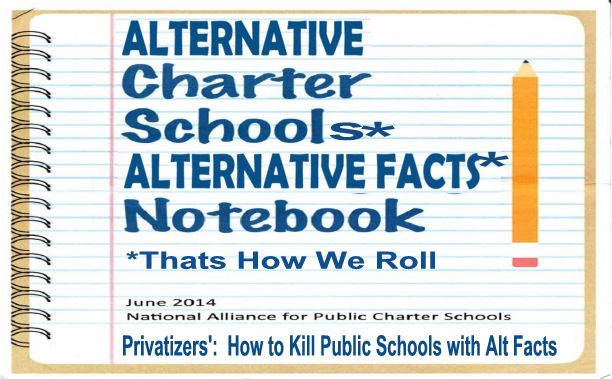
‘Alternative’ Education: Using Charter Schools to Hide Dropouts and Game the System School officials nationwide dodge accountability ratings by steering low achievers to alternative programs. In Orlando, Florida, the nation’s tenth-largest district, thousands of students who leave alternative charters run by a for-profit company aren’t counted as dropouts.
TUCKED AMONG POSH GATED COMMUNITIES, and meticulously landscaped shopping centers, Olympia High School in Orlando offers more than two dozen Advanced Placement courses, even more afterschool clubs, and an array of sports from bowling to water polo. U.S. News and World Report ranked it among the nation’s top 1,000 high schools last year. Big letters painted in brown on one campus building urge its more than 3,000 students to “Finish Strong.”
Olympia’s success in recent years, however, has been linked to another, quite different school five miles away. Last school year, 137 students assigned to Olympia’s attendance zone instead attended Sunshine High, a charter alternative school run by a for-profit company. Sunshine stands a few doors down from a tobacco shop and a liquor store in a strip mall. It offers no sports teams and few extra-curricular activities.
Sunshine’s 455 students — more than 85 percent of whom are black or Hispanic — sit for four hours a day in front of computers with little or no live teaching. One former student said he was left to himself to goof off or cheat on tests by looking up answers on the internet. A current student said he was robbed near the strip mall’s parking lot, twice.
Sunshine takes in cast-offs from Olympia and other Orlando high schools in a mutually beneficial arrangement. Olympia keeps its graduation rate above 90 percent — and its rating an “A” under Florida’s all-important grading system for schools — partly by shipping its worst achievers to Sunshine. Sunshine collects enough school district money to cover costs and pay its management firm, Accelerated Learning Solutions (ALS), a more than $1.5 million-a-year “management fee,” 2015 financial records show — more than what the school spends on instruction.
But students lose out, a ProPublica investigation found. Once enrolled at Sunshine, hundreds of them exit quickly with no degree and limited prospects. The departures expose a practice in which officials in the nation’s tenth-largest school district have for years quietly funneled thousands of disadvantaged students — some say against their wishes — into alternative charter schools that allow them to disappear without counting as dropouts.
“I would show up, I would sit down and listen to music the whole time. I didn’t really make any progress the whole time I was there,” said Thiago Mello, 20, who spent a year at Sunshine and left without graduating. He had transferred there from another alternative charter school, where he enrolled after his grades slipped at Olympia.
The Orlando schools illustrate a national pattern. Alternative schools have long served as placements for students who violated disciplinary codes. But since the No Child Left Behind Act of 2001 refashioned the yardstick for judging schools, alternative education has taken on another role: A silent release valve for high schools like Olympia that are straining under the pressure of accountability reform.
As a result, alternative schools at times become warehouses where regular schools stow poor performers to avoid being held accountable. Traditional high schools in many states are free to use alternative programs to rid themselves of weak students whose test scores, truancy and risk of dropping out threaten their standing, a ProPublica survey of state policies found.
Concerns that schools artificially boosted test scores by dumping low achievers into alternative programs have surfaced in connection with ongoing litigation in Louisiana and Pennsylvania, and echo findings from a legislative report a decade ago in California. The phenomenon is borne out by national data: While the number of students in alternative schools grew moderately over the past 15 years, upticks occurred as new national mandates kicked in on standardized testing and graduation rates.
The role of charter alternative schools like Sunshine — publicly funded but managed by for-profit companies — is likely to grow under the new U.S. Secretary of Education, Betsy DeVos, an ardent supporter of school choice. In her home state of Michigan, charter schools have been responsible in part for a steep rise in the alternative school population. She recently portrayed Florida as a national model for charters and choice.
by Hannah Fresques , Olga Pierce , Al Shaw and Heather Vogell Which districts have large numbers of students in alternative schools, and where are those schools potentially problematic?
by Heather Vogell and Ariana Tobin ProPublica and USA Today are teaming up to cover a neglected sector of American K–12 education: a vast and growing system of “alternative” schools. These schools are made up of roughly half a million of the nation’s most vulnerable students, and as our initial reporting shows, many are getting a second-tier education . Alternative schools have long served as dis
by Hannah Fresques , Heather Vogell and Olga Pierce Roughly half a million of the nation’s most vulnerable students are enrolled in a neglected sector of American K–12 education: a sprawling system of “alternative” schools.