Latest News and Comment from Education

Sunday, November 15, 2015

Schools Matter: Corporate Dixiecrat Version of ESEA Moves Closer to Passage

Schools Matter: Corporate Dixiecrat Version of ESEA Moves Closer to Passage:

Corporate Dixiecrat Version of ESEA Moves Closer to Passage


The latest version of the Elementary and Secondary Act to replace NCLB moved ever closer in the past couple of days, as a deal was struck on a final version that will be tinkered with over the next two or three weeks before a final vote that will come after Thanksgiving.

The new deal keeps enough of the federal requirements to make the testing industry breathe a sigh of relief, as annual testing will be remain in place.  Also, and importantly for the charter industry, the Feds will continue to require states to continue interventions for the bottom 5 percent of schools. 

So the charter profiteers will have plenty of room for growth (there will always be a bottom 5 percent), and even more importantly, Orrin Hatch and Michael Bennett made sure that billions will be available to fund the well-connected no excuses segregated chain gangs that have a record of high test scores:


“Too often, we fund unproven programs with little to show in the way of results. More of our federal dollars should work to encourage innovative programs and practices that can demonstrate significant education outcomes. Our Education and Innovation Research Program establishes a dedicated funding stream to support the development and expansion of evidence-based programs and practices designed and implemented by educators and local communities.”
Additionally, the new "dedicated revenue stream" will allow federal grants to other corporate welfare artists besides charter operators:

CURMUDGUCATION: KY: Big Data in Action

CURMUDGUCATION: KY: Big Data in Action:

KY: Big Data in Action


If you've been following the discussions of Competency Based Education and personalized educationand huge new data mining, and you've been wondering what it would all look like on the ground--well, let's go to Kentucky!

The US Department of Education is might proud of Kentucky and their embrace of a one-stop shop for data about students and teachers. That stop is called the Continuous Instructional Improvement Technology System, and yes, there are so many naming and branding problems with the system that it is almost endearing in its clunkiness. I would not be surprised for a moment if I learned that Kentucky teachers are in-serviced by watching a filmstrip accompanied by a cassette that includes droning narration and a beep every time the filmstrip is supposed to be advanced. The sort-of-logo is a misshapen star that is clearing racing across something, carrying the words "Unbridled learning" on its...um... back. I presume that's some sort of Kentucky horsey reference. On top of that, nobody seems to know what to do with the name, which I have now seen rendered as "CIITS" or "CiiTS" in a variety of fonts and, well, it comes across anywhere between awkward and grossly inappropriate. And how is it pronounced? Apparently "sits," which is kind of awesome, because now when a Kentucky teacher gets a lousy rating through the system, colleagues can say the teacher took a real sitz bath.

All I'm saying is that somebody did not perform due diligence on the naming of this thing.

So what is this thing actually?

It gives teachers ready access to student data, customizable lessons and assessments, and a growing 
CURMUDGUCATION: KY: Big Data in Action:


When THEY take dirty money it is BAD, but when WE do … well that’s different. - Wait What?

When THEY take dirty money it is BAD, but when WE do … well that’s different. - Wait What?:

When THEY take dirty money it is BAD, but when WE do … well that’s different.

Image result for dirty money logo


One of this week’s Emails from the Connecticut Democratic Party was another Call to Action to fight the influence of Corporate Money that is destroying our Democracy.
The email urged me to add my name to the historic effort to end the damage that is being caused by Supreme Court’s decision in the infamous Citizens United case that allowed corporate money to corrupt politics in the United States.
The Connecticut Democratic Party’s email reminded,
Ever since the disastrous decision of Citizens United v Federal Election Commission, the Koch brothers and their corporate cronies have been buying our democracy out from under us—and we can’t let it stand anymore.
Add your name and call for an end to Citizens United
NAME: Jonathan Pelto
SIGNATURE: PENDING
We have some bad news for you: your money is being used to help radical Tea Party Republicans win.
We know this is a shock to you—but it’s sadly true. That’s because HUGE corporations—where we buy our groceries, our gas for our cars, cleaning supplies—have unlimited influence over our elections, and they are POURING 
When THEY take dirty money it is BAD, but when WE do … well that’s different. - Wait What?:

An open letter to the Seattle School Board: Rethink idea of a raise and contract extension for the superintendent. | Seattle Education

An open letter to the Seattle School Board: Rethink idea of a raise and contract extension for the superintendent. | Seattle Education:

An open letter to the Seattle School Board: Rethink idea of a raise and contract extension for the superintendent.

Thirteen Thousand Dollar Question


The following is an open letter from parent, Jill MacCorkle, to Seattle’s current and newly elected School Board Directors. At the November 18, 2015 School Board meeting, Directors will be voting on a raise and contract extension for Superintendent Nyland. Jill’s previous email to the board, which compares Superintendents’ compensation across the state, can be found here: letter to directors re Nyland raise.   -Carolyn Leith
Dear Directors and Directors-Elect,
I am writing again about the matter before the board of a raise and contract extension for the superintendent. Having gotten no response from any directors to my previous email, I am presenting again my argument against a raise in the attached letter. This contains some revisions from my previous email and is the version that I sent to the media, so if you haven’t read my previous email, feel free to skip it in favor of reading this updated version.
Since the time that I first wrote to the board and now, the superintendent has offered to donate half of the proposed raise back to the district. That was a poor choice of options; parents want a superintendent who is wholehearted, not halfhearted. According to a report on November 6 from KPLU on the State of the Union address given by Dr. Nyland, the superintendent has stated, “My raise is not going to solve any of the issues we have on the table. I’ve done better than anyone else and I will take the smallest raise in the district as far as I know.” First of all, saying that he has done better than anyone else is not exactly a glowing testimony to his work, since the bar for recent superintendents (save Susan Enfield) is so low. His claim that his raise is not going to solve any issues on the table demonstrates what parents and teachers know: that while the superintendent may have an understanding of the issues that are important in the downtown office, he is out of touch on the issues that are ongoing in our buildings and classrooms. There is not a single parent, teacher, or administrator in any of our schools who couldn’t think of a problem they could address with $13,803, the amount of his raise. $13,803 would buy 3000 reams of paper, 920 hardcover books, one month ofORCA cards for Rainier Beach High School students, 552 soccer jerseys, 276 children’s winter coats, 106 graphing calculators, or 500 rat traps for Rogers Elementary. I know An open letter to the Seattle School Board: Rethink idea of a raise and contract extension for the superintendent. | Seattle Education:

CURMUDGUCATION: ICYMI: Sunday Reading from the Interwebs

CURMUDGUCATION: ICYMI: Sunday Reading from the Interwebs:

ICYMI: Sunday Reading from the Interwebs


Some reading for your Sunday afternoon leisure (if you have such a thing) 

The Investment

Jose Vilson went to New Jersey to talk to teachers there. This is a piece of what he had to say.

EngageNY Math, Now Eureka, a Common Core Dropping

One feisty teacher's journey into the land of pre-packaged, not-so-great math curriculum.

Plutocrats in Plunderland

Many of us took a swipe at the TeachStrong rollout this week. This piece gives us a good look at some of the connections being worked behind the curtain.

I also recommend this take on TeachStrong from Daniel Katz.

The Strange, True Story of How a Chairman at McKinsey Made Millions of Dollars off His Maid

This piece from The Nation is not directly related to education. But it is a well-researched story about corruption in New York and how the folks in the 1%  just kind of roll over the rest of us. If you've been following the reformster world, you know the name McKinsey, the consulting group responsible for growing so much of the reformster careers. Here's a good hard look at just what sort of people we're talking about.

Dear Mark

Emily Talmage is a Maine blogger with an interesting story. As an Amherst grad she fell into the arms of Teach for America, and then decided that she's like to be a real teacher. But before Amherst, she prepped at Phillips Exeter, where her time overlapped with that of Mark Zuckerberg. Here she is, writing a letter to her old classmate about his sudden interest in "personalized" learning.


Guest Post: No Excuse


Emily Kaplan is an elementary school teacher in the Boston area. She's currently teaching in a public school, but her previous experience is with one of the region's high-achieving charter chains. She has written here about both her experience and some lessons from it, and I'm pleased to publish this here with her permission.

NO EXCUSE: AN ARGUMENT AGAINST DECEPTIVE METRICS OF SCHOOL SUCCESS 

           Sixteen seven- and eight-year olds sit in a circle on the floor. On the wall to their left— the first thing they see upon entering and exiting the classroom, always done in complete silence— is a list of individual “Assessment Goals.” (This “no excuses” charter network creates its own high-stress tests, which all students take at least five times per month, beginning in kindergarten.) One student´s math goal reads, “I only use strategies that I know.” All are written in the teacher’s handwriting. Others include, “I read my work over so I don´t make careless mistakes.” “I begin each sentence with a capital letter.” “I draw base-ten blocks to show my work.”


On the wall to their right is a list of the class averages from the last six network assessments (taken by all second graders across the charter network´s three campuses), all of which are in the 50s and 60s. Even though these two-hour tests are designed by network leaders to be exceptionally challenging— a class average of an 80% is the holy grail of teachers, who use their students´ scores to compete for status and salary increases— this class´s scores are the lowest in the school, and the students know it.
The teacher speaks to them in a slow, measured tone. “When I left school Guest Post: No Excuse

With A Brooklyn Accent: The Best Decision I Ever Made

With A Brooklyn Accent: The Best Decision I Ever Made:

The Best Decision I Ever Made


 In the late 80's, I made a momentous decision. I decided to return the advance on a book that was 3/5 finished- a book that might well have taken me from Fordham to Columbia or Princeton or Yale- and devote the next ten years of my life to coaching and running youth programs in my Brooklyn neighborhood. It is a decision that I have never regretted. Not only did I have a chance to see my own two children mature into top flight athletes who played their sports in college, I had an opportunity to spend long hours with young people who came from some of Brooklyn's most hard pressed neighborhoods as well as Park Slope, which was then a mixed income community. Those experiences had a profound impact on me as a teacher and a scholar as well as bringing me great joy and a feeling of accomplishment. It is the players I coached who gave me an intensive exposure to hip hop, often on car rides around Brooklyn and Queens and up and down the Eastern seaboard , while revealing its relevance to their lives and experience. It was in those car rides in the early and mid 90's that I first heard Wu Tang, DMX, Biggie and JZ; along with stories that placed their music in context. It is through the basketball program I ran on Saturdays in JHS 51 that I learned that even the toughest young With A Brooklyn Accent: The Best Decision I Ever Made:

Puerto Rico Teachers Plan One-Day Strike to Protest Corporate Education Reform | gadflyonthewallblog

Puerto Rico Teachers Plan One-Day Strike to Protest Corporate Education Reform | gadflyonthewallblog:

Puerto Rico Teachers Plan One-Day Strike to Protest Corporate Education Reform

11214329_10153183230456981_1552435887463960982_n


Welcome to sunny Puerto Rico.
The ocean is a gorgeous cerulean blue. Palm trees wave gently in the salty breeze. And in the distance you can hear percussion, horns and singing.
The protest has begun.
12242864_10153398609583152_567773654_o
Residents of this United States territory have been fighting freshman GovernorAlejandro GarcĆ­a Padilla’s efforts to close public schools, privatize those left and shackle teachers to the same corporate education reform schemes that are crippling schools on the mainland.
This Tuesday island educators are asking parents not to send their children to school. Teachers plan to conduct a one-day strike to protest legislation that could be passed the same day to further cripple the Commonwealth’s public education system.
“On November 17th we’ll be giving our lesson’s outside our classrooms,” says Mercedes Martinez, president of the Federación de Maestros de Puerto Rico, the teachers union.
“We’ll be in front of our schools early in the morning and at 10:00 a.m. will march from Congress to the Governor’s Mansion in San Juan. This is one of many activities that we’ll perform in defense of public education. We will not accept these precarious impositions and will fight back.”
12212114_10153398609843152_2007230691_n

Questioning the power we give parents | @ THE CHALKFACE

Questioning the power we give parents | @ THE CHALKFACE:

Questioning the power we give parents


Opt out or test refusal movements offer tremendous power to parents because teachers may not, in the vast majority of cases, be able to assume the risks of resisting standardized testing. The argument goes that you can’t “fire” parents and they ultimately know what is best for their children (except when they don’t).
I’ve wondered over time if there are any caveats to teachers standing behind parents, relying on the parents to fuel the resistance. But what happens when the resistance crosses their children? The rejoinder might be, “Well, we have the best interests of children in mind, so technically it never will.”
I wouldn’t be so sure.
I was reminded once again of my previous thoughts about parent-power when reading about a beloved PE teacher’s abrupt dismissal over what seems like a very spurious accusation:
Sloan, 60, a popular coach hailed as a role model for overcoming his handicap, was yanked from PS 102 in Harlem after a parent setting up for a party last year complained she smelled booze on his breath. He claims it was the alcohol-based mouthwash.
Far be it from me to rely on the New York Post for anything friendly about teachers. Yet, how could an Questioning the power we give parents | @ THE CHALKFACE:

Schools and Obesity (Part 1) | Larry Cuban on School Reform and Classroom Practice

Schools and Obesity (Part 1) | Larry Cuban on School Reform and Classroom Practice:

Schools and Obesity (Part 1)


Recent articles trumpet that rates of children and adult obesity are not getting better (see here and here). In 2010, First Lady Michelle Obama launched an anti-obesity campaign “Let’s Move” to reduce rates of childhood obesity. While the campaign has gained traction results have been disappointing. As she saidrecently: “Right now, one in three kids in the U.S. is overweight or obese – for African American and Hispanic kids, the rate is nearly 40 percent. And obesity is now one of the leading causes for preventable death and disease in the United States.”
The “Let’s Move” campaign has cultivated close ties with large corporations (e.g., Wal-Mart) to persuade large companies to sell healthy product, directed media attention to overweight children and perils to their health as adults, and gained bipartisan support for a federal law in 2010 that mandated free-and-reduced price meals for 21 million children containing more healthy ingredients like fruit, vegetables, whole grains, lean protein and low-fat dairy products . The First Lady has gone to schools highlighting healthier lunches, bans on sugary sodas and fast food, and increased physical activity during the school day. She exercised with children and ate the nutritious meals served at lunch-time. While schools have been an important of the campaign, they have not been a wholly exclusive part of “Let’s Move” for the past five years. Note the words: “important” and “wholly exclusive” in referring to the role of schools in this and similar anti-obesity campaigns. As has national socioeconomic problems in the early 20th century such as Americanizing waves of eastern and southern European immigrants, seeking racial equity in desegregation since 1954 and, since the early 1980s, a stronger economy through tougher standards, accountability, and testing, the U.S.’s obesity problem has not become “educationalized.” Schools are part of any solution to obesity, campaigners assert, but the epidemic of obesity reaches into homes, stores, and the structures of a market-driven capitalism.
Why is that?
As rates of obesity in both children and adults trend upward–the U.S. has thehighest per-capita rate among developed nations–and its effects on health have Schools and Obesity (Part 1) | Larry Cuban on School Reform and Classroom Practice:

Why You Can Opt Out of Standardized Tests Without Fear of Penalties to Your School | Seattle Education

Why You Can Opt Out of Standardized Tests Without Fear of Penalties to Your School | Seattle Education:

Why You Can Opt Out of Standardized Tests Without Fear of Penalties to Your School

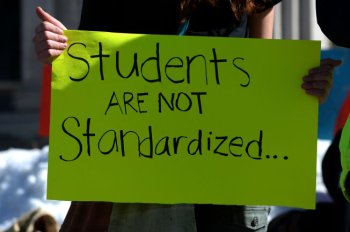
students-are-not-standardized


From Fair Test:
States, districts and schools sometimes claim they will lose federal Title I funds if parents, students or teachers boycott standardized tests required under No Child Left Behind (NCLB). However, in summer 2015 the U.S. Department of Education (DOE) acknowledged it has no plans to penalize districts or schools by withholding funds. That was DOE’s response after few districts in New York State reached NCLB’s 95% minimum participation requirement. While DOE said it could withhold funds if states do not do enough to persuade parents to participate, the chances of that happening are effectively zero.
As far as we know, no school or district anywhere in the country has ever been penalized for failing to test enough of its students. Further, seven states (Utah, Wisconsin, Pennsylvania, Minnesota, Oregon, Washington and California) have laws allowing opt out, and none have been sanctioned. In fact, Oregon made it easier for students to opt out in 2015, but DOE has done nothing. Neither has any state taken steps to cut funds to schools. New York State had threatened to do so, but like the feds backed down.
Therefore, parents, students and teachers should not fear harmful financial consequences to their schools due to federal law if Why You Can Opt Out of Standardized Tests Without Fear of Penalties to Your School | Seattle Education:

Why rich folks love charter schools | Seattle Education

Why rich folks love charter schools | Seattle Education:

Why rich folks love charter schools

…even though they would never send their children to one.

its-all-about-the-money-4-540x630


As a result of this change to the tax code, banks and equity funds that invest in charter schools in underserved areas can take advantage of a very generous tax credit. They are permitted to combine this tax credit with other tax breaks while they also collect interest on any money they lend out. According to one analyst, the credit allows them to double the money they invested in seven years. Another interesting side note is that foreign investors who put a minimum of $500,000 in charter school companies are eligible to purchase immigration visas for themselves and family members under a federal program called EB-5.
By Alan Singer
Obscure laws can have a very big impact on social policy, including obscure changes in the United States federal tax code. The 2001 Consolidated Appropriations Act, passed by Congress and signed into law by President Bill Clinton, included provisions from theCommunity Renewal Tax Relief Act of 2000. The law provided tax incentives for seven years to businesses that locate and hire residents in economically depressed urban and rural areas. The tax credits were reauthorized for 2008-2009, 2010-2011, and 2012-2013.
As a result of this change to the tax code, banks and equity funds that invest in charter schools in underserved areas can take advantage of a very generous tax credit. They are permitted to combine this tax credit with other tax breaks while they also collect interest on any money they lend out. According to one analyst, the credit allows them to double the money they invested in seven years. Another interesting side note is that foreign investors who put a minimum of $500,000 in charter school companies are eligible to purchase immigration visas for themselves and family members under a federal program called EB-5.
The tax credit may also explain why Facebook CEO Mark Zuckerberg partnered with the former mayor of Newark, New Jersey to promote charter schools, donated a half a Why rich folks love charter schools | Seattle Education:

Alexander: School reform bill could be on Obama’s desk by December - News Sentinel Story

Alexander: School reform bill could be on Obama’s desk by December - News Sentinel Story:

Alexander: School reform bill could be on Obama's desk by December


WASHINGTON — U.S. Sen. Lamar Alexander has made fixing the No Child Left Behind school-reform law his top priority as chairman of the Senate committee that oversees education issues.
The Maryville Republican is on the verge of achieving that goal as the year draws to a close.
The Senate voted 81-17 in July to pass a comprehensive bill that rewrites the landmark legislation and scraps the parts that critics say are no longer working. The House has passed its own bill, and negotiators for the two chambers are close to reaching a compromise and sending the legislation to President Barack Obama for his signature.
In an interview with the News Sentinel, Alexander talked about his push to reform the 13-year-old law and other matters before his committee.
Q: Can you give us a status report on the school reform bill, which you’re calling the Every Child Achieves Act?
A: My hope would be that the Senate and the House conference could meet before Thanksgiving, agree on a bill, send it back to the two houses, and then send it on to the president, and it will become law during December.
This is a bill that, as Newsweek magazine said everybody wants fixed. It has bipartisan support from teachers, governors, school administrators, parents. There’s no excuse for not getting it done. It will end the federal Common Core mandate, reverse the trend to a national school board and restore decisions about schools and children to parents, classroom teachers and communities, where those decisions should be.
Q: How confident are you that you can send a bill to the president in a form that he will sign?
A: Obviously, we’re doing some things President Obama disagrees with. But from the beginning of our discussions, the president and the White House have been very constructive, and we’ve tried to accommodate as many of his concerns as we can. I believe if we can agree on it, the president will sign it.
Q: What are the key differences in the House and Senate bills that will have to be worked out?
A: The fundamental issue was how much authority to restore to states and communities — how much more local control should there be of public schools. The Senate bill that passed is the biggest step toward local control of public schools in 25 years. It doesn’t go as far as I would like, but it’s an improvement. That’s No. 1.
The second big issue was testing. The conclusion we came to was to keep the 17 federal tests — tests the federal government requires, but that the states design and that a student will take during elementary and high school — and report the results of the tests so parents and a community can know how the schools and the students are doing, but put the responsibility for what to do about the tests back in the hands of classroom teachers and local school boards and states.
The explosion of testing, the over-testing that everyone is concerned about, has primarily come not from federally required tests but from the federal accountability system that told states and school boards what to do about the tests. As a result of that, states and local school districts are giving dozens of unnecessary tests because the federally required test counts for so much. Classroom teachers and local school boards know much better than Washington what to do about the results of the tests.
Q: What’s next for the Senate Health, Education, Labor and Pensions Committee, which you chair?
A: We have two big subjects coming up. One is deregulating and simplifying the federal rules on higher education, and that includes the jungle of red tape that is soaking up time and dollars for universities and administrators. But it also includes making the student aid application form simpler and the way students repay their loans simpler.
The student aid application form, called FAFSA, has 108 questions Alexander: School reform bill could be on Obama’s desk by December - News Sentinel Story:

Charter Schools as Incubators or Charter Schools Inc.? | Randi Weingarten

Charter Schools as Incubators or Charter Schools Inc.? | Randi Weingarten:

Charter Schools as Incubators or Charter Schools Inc.?


When you hear the words "charter school," what comes to mind? High expectations? High student attrition? High achievement? Lack of transparency?
There's no right or wrong answer, because charter schools, like other public and private schools, vary widely. The top-ranked high school in Louisiana is a unionized charter school. On the flip side, a recent study of students enrolled in online charter schools found that they lost 180 days of learning in math over the 180-day school year. (You read that right.)
Charter schools are publicly funded schools with flexibility in program design and operations. The late AFT President Albert Shanker was one of the first proponents, believing public school teachers could incubate innovative ideas, sharing successes and learning from setbacks. That was our goal in creating University Prep, a charter school in the South Bronx that the United Federation of Teachers co-founded with Green Dot Public Schools when I was UFT president. Now in our eighth year, 98 percent of students graduate, and almost all go on to college. The goal was never to undermine the many extraordinary district public schools--or to close or make it harder for traditional public schools.
Unfortunately, some charter proponents have shifted the intent of charters from incubating ideas and sharing successes to competing for market share and taxpayer dollars. A pro-charter group in New York recently ran deplorable ads suggesting they care more about equity than Mayor de Blasio does. The reality is that some charter school operators want to take public funds yet behave like private entities that can play by different rules.
Charter schools tend to enroll fewer students with disabilities, fewer English language learners, and a less-poor population of students than do nearby public schools. Reuters has reported on practices some charter operators use to "get the students they want." Some require character references from a religious or community leader, entry exams, or completion of lengthy forms (often only in English). A Philadelphia charter school accepted applications only one day each year--at a suburban country club.
Some charter schools reportedly "counsel out" or expel students just before state testing day. Recent exposĆ©s revealed that the Success Academy Charter Schools chain has suspended or expelled children as young as kindergartners--often for minor infractions--at a rate seven times higher than elementary students in New York City's public schools.
A new report revealed more than $200 million in fraud, waste and mismanagement in the 15 states examined of the 43 states that allow charters. The U.S. Department of Education this fall awarded $71 million for charter schools to Ohio--whose charter schools are notorious for financial and ethical scandals and academic results that lagfar behind traditional public schools--prompting an outcry from the state auditor. Federal officials have since placed restrictions on the funds.
Since 1995, the Education Department has awarded more than $3 billion to create and expand charter schools throughout the country, despite warnings by its inspector general that the department has provided inadequate oversight of federal funds sent to charter schools.
These failings hurt the charter school operators who are trying to operate aboveboard with students' best interests in mind. And rampant charter expansion undermines traditional public schools. A proposal to "charterize" half of the public schools in Los Angeles would not just disrupt the public school system, it would destroy it. Neighborhood public schools would be stripped of essential resources, programs and personnel, and the district would be bankrupted. These schemes, also playing out in Boston, Chicago, Philadelphia and elsewhere, aim not to supplement public schools Charter Schools as Incubators or Charter Schools Inc.? | Randi Weingarten:

America’s reliance on standardized tests is creating a generation of intellectual infants - Quartz

America’s reliance on standardized tests is creating a generation of intellectual infants - Quartz:
America’s reliance on standardized tests is creating a generation of intellectual infants


Can President Obama revolutionize the American education system before he leaves the White House? Probably not. But his “Testing Action Plan,” or TAP for short, is a step in the right direction.

On Oct. 24, the president took to Facebook to announce TAP, a new set of education guidelines that will reduce the amount of class time spent on standardized test preparation. The three-pronged guidelines prescribe reducing the amount of tests to those that are “worth taking,” that “enhance teaching and learning,” and that use evaluation as just one component of education assessment. After all, “learning is about so much more than filling-in the right bubble,” as Obama concluded at the close of the video.

Critics point out that the Obama administration has largely perpetuated the culture of over-testing through federal mandatesinaugurated by the Dubya years (something which Arne Duncan, the president’s outgoing secretary of Education, fully concedes to doing) and that the TAP guidelines are “vague.” Then there’s the rather glaring fact that the education system has become so ensnarled in the for-profit testing industry that we can’t imagine what the school day would be like without test preparation and test taking, or how to finance the system without the industry. The Common Core is big business. As David Dayen for Salon notes, the Big Four private companies—Pearson, ETS, Houghton Mifflin Harcourt, and McGraw-Hill— “have spent over $20 million lobbying the government between 2009-2014, insisting on more testing to boost their profits … The testing sector generates $2 billion in annual revenue, so the return on investment is excellent.”
Corporate welfare, in other words, depends on the continuation of the culture of over-testing—the buying of test prep books, the hiring of tutors, and so forth. When education relies on a corporate industry to this extent, large-scale changes may indeed bring some amount of change.

As a college professor who has witnessed the deleterious effect of a test-focused education in her 10 years in the classroom, I can say that Obama’s call for revising standardize testing standards is a welcome and necessary change. Education is, at its heart, designed for a noble purpose: to create thoughtful, independent citizens of the world. School should be about learning to think critically—not learning how America’s reliance on standardized tests is creating a generation of intellectual infants - Quartz: