Latest News and Comment from Education

Saturday, August 10, 2019

TNTP is a Part of the Destroy Public Education Infrastructure | tultican

TNTP is a Part of the Destroy Public Education Infrastructure | tultican

TNTP is a Part of the Destroy Public Education Infrastructure

By T. Ultican 8/10/2019
TNTP is one of several organizations that only exist because billionaires have financed them. Wendy Kopp founded TNTP (originally called The New Teachers Project) in 1997. She assigned Michelle Rhee, who had recently finished a two year Teach For America (TFA) tour, to run TNTP. Along with TNTP and TFA there are also the uncertified Broad Superintendents Academy, the fake schoolfor professional educators, Relay Graduate School and others forming a significant part of the infrastructure instilling a privatization mindset into the education community.
TNTP says it mission is to partner with educational entities to:
  • “Increase the numbers of outstanding individuals who become public school teachers; and
  • “Create environments for all educators that maximize their impact on student achievement”
These are laudable goals but why would any school district or state education department turn to an organization with minimal academic background and experience to train teachers and school leaders? Michelle Rhee earned a B.A. in Government from Cornell and a master’s in public policy from Harvard with no education studies. In the Book Chronicle of Echoes, Mercedes Schneider observes that “Wendy Kopp was a child of privilege”. She left her exclusive Highland Park neighborhood in Dallas to study International Affairs at Princeton. Kopp had no education experience or training and Rhee had five weeks of training to go along with two years experience teaching elementary CONTINUE READING: TNTP is a Part of the Destroy Public Education Infrastructure | tultican 

Stop Blaming Teachers For Cruddy Systems - Teacher Habits

Stop Blaming Teachers For Cruddy Systems - Teacher Habits

Stop Blaming Teachers For Cruddy Systems


We are surrounded by systems. A heating and cooling system is right now controlling the temperature of your house. An operating system controls the device you’re staring at. Should you buy something online, you’ll be at the mercy of a web site’s checkout system. If you leave the house, you’ll either enter your city’s traffic system or take advantage of its public transportation system. Go to Starbucks and you’ll encounter a new system. McDonald’s, a different system. Should you need to visit a doctor or dentist, you’ll be pushed into yet more systems. And when you return home tonight and want nothing more than to lie on your couch to watch a movie, you’ll need to navigate Netflix’s, or Prime Video’s, or your local Family Video’s system to do so.
We appreciate some systems and are annoyed by others. I like Pandora Music’s system; hit a button and it does the rest for me. I like my employer’s direct deposit system. My car is full of helpful and easy to use systems. On the other hand, if I could, I would forever avoid America’s tax and health care systems, and I only visit the Department of Motor Vehicles when there’s no other choice, and only then when I think there will be no other people there (which is never, in case you’re CONTINUE READING: Stop Blaming Teachers For Cruddy Systems - Teacher Habits

CURMUDGUCATION: Reed Hastings: Stars In Every Position

CURMUDGUCATION: Reed Hastings: Stars In Every Position

Reed Hastings: Stars In Every Position

We’re like a pro sports team, not a kid’s recreational team. Netflix leaders hire, develop and cut smartly, so we have stars in every position.

That's Reed Hastings in a 2009 interview about his then-juggernaut business, Netflix. I came across it recently and, because Hastings has approached education and charter schools with the same business attitude, hoping to turn charter schools into a Netflix-style success story, it seems worth doing a deep read.


This guy.
Hastings has had his hand in many charter pies, from backing outfits like Rocketship and KIPP, as well as serving on the board of California Charter Academy, a chain that collapsed mid-year, leaving 6,000 students high and dry to helping shape charter law in California. Hastings has also had a hand in the launch NewSchools Venture Fund, an investment group that backs ed tech and other edupreneurs. So we're not talking fringe player here.

So what do we discover in this quote?

First, the "pro sports team, not a kid's recreation team" aspect. A pro sports teams picks and chooses its players. A public school does not. Nor can a public school "cut" students who don't measure up.

"Stars in every position" is the same focus. In Hasting's mind, that may apply only to the staff and administration of a school, but people who actually work in education know that part of what CONTINUE READING: 
CURMUDGUCATION: Reed Hastings: Stars In Every Position


Jeremy Mohler: What Is Democracy? Bargaining for the Common Good | Diane Ravitch's blog

Jeremy Mohler: What Is Democracy? Bargaining for the Common Good | Diane Ravitch's blog

Jeremy Mohler: What Is Democracy? Bargaining for the Common Good

Jeremy Mohler of the organization “In the Public Interest” wrote this reflection on the meaning of democracy:
The word “democracy” either fires you up or makes your eyes roll.
It’s so overused that even Donald Trump is wielding it to ramp up support for his administration’s meddling in Venezuela.
There’s even a new documentary out called What is Democracy? by filmmaker and activist Astra Taylor, who interviews everyone from philosophers to factory workers to get at the answer. The conclusion? There’s no definitive single answer to the question.
Maybe all we can say is: you know democracy when you see it.
I certainly see a refreshing example of democracy on display in the growing public school teachers movement. And it’s the real thing—not the electoral kind that we’re used to.
It’s called “bargaining for the common good.” The gist: teachers and other government workers use their ability to negotiate for better wages and working conditions to also improve the lives of other people in their community.
Some recent examples:
In January, striking teachers in Los Angeles won better wages and benefits but also 300 more nurses district wide, more green space at every school, support for immigrant families, a stop to random police searches at schools, and more.
In Oregon, the state’s largest unions came together a few years ago to collectively win higher wages, paid sick CONTINUE READING: Jeremy Mohler: What Is Democracy? Bargaining for the Common Good | Diane Ravitch's blog

CURMUDGUCATION: What Does "Personalized Learning" Even Mean?

CURMUDGUCATION: What Does "Personalized Learning" Even Mean?

What Does "Personalized Learning" Even Mean?


Personalized learning is all over the educational landscape these days, even though nobody can offer a clear and consistent explanation for what it might be. The field encompasses everyone from teachers designing more effective methods to businesses with a new edu-product to sell. Assuming for the moment that there is no solid, universal definition, let's consider the different aspects of instruction that could be involved when someone is pitching personalized learning.
Pace
Personalized learning can refer simply to pace. All students cover the same materials in the same order, moving at whatever speed seems to best suit them. If you're old enough to remember doing SRA reading exercises out of the box in your elementary classroom, you have experienced this type of personalization.
Timeline
A more extreme version of pace. Some versions of personalization involve flexible time, with the student allowed as much (or as little) time as is required for them to show mastery of that particular unit. This often requires changes to the traditional rules in order to accommodate students with wildly different, so that Pat's school year may be less than 180 days and Chris's might be more. This could mean that Pat could finish high school by age 15 while Pat was still there at age CONTINUE READING: CURMUDGUCATION: What Does "Personalized Learning" Even Mean?

Toni Morrison and Motherhood – Parenting for Liberation

Toni Morrison and Motherhood – Parenting for Liberation

Toni Morrison and Motherhood

“There was something so valuable about what happened when one became a mother. For me it was the most liberating thing that ever happened to me. Liberating because the demands that children make are not the demands of a normal ‘other.’ The children’s demands on me were things that nobody ever asked me to do. To be a good manager. To have a sense of humor. To deliver something that somebody could use. And they were not interested in all the things that other people were interested in, like what I was wearing or if I were sensual. Somehow all of the baggage that I had accumulated as a person about what was valuable just fell away. I could not only be me—whatever that was—but somebody actually needed me to be that. If you listen to [your children], somehow you are able to free yourself from baggage and vanity and all sorts of things, and deliver a better self, one that you like. The person that was in me that I liked best was the one my children seemed to want.” -From Toni Morrison and Motherhood: A Politics of the Heart 
📷 Jill Krementz

Toni Morrison and Motherhood – Parenting for Liberation


Largest U.S. Pediatric Group Says Racism Harms Black Children and Adolescents

Largest U.S. Pediatric Group Says Racism Harms Black Children and Adolescents

Pediatricians: Black Children Suffer Significantly From Racism

Image result for Black Children Suffer From Racism
Surprise! Racism—that “thing” white people say doesn’t exist—has dire long-term effects on the health of black children and adolescents, according to a report released by the country’s largest group of pediatricians.
The report, crafted into a first-of-its-kind policy statement from the American Academy of Pediatrics, calls racism “a socially transmitted disease passed down through generations, leading to the inequities observed in our population today.” It draws on 180 studies to reach its conclusions and includes specific recommendations.
It also notes that in Trump’s America (read: “the current political and cultural atmosphere,” according to the Washington Post), the danger to children is more acute and the work more urgent.
“If you look at what’s in the news today, in social media, on Twitter, there is so much kids are exposed to,” said Jackie Douge, a pediatrician who co-wrote the policy, to the Post. “As much as you want to keep it in the background, it’s not in the background. It’s having direct health effects on kids.”
The effects of racism have long been documented by the medical community and has dire effects on our health, as The Post reports:
Exposure to racism in adults has been linked to an increased risk of heart CONTINUE READING: Largest U.S. Pediatric Group Says Racism Harms Black Children and Adolescents

Hitting Left with the Klonsky Brothers. Jackie Serrato and Rossana Rodriquez. – Fred Klonsky

Hitting Left with the Klonsky Brothers. Jackie Serrato and Rossana Rodriquez. – Fred Klonsky

HITTING LEFT WITH THE KLONSKY BROTHERS. JACKIE SERRATO AND ROSSANA RODRIQUEZ.

Both Jackie and Rossana have been on Hitting Left before so we all laughed when they screwed up the intro.
Live radio.
We asked them both to come back because we wanted to spend some time talking about the recent events in Puerto Rico and issues of immigration and white supremacy.
Mike had originally asked our old friend and comrade Cha Cha Jimenez, the founder of the Young Lords Party in the late 60s to come on the show. But Cha Cha couldn’t work the schedule and it was he who suggested Jackie.
A writer for the Chicago Reporter, Jackie has been covering events in Little Village and Pilsen. She’s also been doing a story, yet to be published, on the Rainbow Coalition that was created in Chicago 50 years ago. It was made up of the Young Lords, the Black Panther Party, an Uptown group of white working class youth called the Young Patriots and Students for a Democratic Society.
When my brother asked Jackie about one of the things she learned from looking back at that history, Jackie’s response was both surprising and full of insight.
She said that as a woman who was not born yet at the time of that Movement, she was impressed that the idea of what we call intersectionality today is not new. She saw it in that Movement from 50 years ago.
Rossana explodes with energy just walking into the Lumpen Radio studio on Morgan Street in Bridgeport.
She is the City Council member representing the north west side 33rd Ward that CONTINUE READING: Hitting Left with the Klonsky Brothers. Jackie Serrato and Rossana Rodriquez. – Fred Klonsky

Take A Look At America's Segregated — And Unequal — Schools : NPR

Take A Look At America's Segregated — And Unequal — Schools : NPR

PHOTOS: Where The Kids Across Town Grow Up With Very Different Schools

On one side of the line — fresh paint and computer labs.
Across that line? Old textbooks, broken chairs and, above all, many more students of color.
Decades after Brown v. Board supposedly ended segregated schooling, these boundaries show a country where education remains deeply divided and unequal.
"You know it as soon as you look at the school. You know it the minute you walk into a classroom," says Rebecca Sibilia, the founder and CEO of EdBuild. Her organization has a new report on the pervasive inequality in U.S. schools. "There are kids who see this every day, and they understand."
Across the country, racist housing policies created segregated neighborhoods. And because many schools in the U.S. are funded locally, through property taxes or other funds, school districts with wealthier residents are able to funnel money to their schools. Neighboring school districts miss out.
Additional money from state and the federal governments is meant to close these local funding gaps, but it's seldom enough.
Decades after Brown, housing segregation combined with this funding model have entrenched what EdBuild calls "racially isolated" school systems. In nearly 1,000 communities, according to EdBuild, one school district directly abuts a district that differs dramatically by racial makeup and spending per student.
Almost 9 million students attend these underfunded, racially isolated districts.
NPR sent photographers to several of them across the country to document the stark differences across these borders.
This is what they saw.

Stark differences, in black and white

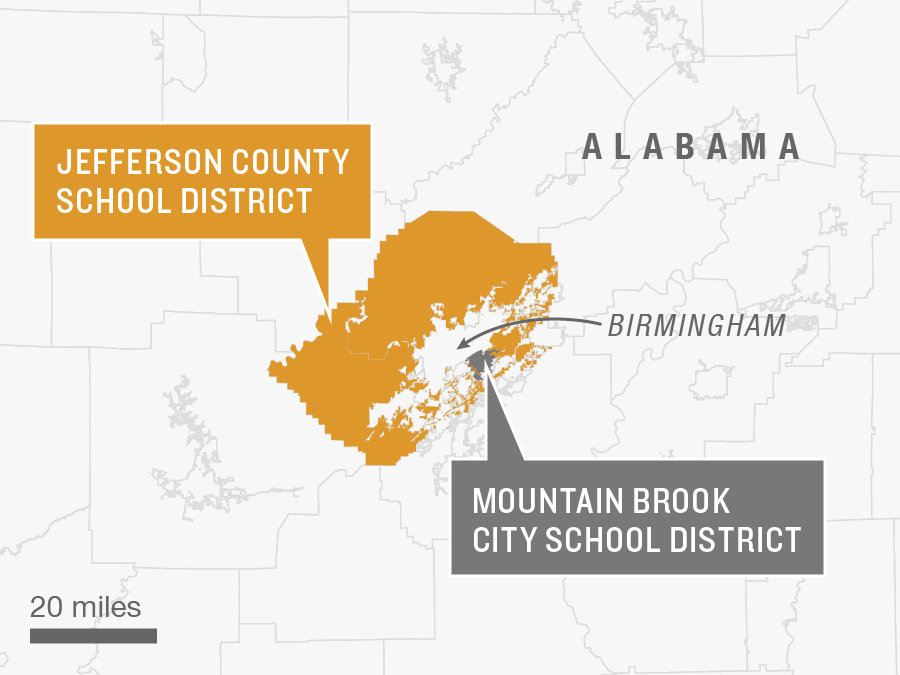
JEFFERSON COUNTY SCHOOLS / MOUNTAIN BROOK CITY SCHOOL DISTRICT
OUTSIDE BIRMINGHAM, ALA.
Map showing the two school districts near Birmingham in Alabama
JEFFERSON COUNTYMOUNTAIN BROOK CITY
Enrollment36,1714,343
Total revenue per pupil$9,220$14,327
Percent nonwhite58%4%
Poverty rate17%6%
Median household income$27,932$70,625
Owner-occupied median property value$134,400$578,100

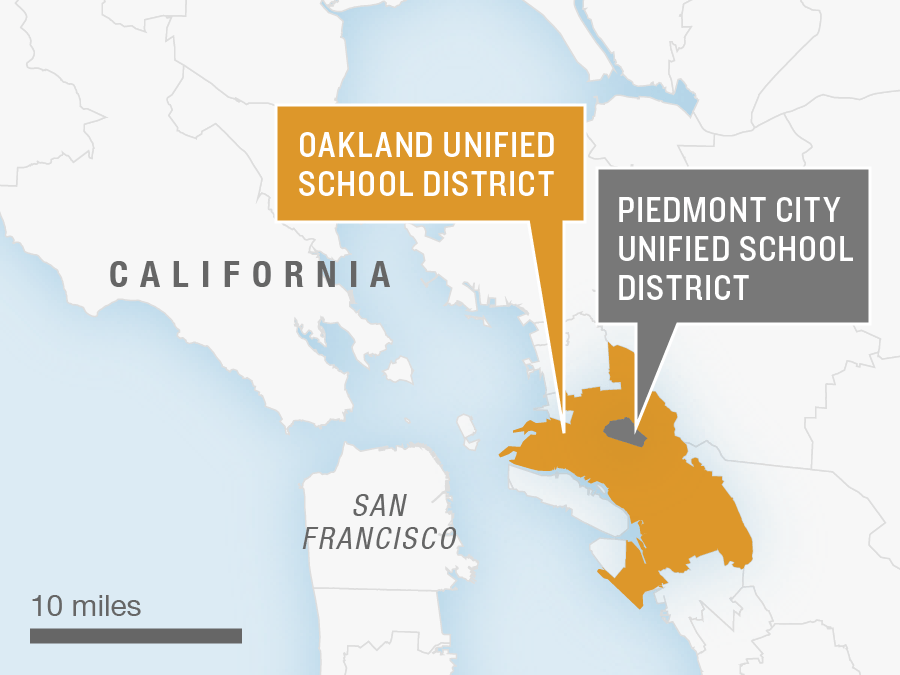
An island of wealth surrounded by the city of Oakland

OAKLAND UNIFIED SCHOOL DISTRICT / PIEDMONT CITY UNIFIED SCHOOL DISTRICT
NORTHERN CALIFORNIA
Map showing the two Bay Area school districts
OAKLANDPIEDMONT CITY
Enrollment49,7602,692
Total revenue per pupil$12,721$17,725
Percent nonwhite90%40%
Poverty rate18%2%

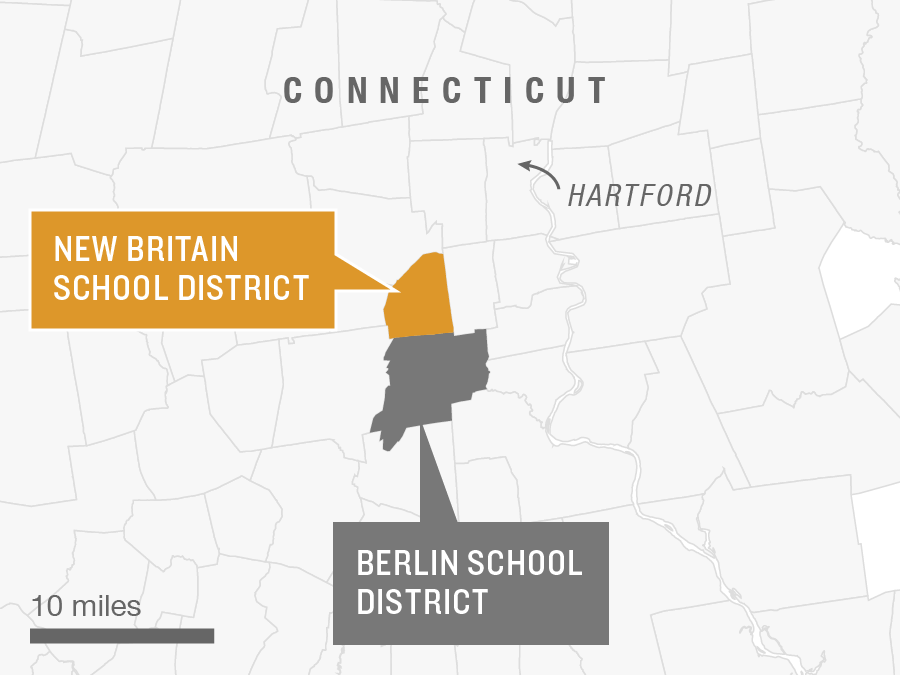
In Connecticut, one district "eclipsed" by its neighbor

NEW BRITAIN SCHOOL DISTRICT / BERLIN SCHOOL DISTRICT
HARTFORD, CONN.
Map showing the two school districts
NEW BRITAINBERLIN
Enrollment10,0652,791
Total revenue per pupil$16,251$21,579
Percent nonwhite80%18%
Poverty rate31%5%
Median household income$43,611$93,328
Owner-occupied median property value$156,800$281,100

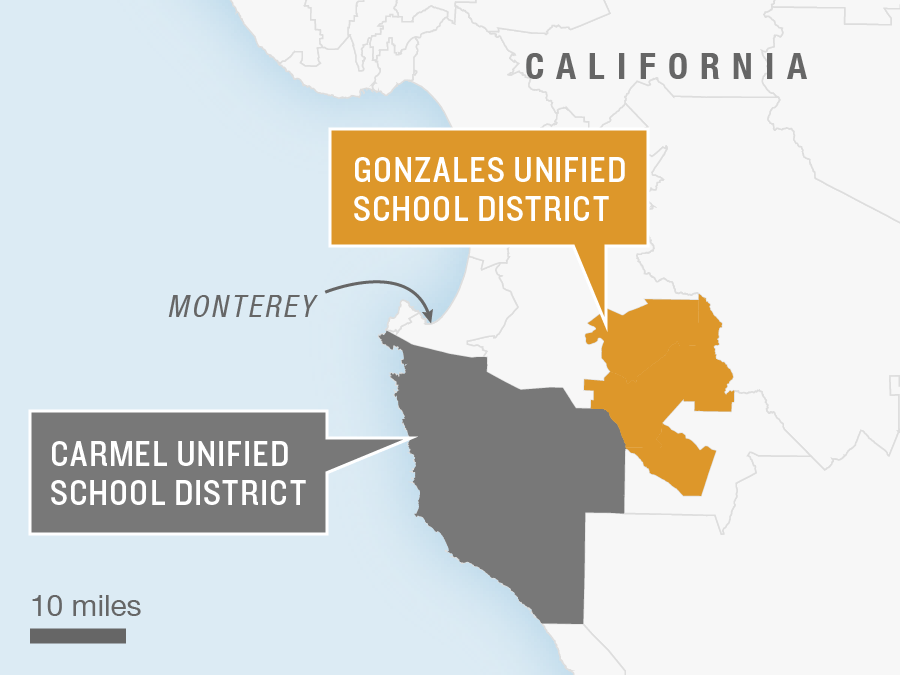
The California coastline, marked by inequality

GONZALES UNIFIED SCHOOL DISTRICT / CARMEL UNIFIED SCHOOL DISTRICT
CARMEL, CALIF.
Map showing the two school districts
GONZALESCARMEL
Enrollment2,4242,509
Total revenue per pupil$12,341$24,183
Percent nonwhite98%38%
Poverty rate18%6%
Median household income$52,656$90,492
Owner-occupied median property value$325,700$1,073,700
CONTINUE READING: Take A Look At America's Segregated — And Unequal — Schools : NPR