Latest News and Comment from Education

Monday, December 26, 2016

Jersey Jazzman: "Kingdom Gain" Through School Vouchers: It's Already Working

Jersey Jazzman: "Kingdom Gain" Through School Vouchers: It's Already Working:

"Kingdom Gain" Through School Vouchers: It's Already Working


Why do our new Secretary of Education and her husband support school vouchers? Back in 2001, they were quite candid about it:

The billionaire philanthropist whom Donald Trump has tapped to lead the Education Department once compared her work in education reform to a biblical battleground where she wants to "advance God's Kingdom." 
Trump’s pick, Betsy DeVos, a national leader of the school choice movement, has pursued that work in large part by spending millions to promote the use of taxpayer dollars on private and religious schools. 
Her comments came during a 2001 meeting of “The Gathering,” an annual conference of some of the country’s wealthiest Christians. DeVos and her husband, Dick, were interviewed a year after voters rejected a Michigan ballot initiative to change the state’s constitution to allow public money to be spent on private and religious schools, which the DeVoses had backed. 
In the interview, an audio recording, which was obtained by POLITICO, the couple is candid about how their Christian faith drives their efforts to reform American education.
School choice, they say, leads to “greater Kingdom gain.”
 
The two also lament that public schools have “displaced” the Church as the center of communities, and they cite school choice as a way to reverse that troubling trend. [emphasis mine]
The DeVoses made these comments at "The Gathering," an annual conference of wealthy Christians that pushes a hard-right social agenda, including normalizing homophobia, Jersey Jazzman: "Kingdom Gain" Through School Vouchers: It's Already Working:


Democratic Schooling | Deborah Meier on Education

Democratic Schooling | Deborah Meier on Education:

Democratic Schooling

I have argued in speech and writing for years that democracy is not “natural.” Although it is well within our human capacities it is not our “default” position. To demonstrate this would take longer than this blog/web allows. But I think there are good solid reasons why as a specie we retreat to authoritarian solutions so often. We cut corners when it seems too important to trust “our members,” our fellow citizens, etc. Sometimes we do it with open eyes and often we do it with eyes closed. We organize our organizations, our schools, our towns, cities and federal governments in ways that make some have a head start, extra weight, etc, etc. I am even in favor of some of these obstacles we place on “pure” forms of democracy.
As an educator the place I have tried to explore and work with creating Democratic organizations has been in my schools. As we designed and lived with our original plan at Mission Hill (the K-8 school I was one of the founders of in Boson in 1997) we saw flaws and we wrestled with them. Some we changed, others we lived with because we could not see how to improve them. We did not include everyone on our Governing Board, like the cook and maintenance staff. Probably we should have? We did not include students for many years, and then just 7th and 8th graders. I can defend this decision but what were the trade-offs? We worked out a consensus system that required the approval of three out of the five elected representatives of each constituency group to move ahead. We also gave the principal the power to delay a vote if he/she felt it was a matter of the health/safety of children or fiscal irresponsibility—two areas he/she was legally responsible for. In case of a paralyzed situation (like we have had in D.C.) we had a plan for bringing in mediators and if need be, a new vote of representatives, or a change in leadership.
It was in working these out that I learned to understand more about the problems a Democratic Schooling | Deborah Meier on Education:

How Indiana’s school voucher program soared, and what it says about education in the Trump era - The Washington Post

How Indiana’s school voucher program soared, and what it says about education in the Trump era - The Washington Post:

How Indiana’s school voucher program soared, and what it says about education in the Trump era


Indiana lawmakers originally promoted the state’s school voucher program as a way to make good on America’s promise of equal opportunity, offering children from poor and lower-middle-class families an escape from public schools that failed to meet their needs.
But five years after the program was established, more than half of the state’s voucher recipients have never attended Indiana public schools, meaning that taxpayers are now covering private and religious school tuition for children whose parents had previously footed that bill. Many vouchers also are going to wealthier families, those earning up to $90,000 for a household of four.
The voucher program, one of the nation’s largest and fastest-growing, serves more than 32,000 children and provides an early glimpse of what education policy could look like in Donald Trump’s presidency.
Trump has signaled that he intends to pour billions of federal dollars into efforts to expand vouchers and charter schools nationwide. Betsy DeVos, his nominee for education secretary, played an important role in lobbying for the establishment of Indiana’s voucher program in 2011. And Vice President-elect Mike Pence led the charge as the state’s governor to loosen eligibility requirements and greatly expand the program’s reach.
The notion of sending taxpayer funds to private and parochial schools is one of the most polarizing ideas in education. To proponents, the rapid expansion of Indiana’s program is a model for giving more families the chance to seek better educational options. But Indiana’s How Indiana’s school voucher program soared, and what it says about education in the Trump era - The Washington Post:


Hoosier School Heist TV is Doug Martin's channel featuring videos of his book tour across Indiana speaking on the corporate takeover of public education. Order Hoosier School Heist at http://hoosierschoolheist.com/.
Follow Hoosier School Heist on Facebook: https://www.facebook.com/HoosierSchoolHeist
Tweet with Doug Martin at: https://twitter.com/DougMartinED

Trump ally who wished death on Obama is a school board member, and calls for his removal are growing - The Washington Post

Trump ally who wished death on Obama is a school board member, and calls for his removal are growing - The Washington Post:

Trump ally who wished death on Obama is a school board member, and calls for his removal are growing


The co-chairman of Donald Trump’s presidential campaign in New York, who wished death on President Obama in 2017, is a member of the Buffalo Board of Education — but that could soon change. There are calls for him to be forced off the board because of vile remarks he has made about the president and first lady.
Carl Paladino, a wealthy Republican businessman who says he is “friends” with Trump, was among a group of New Yorkers asked by the alternative newspaper Artvoice to answer questions about their wish list for the new year.
In response to a question about his biggest wish in 2017, Paladino said he hoped “Obama catches mad cow disease after being caught having relations” with a cow, then dies and is buried in a cow pasture. He also said he hopes Michelle Obama would “return to being a male and let loose in the outback of Zimbabwe where she lives comfortably in a cave with Maxie, the gorilla.”
Paladino was blasted by elected officials, including New York Gov. Andrew M. Cuomo (D); his alma mater, St. Bonaventure University; and others for his remarks. Trump transition team spokeswoman Jessica Ditto said, “Carl’s comments are absolutely reprehensible, and they serve no place in our public discourse.” The transition team did not, however, say whether it was disassociating itself from Paladino.
Paladino has been a member of the Buffalo school board since winning election in 2013. He is known for making highly controversial statements; during his unsuccessful 2010 gubernatorial campaign, he was accused of sending graphically racist and sexist emails to some friends.
Calls for Paladino to resign were made by Erie County Executive Mark C. Poloncarz, as well as Trump ally who wished death on Obama is a school board member, and calls for his removal are growing - The Washington Post:
Big Education Ape: How is Carl Paladino Still on the Buffalo School Board? -Badass Teachers Association - http://bigeducationape.blogspot.com/2016/12/how-is-carl-paladino-still-on-buffalo.html

Schooling in the Ownership Society: New for-profit ed management company won't pull Ohio charters out of the muck.

Schooling in the Ownership Society: New for-profit ed management company won't pull Ohio charters out of the muck.:

New for-profit ed management company won't pull Ohio charters out of the muck.


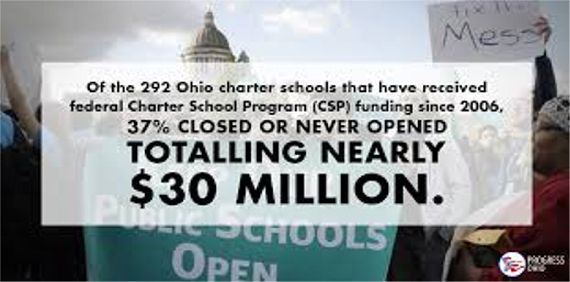
Few states rely so heavily on for-profit management companies as does Ohio. Lately, corporate reformers at the Cambridge Education Group, have formed a new charter school network in to try and clean up the mess created by their former notorious company, for-profit White Hat charters. But Cambridge's new name is not enough to pull them from the muck and corruption of "free market" education.

The company was formed in 2012, founded by Marcus May, a former White Hat executive.

Beacon Journal staff writer, Doug Livingston writes:


The Akron company and the 20 Ohio charter schools it manages are seeking to disentangle themselves from the likes of White Hat Management, a primordial force in Ohio’s charter school movement.
 But Cambridge claims to be different. It has no interest in owning school assets or signing property leases that make it hard for school boards to fire the management companies they hire.
But, writes Livingston, "Cambridge, for all its promise, can’t shake a past rife with questionable business relationships."

Summit Academy, White Hat, Concept Schools of Illinois and Imagine Schools of 
Schooling in the Ownership Society: New for-profit ed management company won't pull Ohio charters out of the muck.:


Will we see you at our 2017 conference? - Network For Public Education

Will we see you at our 2017 conference? - Network For Public Education:

Will we see you at our 2017 conference?

We are now planning for our 2017 conference on October 14 and 15 at the Marriott in Oakland, California. We need your help to determine our facility needs. Please answer a short, three question survey today.
You will find the survey here.
Please also participate in our Stop Betsy DeVos campaign. You can find everything you need here.
As we battle against the destruction  of our democratically governed, public schools, NPE continues to study the role of charter schools in privatization. You can read the latest in our charter school series in the Washington Post Answersheet here.
Thanks for all that you do, and happy holidays!  And don’t forget to remember NPE in your end of year giving. You can make your tax deductible donation here.
Happy holidays and thanks.
Carol Burris Executive Director, NPE
 Will we see you at our 2017 conference? - Network For Public Education:

How Hedge Funds Will Profit from School Privatization | The Huffington Post

How Hedge Funds Will Profit from School Privatization | The Huffington Post:

How Hedge Funds Will Profit from School Privatization


In the News: A number of news items in recent weeks show how powerful money-brokers work inside and outside the law in their war on public education in the United States.
(1) In the State of Washington, a State Supreme Court Judge up for reelection sided with a 6-to-3 court majority in a ruling that declared a state law directing tax dollars to independently run charter schools unconstitutional. To remake the court in their image hundreds of thousands of pro-charter Bill Gates and Paul Allen “Microsoft money” was donated to support his opponents campaign. Fortunately Washington voters rejected the charter judge, this time.
(2) Federal authorities charged seven leaders of the Platinum Partners hedge fund with fraud for operating what was alleged to be a “Ponzi scheme.” They kept the fund afloat by continually using money from new investors to pay off older investors who wanted out. Mark Nordlicht, founder and the chief investment officer for Platinum, also dabbles in operating low-cost religious schools that would benefit from the Trump-Amway DeVos voucher give-away
(3) The New York Times Business pages featured Bill Ackman of Pershing Square Holdings in an article they called “Hedge Fund Math: Heads or Tails, They Win.” It seems that even when his hedge fund performs poorly, Ackman always takes a profitable slice of the pie. According to the Los Angeles Times, Ackman’s Pershing Square Foundation has poured millions of dollars into promoting charter schools in their city. Ackman, through his foundation, is also a major donor to private schools and to Teach for America.
(4) Old friends at New York’s Success Academy Charter Network are under investigation by the city’s Comptroller for lax financial oversight, poor record keeping, understating administrative costs, and for billing the Department of Education for special education services they did not provide to students. The How Hedge Funds Will Profit from School Privatization | The Huffington Post:

Crass Edupolitics, Failed Mainstream Media in South Carolina | the becoming radical

Crass Edupolitics, Failed Mainstream Media in South Carolina | the becoming radical:
Crass Edupolitics, Failed Mainstream Media in South Carolina


An Op-Ed in The State and Paul Bower’s Charter school advocates shifting gears in South Carolina (The Post and Courier) inadvertently reveal the same message: South Carolina remains mired in crass edupolitics.
StudentsFirst and 50CAN have become SouthCarolinaCAN, but the merging and renaming hasn’t changed a truly ugly fact: these education advocacy groups across the US have no credibility and are created to provide individuals political platforms that benefit the so-called leaders and the pro-privatization forces funding and supporting these constantly morphing organizations.
Yet mainstream media continues to allow these groups and their leaders significant platforms for their misleading propaganda while educators are nearly absent from the public debate.
Crass edupolitical organizations are a sham, but as long as mainstream media continues to shirk their responsibility to support credible sources, it is the media who are at fault here.
Edujournalism has been and continues to be one of the elements contributing to post-truth fake news.
The crass edupolitics infecting SC remains committed to failed policies such as takeover districts, charter schools, and school choice because these organizations and their leaders are not concerned about education, but about their own political agendas.
Since I have addressed these issues repeatedly, I offer here a few posts below:
The media must choose credibility over press-release journalism if our public institutions, such as public schools, and our democracy has a chance to recover from post-truth fake news.


'The Bad Kids' Showcases Schools for At-Risk Students - The Atlantic

'The Bad Kids' Showcases Schools for At-Risk Students - The Atlantic:

Where the 'Bad Kids' Go to School

A 2016 documentary magnifies an often ignored part of the education world.
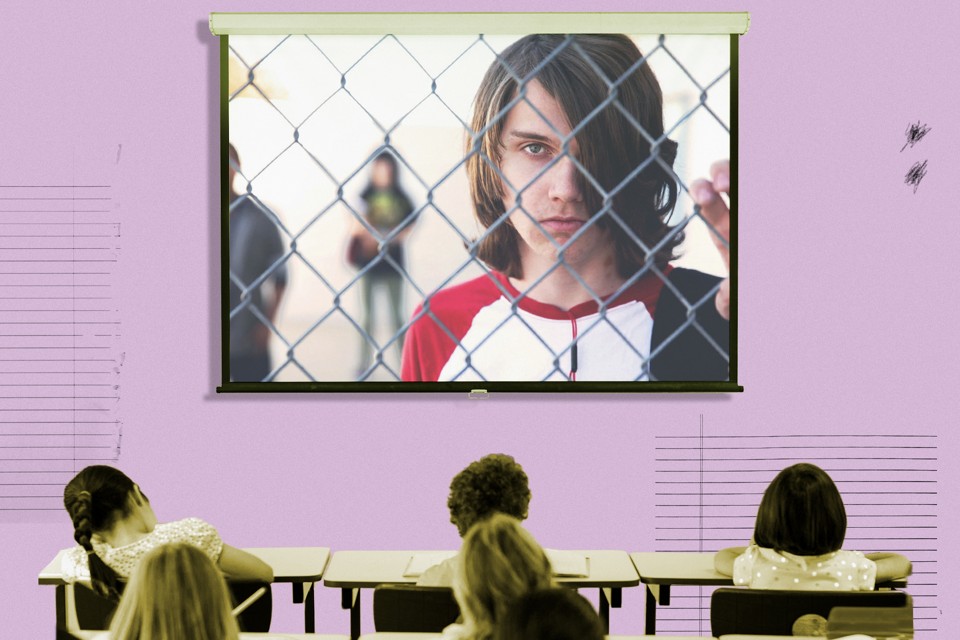
A frame from the documentary "Bad Kids" fills the screen of a projector in a classroom.

This is the first installment in our series examining the intersections of education and entertainment in 2016. Check back for more entries on late-night comedy, a play, animated movies, and television.
The directors behind 2002’s critically acclaimed Lost in La Mancha are the unlikely providers of one of 2016’s best films about education. To be fair, it’s not a vast category. But Keith Fulton and Lou Pepe’s examination of how poverty—and its various manifestations—can derail adolescence in The Bad Kids is a thought-provoking, gut-wrenching, and, at times, cautiously hopeful, look at a part of the U.S. education system many people would rather ignore.
About 125 miles east of Los Angeles in the vast desolation of the Mojave Desert sits Black Rock High School. A sort of last stop for students behind in credits and at risk of dropping out, the school is tasked with educating teens who have been sexually abused, who are addicted to drugs, and who, in many cases, have lost any sense of hope for their future.
“The world is actually a dark place,” Lee Bridges, a teen father who struggles to balance coursework with raising his son and supporting his girlfriend, says toward the beginning of the documentary. “When it comes to school, I just don't believe I have what it takes.” It would be easy enough for the film to indulge that idea. Over the course of an hour and a half, viewers meet students who have the odds more than stacked against them. Kids drop out, use drugs, drive their teachers to tears. But there are moments of quiet triumph and real progress, too. A student earning enough credits to finally graduate. A usually disengaged kid gushing over Voltaire.
The filmmakers don’t offer sweeping reforms or policy suggestions. But they do strive to point out that helping poor and at-risk students succeed is about more than just academics. A kid can’t focus on philosophy if he’s hungry or exhausted because he slept on a recliner outside someone’s shed. As Pepe said during a phone interview, “I think the experience that I had that I hope is in the film is that this is an educational environment, an educational culture that doesn’t say, ‘oh, those problems have nothing to do with algebra, so just stay quiet about them.’” The word he chose when someone in a pitch meeting asked him for one word to describe the film? Empathy.'The Bad Kids' Showcases Schools for At-Risk Students - The Atlantic:


Native American Education: What Will It Take To Fix The 'Epitome Of Broken'? : NPR Ed : NPR

Native American Education: What Will It Take To Fix The 'Epitome Of Broken'? : NPR Ed : NPR:

Native American Education: What Will It Take To Fix The 'Epitome Of Broken'?

Navajo students at Crystal Boarding School in New Mexico sing traditional songs in class.
Carrie Jung/KJZZ

High up in the mountains of the Navajo Nation in New Mexico, Delphine Gatewood teaches special education at the Crystal Boarding School. She's dreading this winter, like she dreads every winter, because temperatures can slip into the negative digits which the school building just can't handle.
"You have a boiler system that regulates heat at one certain temperature so you can't turn it down," she says. "It gets so hot in the classroom and you have to open the windows in the dead of winter."
The Crystal Boarding School isn't part of any local school district in New Mexico. It's overseen at the federal level by the U.S. Bureau of Indian Education. As are nearly 200 other Native American schools nationwide.
In 2015, Arne Duncan, the secretary of education at the time, called the bureau "the epitome of broken." The federal school system has been around for more than 150 years, marred by a past of forcefully assimilating students, rock-bottom academic performance and a crumbling infrastructure.
That's why the Obama administration has been pouring resources into leading an effort with the bureau to change the way it serves the 50,000 students attending its schools nationwide.
The bureau has said it hopes to shift into a role that provides more support, rather than issue directives. In other words, shift away from being a direct overseer of schools and give local control to tribal communities.
Infrastructure
Officials at the Bureau of Indian Education estimate that roughly one-third of their school buildings are in poor condition. To fix them, they say it'll take more than $1.3 billion. That's why a big part of the reform effort is to build new schools and repair old ones.
Delphine Gatewood is a both a teacher at Crystal and the grandmother of a kindergartner, first- and fifth-grader here. She says it's hard for her grandchildren to learn at such a run-down, neglected campus. Crystal is one of 10 bureau schools in line to get a brand new facility.
A new school should also free up time for the principal and other administrative staff to focus on student education, and less time trying to repair this 85-year-old facility.
Academics
"We needed to change the way we were doing business," says Tony Dearman, the new director of the Bureau of Indian Education.
Consider this: Right now fourth graders are scoring 22 points lower in reading and 14 points lower in math than Native American students in public schools.
"The system that we used to have at [the bureau was] one size fits all," he says, "and one size fits all in the tribal nations, that's not realistic. That doesn't work."
Dearman says they've got to do better — because when kids go through school without Native American Education: What Will It Take To Fix The 'Epitome Of Broken'? : NPR Ed : NPR:


CURMUDGUCATION: ICYMI: Christmas Digestion Edition + Catch up with CURMUDGUCATION

CURMUDGUCATION: ICYMI: Christmas Digestion Edition:
ICYMI: Christmas Digestion Edition


Yes, it's Christmas day, but I am a creature of habit, so for those of you who, for whatever reason, have some time on your hands, here's this week's list of read-worthy writing. Have an excellent day!

When It Comes to Charter Schools, Facts Matter

Wendy Lecker's interview with Robert Cotto, Jr. about some of the claims being made by charters in Connecticut (and elsewhere) 

Anatomy of a Failure: How a Promising LA Charter Came Apart at the Seams

One more look at how the world of charters really works. Or rather, how it doesn't work at all. 

The Complicated History of America's First Union-Backed Charter Effort

The title is a tiny bit misleading, but here, again, a story of exactly how a charter effort comes off the rails.

The Charter School Profiteers

Allie Gross was going to teach in a Detroit charter to make a difference. What she found changed her mind. This piece is from 2014, but it's yet another good look inside the charter machine. 

The Movies That Doesn't Exist and the Redditors Who Think It Does

This is not directly related to education at all, but it's still a fascinating look at how we spread and hold onto "facts" that just aren't so.

Protect Public Ed

44 teachers of the year have combined forces to speak up for public education. There isn't much at this site yet, but it's worth paying attention.

China Helps Game SATs

Reuters continues to be teh go-to source for journalism about the SAT. Here's a closer look at how China maintains a thriving cheating industry for the venerable test.


Is This The Most Dangerous Member of Trump's Cabinet

The Big Think, a website outside the education community, with a consideration of Betsy DeVos as the most destructive proposed cabinet member

What School Grades Really Say

An editorial from Evansville, Indiana takes a cold hard look at which school grades actually tell us (hint: not how good the schools are) 
CURMUDGUCATION - http://curmudgucation.blogspot.com/

Catch up with CURMUDGUCATION


Is Common Core Gaining Ground with Teachers?
In October, a bit over 500 registered readers of the EdWeek website took a survey about the Core . The results from these elementary, middle and high school teachers are not earth-shattering, but we might tease a few conclusions out. You want me to do what??!! First, it's worth noting that using EdWeek registered readers means a certain amount of self-selected bias. While I'm not particularly put
Privatized Freedom
Joseph Natoli has a piece at Truth-Out has a piece that's well worth reading, but for all the explication and coverage of the deliberate destruction of Detroit school " The Great Unwinding of Public Education: Detroit and DeVos " has some keen insights into the underlying pathologies fueling the privatization movement. Here's the line that reached out and whacked me right between the eyes: We have

YESTERDAY

ICYMI: Christmas Digestion Edition
Yes, it's Christmas day, but I am a creature of habit, so for those of you who, for whatever reason, have some time on your hands, here's this week's list of read-worthy writing. Have an excellent day! When It Comes to Charter Schools, Facts Matter Wendy Lecker's interview with Robert Cotto, Jr. about some of the claims being made by charters in Connecticut (and elsewhere) Anatomy of a Failure: Ho
For Your Christmas Listening
Here's hoping today is a great day for you and yours. For your listening pleasure, here's an assortment of traditional and not-so-traditional holiday music. May today be an excellent day!

DEC 24

The Only Subjects That Matter
There's a message that has been delivered loud and clear for the last decade-- only two subjects in school matter. Only reading and math affect a school's rating. Only reading and math scores factor in teacher evaluation. Only reading and math come with state-approved Official Standards. Only reading and math are on the all-important Big Standardized Test, now believed by an entire generation of s

DEC 23

12 Reasons To Evaluate Teachers
Like giving students standardized tests, evaluating teacher is one of those things that the vast majority of people believe that you do because, well, of course you do. Reasons. You know. Federal policy has required it, and required it with fairly specific provisions, for the past few administrations. Reformsterism focused for quite some time on collecting teacher data in order to fix education. M

DEC 22

DeVos's Inconvenient Truths
Valerie Strauss of the Washington Post turned up a 2015 speech from billionaire heiress and Education Secretary Designee Betsy DeVos in which Devos lays out her six "inconvenient truths," the guiding principles by which her vision of American education is powered. Ed Patru, a self-identified spokesperson for Friends of Betsy DeVos (so I guess that's a thing-- damn), indicates that the speech is a

DEC 21

Unavoidable Costs
I have libertarian friends (it's true). And one of them posted this particular meme Now I don't think either of these statements is accurate on its own; if something is a right, it's a right and there is no "should be," and libertarian "no one has a right to your labor" talk stops the moment money changes hands, thereby buying the right to that labor. But that's beside the point. Health care and e

DEC 20

A Terrifying Look at the Future
Do you want to see just how bad data mining + gamification + creating a data-based profile for every citizen, just how terrifying this idea is? Meet Sesame Credit -- and realize that Big Brother was an absolute pliant wimp by comparison. Just watch this. I don't even know where to begin, but you need to watch this.
Trump-Fueled Cyber Boom
Pundits and the commentariat may not be able to say what exactly will happen to education under Herr Trump, but at least one group thinks they have a pretty good idea-- investors. Molly Hensley-Clancy covers business for Buzzfeed (yes, that's apparently a real job) and she reports that since election day, investors have been expressing some exuberance about K12 , the infamous major player in the c

DEC 19

Teaching in the Machine Age (Or Not)
The Christensen Institute is devoted to "disruptive innovation," or as a five-year-old might put it, new and creative ways to kick over the big stack of blocks. For the big stack of blocks that is public education, Christensen has the big boot of personalized computer-driven education-favored product. And a new part of their pitch is the recently released report/PR prospectus, " Teaching in the Ma

DEC 18


Gerrymandering Charter Success
Once again I'm reading a spate of charter fan fiction in which charters are lauded for out-performing the rest of the schools in their city. That one right there near the center is where I've been smacking my head "Out-perform the rest of the